The Ticker Analysis
Headlines Are Loud, Signals Are Not
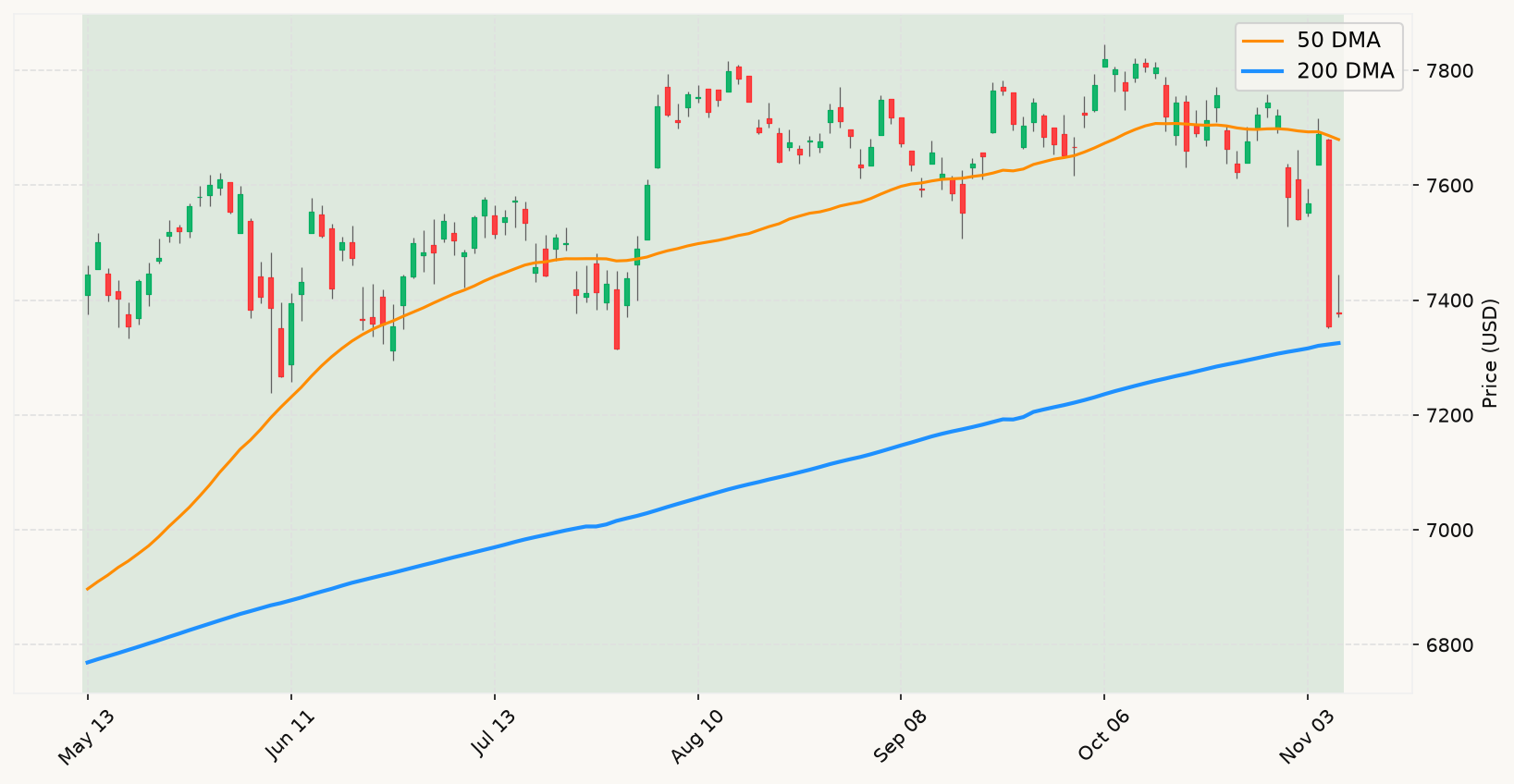
The story dominating screens this morning — an Nvidia CEO embroiled in a foreign spy investigation, piled on top of a midterm-election-driven AI selloff — is exactly the kind of dramatic, emotionally resonant headline that historically leads investors into bad decisions. The right starting question isn't "how bad is this?" but "does any of this change the two things that actually matter: the primary market trend, and the direction of the leading economic indicators?" Right now, the answer to both is no. The S&P 500 remains above its long-term stock market trend — still in confirmed bull territory. Until that changes in a sustained way, every narrative-driven selloff deserves skepticism, not capitulation.
The post-midterm rotation — out of AI infrastructure and capital-intensive chip plays, into hyperscalers and defensive tech — is the market processing a policy shift, not signaling an economic breakdown. That's a meaningful distinction. Sector reshuffling within a bull market is noise in the framework; it doesn't move any recession indicator needle. The leading economic signals that actually matter — employment conditions, the interest rate environment, and growth nowcasts — remain constructive. October payrolls came in well above expectations. The 10-year/3-month spread is positive, not inverted. GDP trackers are running solidly above trend for Q4. None of the convergence conditions for a recessionary signal are present. The 80% base rate — that roughly four in five corrections resolve without becoming prolonged bears — is fully in force here.
The Nvidia CEO scandal is a company-specific governance event, not a systemic macro signal. Its impact on the AI trade is real and sentiment-driven, but sentiment events — however alarming in the moment — have consistently proven to be the self-correcting variety across the historical dataset. The speed and violence of last week's tech selloff actually follows the classic signature of a fear-driven correction rather than the slow grind of a recessionary bear. Fast, steep, news-catalyzed declines that crash into oversold territory and generate panic coverage have been the most reliably recoverable pattern in the data going back decades. The RSI reading is approaching, but hasn't yet reached, the kind of extreme exhaustion level that historically precedes near-term bounces. Watch that level closely — it's a useful short-term directional signal even if it's not a re-entry trigger for the full position.
The two genuinely informative macro developments this week are both constructive for the medium-term outlook. China's two-month tariff extension, timed ahead of an APEC Xi-Trump meeting, reduces the tail risk of a sudden trade-war escalation that could have altered the economic trajectory. And oil's retreat on Iran diplomacy signals easing geopolitical risk premium — a quiet disinflationary nudge at exactly the moment markets are most anxious about the Fed's next move. Tuesday's CPI print is the near-term event risk that could either settle nerves or reawaken them. But even a hotter-than-expected number wouldn't change the structural market regime assessment — it would change the Fed's December calculus, not the fundamental bull-or-bear call. The posture remains: stay invested, let the velocity diagnostic work, and don't let dramatic headlines do the job that economic data hasn't done. MoreLess