The Ticker
Bull Market
The bulls are sipping lemonade on a sunny porch — there's a thundercloud or two grumbling on the horizon, but the grass is green, the barbecue is lit, and nobody's heading for the storm cellar just yet.
Top Story
Big Tech's AI Spending Reckoning Arrives as Mega-Cap Earnings Flood In
This week Wall Street faces its most concentrated stress test of the earnings season: Alphabet and Microsoft report Wednesday, Amazon follows Thursday, and the Federal Reserve issues its rate decision the same afternoon. At the center of every boardroom conversation is the same question — is the staggering capital being poured into artificial intelligence actually generating returns, or is the industry building an expensive cathedral with no congregation yet?
The broader earnings season has progressed reasonably well. Meta and Tesla both reported last week, clearing the first wave of Magnificent Seven results. Analysts are watching cloud revenue growth, AI product adoption metrics like Azure and Google Cloud expansion, and whether management commentary on 2027 capital expenditure guides higher or lower. Strong results from any one of these three giants could shift sentiment quickly; a disappointment risks reigniting the debate about AI profligacy that rattled semiconductor stocks earlier this month.
The Fed decision Wednesday afternoon is expected to be a hold, keeping the funds rate in place after last month's quarter-point hike. Chair Warsh has maintained his reputation for unpredictability by avoiding any explicit forward guidance, which means the press conference itself carries as much market-moving potential as the actual rate announcement. With core inflation still running above target and energy prices elevated after the recent crude surge tied to Middle East tensions, the Fed has little political cover to turn dovish.
The wildcard driving cross-asset volatility this week remains oil. Brent crude surged more than six percent last week following Houthi attacks on Saudi energy infrastructure, raising alarm about sustained cost pressures across airlines, logistics, and consumer staples. A tentative diplomatic opening — with Qatari mediators reportedly in Tehran — nudged crude slightly lower to open Monday, but markets remain wary. Elevated energy prices complicate the Fed's calculus, threaten corporate margins in energy-intensive industries, and keep global inflation expectations on a slow simmer heading into year-end. MoreLess
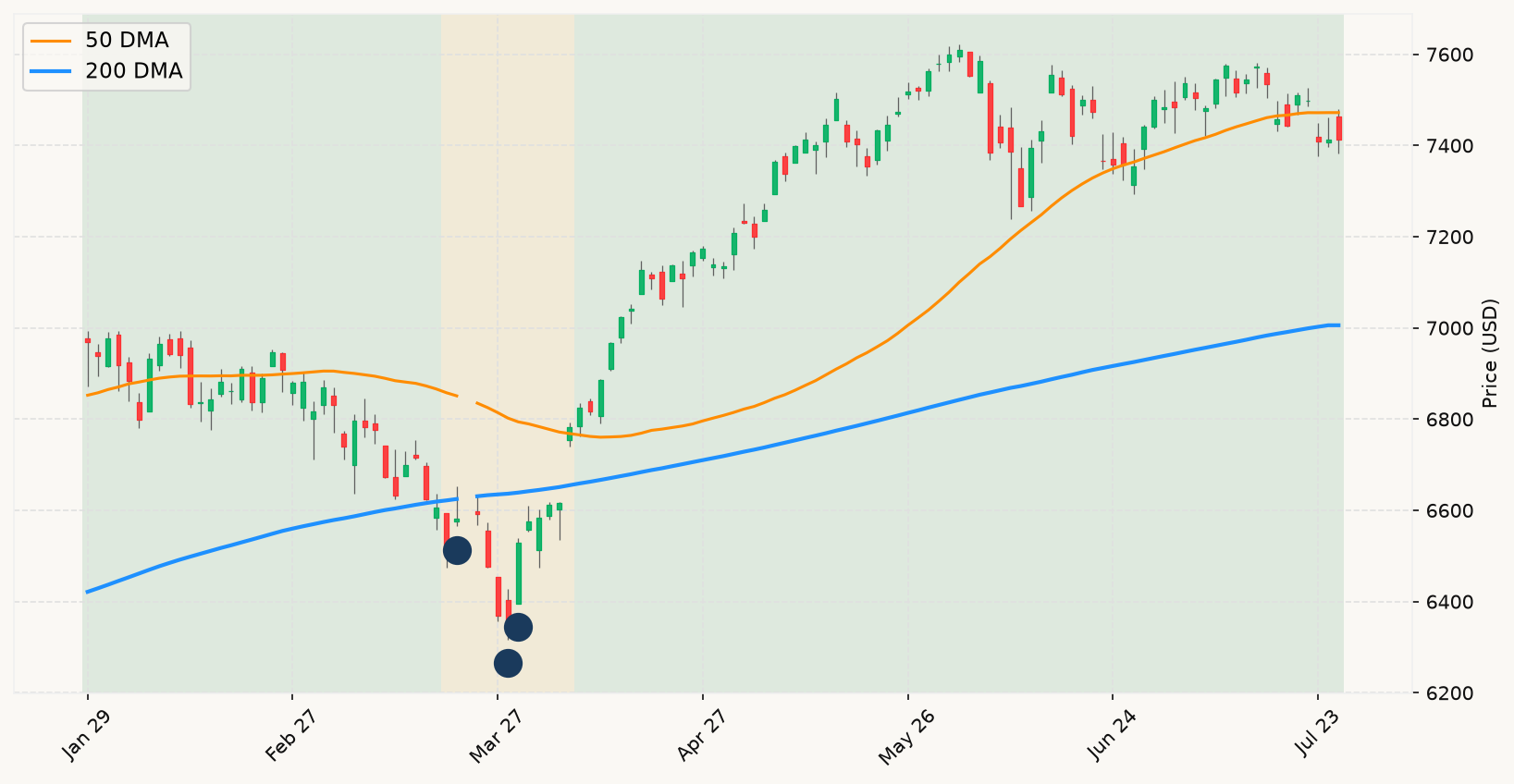
Six Month Chart (SPX)
⊞ Expand
The Ticker Analysis
Stay the Course: Noise Is Not a Signal
The primary market trend remains solidly bullish — the S&P 500 is trading well above its long-run trend line, and the interest rate environment has shifted from inverted to positively sloped, which removes one of the two legs historically required to confirm a recessionary setup. With employment conditions still intact and no convergence of leading deterioration signals, the diagnostic framework calls for a single posture: stay fully invested and resist the temptation to interpret headline noise as structural signal. The current drawdown from the recent all-time high is shallow and short in duration — nowhere near the threshold where defensive action becomes warranted.
The week's headline risk — the Fed decision and mega-cap tech earnings — falls squarely into the category of market noise from a structural standpoint. The Fed is widely expected to hold, and even if Warsh surprises with a hike, a single rate move in a still-positive growth environment does not alter the recession probability picture in a meaningful way. As for the AI earnings debate: scrutiny of capital expenditure returns at Microsoft, Alphabet, and Amazon is legitimate business analysis, but the market has been processing these concerns in real time for months. Any result that clears the bar is already partially priced. Any miss will generate headlines, but a short-term earnings-driven selloff is not a signal — it is noise wearing a convincing costume.
The oil story warrants the most serious attention of the three dominant themes, not because it changes the current technical posture, but because it represents the channel through which economic deterioration could eventually materialize. Sustained energy price elevation feeds into core services inflation, compresses margins in transportation and retail, and complicates the Fed's ability to ease even if growth softens. This is the slow-moving macro variable worth monitoring. A Brent crude price sustained well above $110 that begins showing up in deteriorating nowcast readings and softening labor market prints would start moving the needle on the leading indicator convergence test. Right now, it has not. The geopolitical risk premium in oil appears to be easing slightly with diplomatic overtures, and the economic data remains constructive.
China's fifth plenum and the continued pressure on Chinese equities are worth monitoring as a global demand signal, but they do not change the U.S. market regime analysis. The S&P 500 primary trend is intact, monetary policy signals have normalized, employment conditions show no alarm bells, and the velocity of the current decline from the all-time high is far too mild and gradual to trigger a panic diagnosis. The base rate argument is overwhelming: in the vast majority of historical episodes that looked like this — modest pullback from a recent high, bullish trend intact, no recession confirmation — the correct move was to hold and let the noise run its course. That is the ruling here. MoreLess