The Ticker
Bull Market
The barn door blew open and the chickens scattered everywhere, but the farmhouse itself is still standing strong — the ground underneath is solid, the sun's still shining on the fields, and the smart money is already peeking back through the fence.
Top Story
Democrat Midterm Sweep Triggers Historic AI & Tech Meltdown
Wall Street is reeling from one of its worst weeks in years, triggered not by a recession or a Fed shock but by a ballot box. Democrats' sweeping capture of both the House and Senate — driven in large part by voter fury over AI data centers — sent the Nasdaq 100 into a historic one-day plunge Thursday, with the reverberations still being felt in premarket trading Friday morning.
The election result has fundamentally rattled the investment thesis underpinning the AI trade. With Democrats now controlling Congress, top lawmakers are openly calling for a national data center moratorium, spooking hyperscalers, semiconductor names, independent power producers, and the entire ecosystem of companies that had staked their growth stories on relentless AI infrastructure buildout. Chip stocks have been the epicenter, with the Philadelphia Semiconductor Index on track for a punishing weekly loss. The one silver lining in tech came from Lam Research, which surged double digits premarket after announcing a massive $25 billion share buyback, signaling management confidence even as peers cratered.
The broader macro picture, by contrast, is sending reassuring signals. October's jobs report obliterated forecasts, with payrolls more than doubling expectations and the prior month's figures revised sharply higher. Moderna's blowout earnings — reversing a year-ago loss and dramatically lifting its full-year guidance — are a reminder that the earnings cycle has legs beyond AI infrastructure. The fundamental economy, in other words, is not the problem; the problem is regulatory risk repricing for one of the market's most crowded and expensive sectors.
For Fed watchers, the strong payrolls print complicates the near-term rate picture by reinforcing that the labor market remains resilient, reducing urgency for any near-term cuts. Combined with still-elevated commodity prices — with oil nudging higher amid fresh Middle East tensions — the inflation picture retains a stickier tone than markets might prefer. The convergence of a healthy jobs market, solid corporate earnings outside the AI epicenter, and a political shock concentrated in a specific sector sets up a complicated environment: not a broad economic crisis, but a painful repricing of a crowded trade that had become central to the bull market's identity. MoreLess
Six Month Chart (SPX)
⊞ Expand
The Ticker Analysis
Dramatic Selloff, But the Foundation Holds
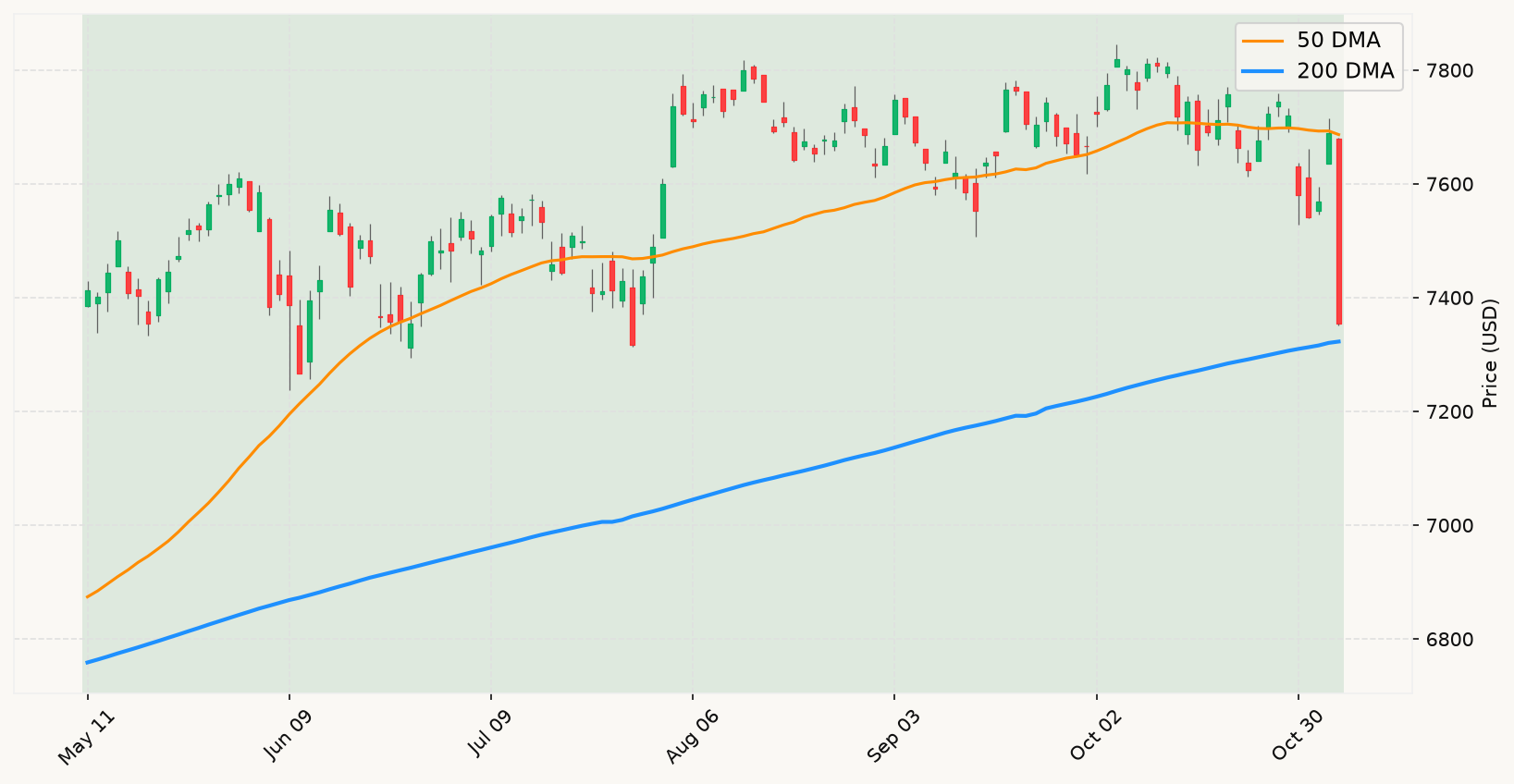
The post-midterm AI selloff is dramatic, but it needs to be evaluated against what the market's actual structure is telling us — not what the headlines are screaming. The S&P 500 sits above its primary market trend line, and the current drawdown from the all-time high is in the mid-single digits, well inside the range of normal intra-year turbulence. The velocity of this decline — sharp, sudden, concentrated — fits the classic profile of a sentiment-driven, panic-style correction rather than the slow grinding deterioration that characterizes genuine recessionary bear markets. History is unambiguous on this pattern: the declines that feel most terrifying in real time, the ones that erase trillions in paper wealth in a single session, are statistically the ones that resolve fastest. The counterintuitive rule holds — fast crashes recover; slow grinders do not.
The recession confirmation leg of the diagnostic is simply not lighting up. Today's October payrolls report demolished expectations, the prior month was revised sharply higher, and the interest rate environment remains constructive with the yield spread in positive territory. Employment conditions are holding firm — there is no Sahm Rule trigger, no broad labor market deterioration, no convergence of leading indicators pointing toward contraction. This is exactly the scenario the base-rate data addresses: 80% of 10%-plus corrections resolve without becoming prolonged bears, and every prolonged bear in the modern dataset has been accompanied by a confirmed or imminent recession. The economic backdrop right now simply does not fit that template.
The specific nature of this selloff — concentrated in AI infrastructure, semiconductors, and the data center ecosystem — is worth understanding clearly. This is a regulatory risk repricing event, not a signal that earnings are collapsing or that the economy is rolling over. Lam Research announcing a $25 billion buyback in the middle of this chaos is not noise; it is a management team saying that the fundamental demand trajectory for their business remains intact. Moderna blowing out estimates and dramatically raising guidance on the same day the Nasdaq posts its worst session in 19 months is a useful reminder that the market is not a monolith — the AI selloff is not the whole economy, and the whole economy is not in distress.
The correct posture here is disciplined patience. The market remains above its primary trend, economic signals remain constructive, and the decline profile matches the fast-correction pattern that has historically rewarded staying invested. This does not mean the pain is over — positioning around a crowded trade after a political shock can produce further volatility in the near term. But the framework's prescription is clear: maintain full exposure, resist the pull of dramatic headlines, and recognize that the RSI is now in deeply oversold territory — a zone that has historically preceded sharp near-term reflex rallies. The only scenario that changes this assessment is a sustained breach of the primary trend line accompanied by a convergence in deteriorating economic indicators. Neither condition is present today. MoreLess