The Ticker
Bull Market
The bulls are still sitting at the cookout even as the tech kids are having a meltdown in the corner — the grill is hot, the economy's got plenty of fuel, and the storm clouds overhead look more like a summer squall than a season-ending nor'easter.
Top Story
AI Trade Cracks as Nasdaq Slides Into Correction on Election Day
The Nasdaq 100 has officially entered correction territory — down more than 10% from its early-October record — as a crisis of confidence in the economics of artificial intelligence collides with Election Day uncertainty. Semiconductor stocks are at the epicenter of the selloff, with the Philadelphia Semiconductor Index losing roughly 12% in just three sessions, dragging down names like Intel, AMD, and Marvell. It is the index's third correction of 2026, and it is happening in real time as Americans head to the polls.
Earnings season is providing the catalyst but not the cause. Apple beat on revenue but guided gross margins below expectations, blaming a global memory cost crunch and expenses tied to the Siri AI rollout. Palantir posted jaw-dropping revenue growth — nearly doubling year-over-year — yet still fell sharply premarket because a key forward-looking bookings metric slowed dramatically. Shopify delivered 32% revenue growth and strong free cash flow but dropped more than 12% in premarket trading. The pattern is consistent: even strong results are being punished when the outlook fails to clear a sky-high bar.
The Federal Reserve's posture remains the steadying hand in the background. With Chair Warsh describing the economy as expanding at a strong pace and real GDP nowcasts tracking comfortably above 3% for Q4, there is no sign that the central bank is close to shifting to an easing stance — which keeps the interest rate environment firm but removes one source of near-term uncertainty. The bigger policy wildcard is the election: prediction markets are pricing a 75%-plus probability of a Democratic congressional sweep, which would introduce new legislative dynamics around AI regulation, tax policy, and next year's debt ceiling negotiations.
The geopolitical backdrop adds another layer of complexity. Overnight U.S. strikes on Iran's Qeshm Island near the Strait of Hormuz reversed Monday's dramatic 7.6% Brent crude selloff, with oil climbing back above $106 a barrel. The whipsaw in energy prices — driven by alternating peace-talk optimism and military escalation — underscores how fragile the Middle East situation remains. With the October jobs report due Friday and Nvidia earnings on the horizon in mid-November, the market faces a packed calendar of potential inflection points in the days immediately ahead. MoreLess
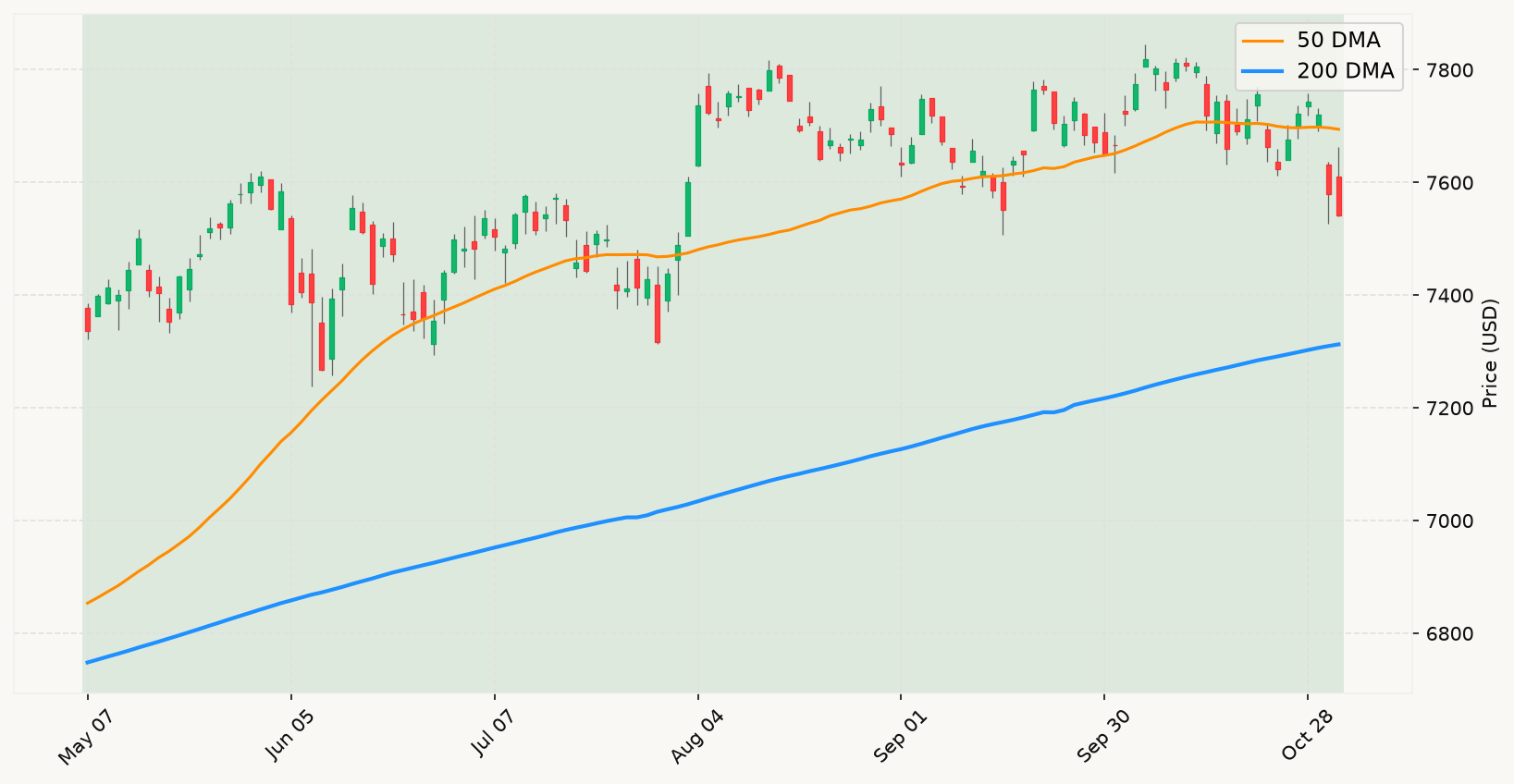
Six Month Chart (SPX)
⊞ Expand
The Ticker Analysis
Loud Noise, Weak Signal — Stay the Course
The S&P 500 sits comfortably above its primary market trend — the defining bull-market signal — while the Nasdaq 100's correction is doing the heavy lifting in the headlines. It is worth separating these two stories. The broad market has held up reasonably well, supported by sector rotation into industrials and financials even as large-cap tech bleeds. A market where the majority of stocks are rising while a concentrated group of high-multiple AI names sells off is not the same animal as a broad recessionary decline. The current setup looks far more like a valuation reset in a specific thematic trade — the AI capex narrative — than a systemic deterioration in economic conditions.
The economic backdrop provides no recession confirmation whatsoever. Both real-time GDP models are tracking solid growth well above 2% for Q4, employment conditions remain constructive with no Sahm-type deterioration visible, and monetary policy signals — while firm — are not flashing the kind of inversion that has historically preceded every modern U.S. recession. For the bear case to escalate into something structural, you would need these leading indicators to converge on contraction while the stock market continues its gradual grind lower. That is emphatically not what the data is showing right now.
The semiconductor selloff and AI capex skepticism are generating genuinely frightening headlines, but the historical record is unambiguous on this point: the declines that feel most terrifying in real time — fast, steep, sentiment-driven — are statistically the ones that resolve. The 80% base rate says that 18 of the last 22 market corrections of 10% or more recovered without becoming prolonged bears, and every one of the four that did become prolonged bears was accompanied by a confirmed recession. There is no confirmed recession here. The speed of this decline — sharp and concentrated in a specific sector over a matter of weeks — actually fits the profile of a sentiment-driven correction, not the slow, grinding, broadly distributed deterioration that characterizes recessionary bears. That pattern argues against panic-selling.
The actionable posture is to stay invested and resist the temptation to treat Palantir's bookings slowdown or Apple's margin guide as a systemic economic signal. They are not. They are company-specific and sector-specific repricing events. The market as a whole is telling a different story from the Nasdaq's headline: the broad index remains above its primary trend, economic growth is running hot, and employment is solid. What today calls for is patience and discipline — not capitulation. The noise is loud. The signal, assessed against actual conditions, does not support defensive repositioning. MoreLess