The Ticker Analysis
Bull Market Intact — Tech Tantrum Is Noise
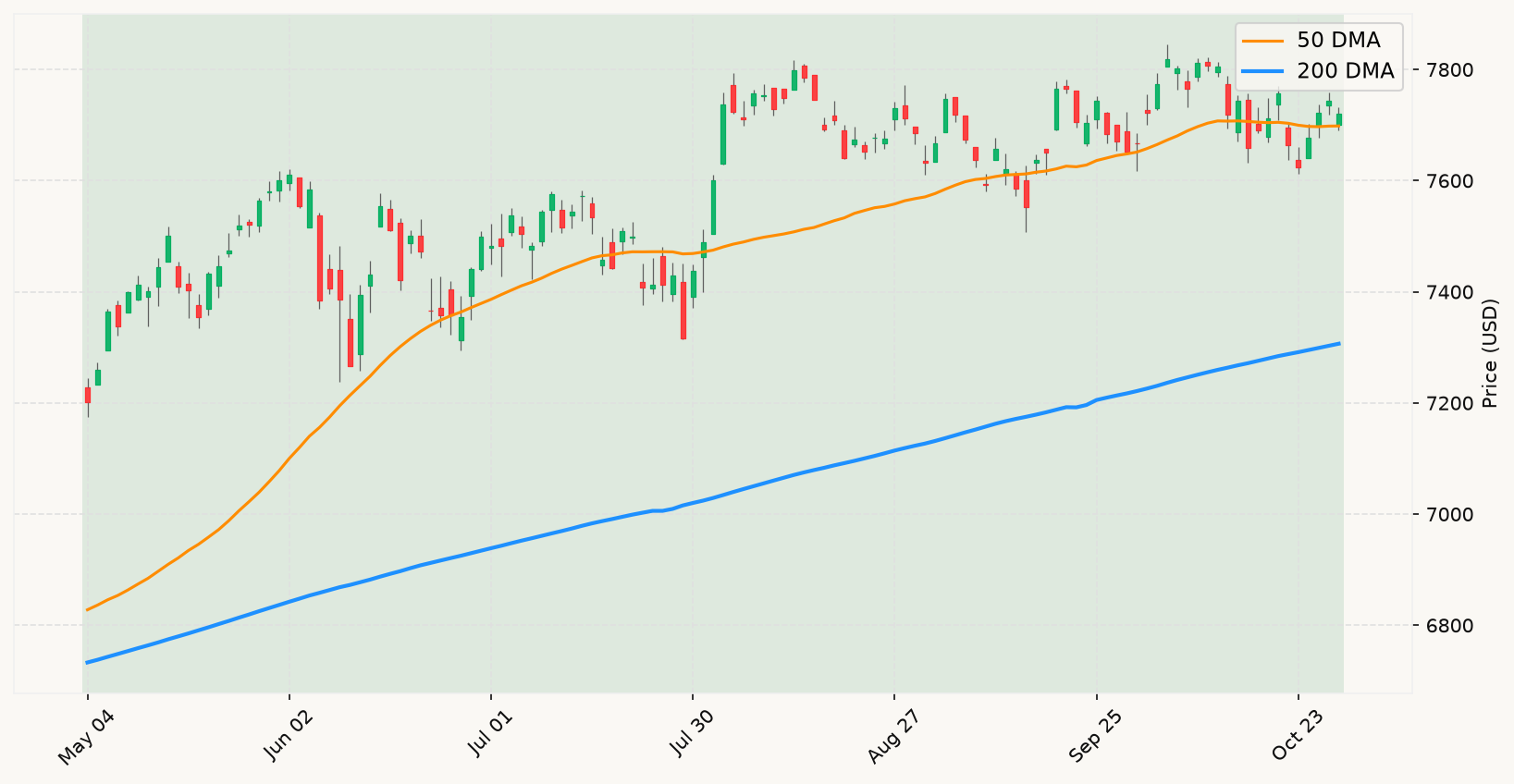
The week's dominant story — a tech sector rout driven by AI capex sticker shock across Amazon, Intel, and Alphabet — is, in the framework of how to think about markets rigorously, a textbook example of noise dressed up as signal. Earnings disappointments, analyst downgrades, and sector rotation are the daily texture of a functioning market. By the time these stories are headline news, they are already priced in. The market's job is to aggregate this information continuously, and the price action of the broader index — not the narrative around individual companies — is what deserves attention. The S&P 500 remains comfortably above its primary market trend, which is the only threshold that matters for regime classification. Until that changes, the bull market is intact, and the correct posture is fully invested.
The Federal Reserve's hold decision, with two hawkish dissenters and a clear signal that December may bring another hike, does shift the interest rate environment toward a slightly more restrictive posture — but this is not new information in any meaningful sense. Markets had already priced a high probability of a hold. What matters is the broader configuration: the yield curve has normalized, with the 10-year running well above the 3-month, removing the inversion signal that historically precedes recessions. A Fed that is pausing — even one leaning toward a December hike — is not a Fed that is tightening into a collapsing economy. The economic backdrop, with Q3 GDP printing above 3%, does not support a recession call. Employment conditions remain solid. None of the four leading indicators that historically converge ahead of a prolonged bear market are flashing red simultaneously.
The oil spike is the headline with the most legitimate macro teeth. Crude at current levels, sustained by ongoing Strait of Hormuz disruptions and the possibility of renewed U.S. military action against Iran, is a genuine inflationary input — the kind that could complicate the Fed's path and squeeze consumer spending. But here is the discipline the data demands: rising energy prices, on their own, have not historically been sufficient to trigger recessionary bear markets without simultaneous labor market deterioration and a grinding, gradual equity decline. The current profile — a market sitting near all-time highs with a small pullback, strong GDP, and robust employment — is the opposite of the early-stage recessionary setup. Elevated oil is a watch item, not an action trigger. The Binance hack is pure noise for equity investors; crypto market dislocations do not transmit to the S&P 500 in any historically reliable way.
The bottom line is that this is a market in a normal, garden-variety late-October turbulence patch — tech earnings jitters, a hawkish Fed undertone, and geopolitical noise — all occurring within a bull market regime that remains fully confirmed. The base rate is overwhelming: the vast majority of 10%+ corrections resolve without becoming prolonged bears, and the current drawdown from the all-time high is barely over 1%. There is no velocity signal, no recession confirmation, and no convergence of leading indicators pointing toward the exits. The correct positioning is to stay fully invested, tune out the narrative churn, and let the primary market trend do its job as the ultimate arbiter of regime. MoreLess