The Ticker
Bull Market
The economic engine is humming along like a well-fed golden retriever on a sunny afternoon — even as the market swats at a cloud of buzzing chip stocks and dodges fireballs from the Middle East, the ground underneath is still solid and the bulls haven't broken a sweat.
Top Story
AI Spending Fears & Saudi Attacks Spark Brutal Tech Rout
Wall Street is starting Friday on the back foot after Thursday delivered one of the ugliest sessions in months — a double-barreled selloff driven by growing skepticism about the AI investment boom and a fresh surge in oil prices triggered by deadly attacks on Saudi energy infrastructure. The Nasdaq suffered its worst day since June, semiconductors shed nearly 7%, and crude shot to its highest close since May, leaving investors to navigate a market that suddenly has more than one thing to worry about.
The earnings picture remains a key source of tension. Q3 season is in full swing, and while the early scoreboard looks broadly strong — with roughly 84% of reporting companies beating consensus EPS estimates, well above historical averages — the beat magnitude is thinner than usual. More pointedly, megacap tech results are sending a complicated message: Meta exceeded revenue expectations and offered upbeat guidance, yet its stock still dropped sharply as investors focused on its ballooning AI capital expenditure plans. The market's patience with the "spend now, monetize later" AI narrative is clearly fraying, and that anxiety is spreading from individual earnings reports into the entire semiconductor supply chain.
On the Fed front, the policy backdrop remains tightly constrained. The Fed raised rates for the first time since 2023 during Q3, and markets are still pricing an additional hike by year-end. New Fed Chair Kevin Warsh has signaled a preference for a smaller balance sheet and a cautious, data-dependent posture rather than any abrupt pivot. That hawkish lean is colliding uncomfortably with Thursday's sharp rally in Treasuries — a flight-to-quality bid that pushed 10-year yields meaningfully lower — creating a divergence between bond market fear and the Fed's stated resolve to keep policy restrictive.
The macro backdrop adds another layer of complexity. Brent crude near $113 is a direct inflation tax on consumers and businesses, complicating any path toward easier monetary policy. October PMI data due today and the University of Michigan consumer sentiment index will be closely watched for signs of whether the combination of high rates and rising energy costs is beginning to bite household confidence. With Q3 GDP nowcasts still sitting comfortably in positive territory, the growth picture has not yet cracked — but the market is clearly stress-testing the durability of that resilience. MoreLess
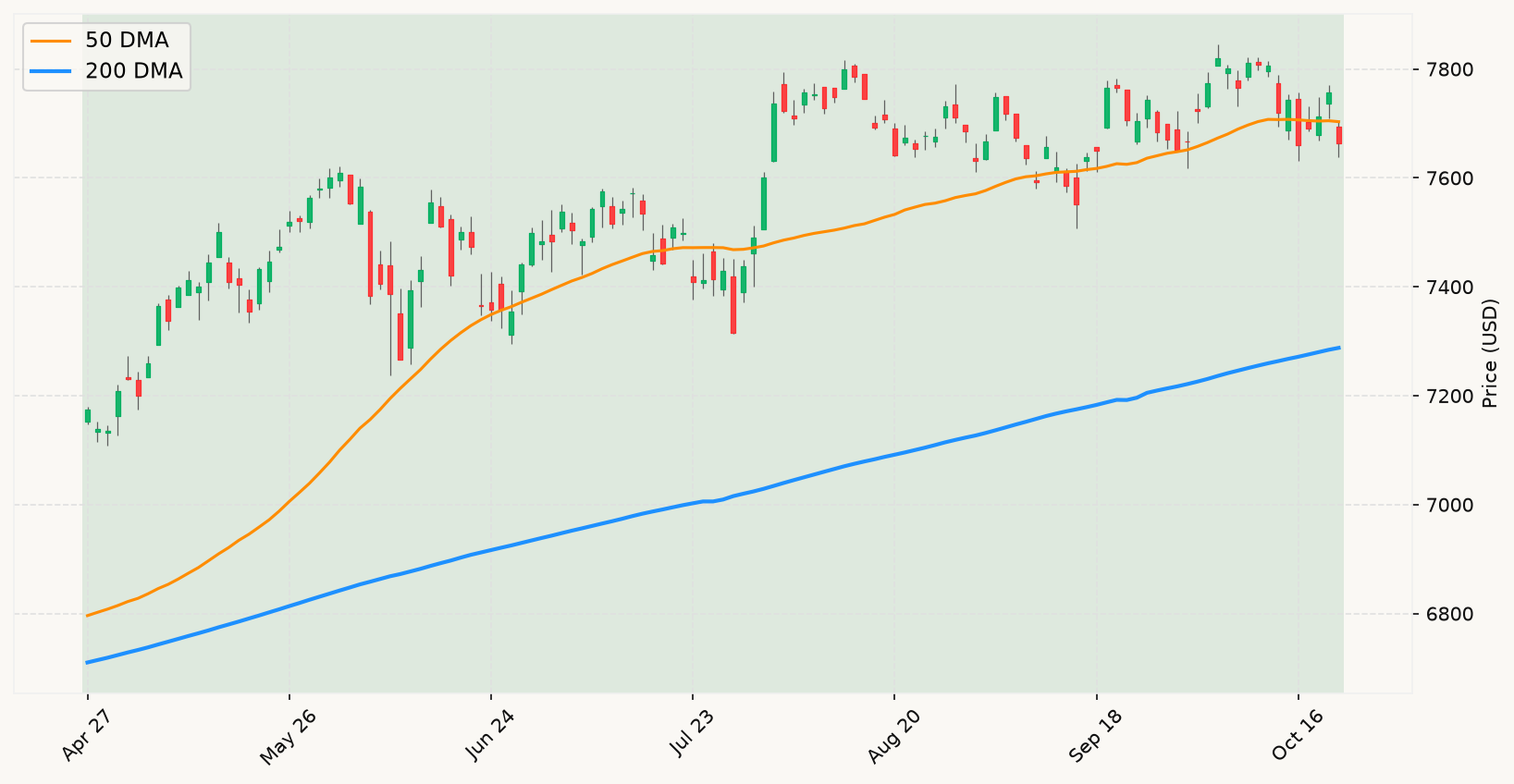
Six Month Chart (SPX)
⊞ Expand
The Ticker Analysis
Scary Headlines, Same Bullish Regime
The primary market trend remains firmly bullish — the S&P 500 is comfortably above its stock market trend line, and the current drawdown from the all-time high set just 17 days ago is barely 2%. That's not a signal; that's routine daily noise dressed up in scary clothes. The chip rout and the Saudi oil shock are both real stories with real headlines, but the framework's first question is always whether the market's actual price behavior has changed the regime — and right now, it has not. A 2% pullback from an all-time high is the market breathing, not the market breaking.
The AI spending anxiety driving the semiconductor selloff is a fundamentally ambiguous narrative. Jensen Huang says demand is "off the charts." Lam Research's CFO flagged near-term supply constraints. Meta's stock dropped even as it beat on revenue. What the market is actually doing with this information is the only thing that matters — and what it is doing is a routine rotation and sentiment reset, not a grinding, slow-moving decline that would raise structural concern. The velocity here is fast and sharp, which is historically the signature of a sentiment-driven correction rather than the onset of a prolonged recessionary bear. Fast crashes scare people into making expensive decisions. The historical record on this is unambiguous: the declines that feel most terrifying resolve the quickest.
The geopolitical oil shock deserves watching for a specific reason: it adds an inflation wildcard into an already-constrained monetary policy environment. Brent near $113 is not a trivial data point when the Fed is already leaning hawkish under Chair Warsh and markets are pricing additional rate hikes. However, elevated oil prices alone are not a recession signal — they are a headwind. The relevant question is whether this headwind starts showing up in employment conditions or in GDP nowcasts moving meaningfully toward zero. Right now, the Atlanta Fed's latest read sits at +3.5% and the NY Fed's Nowcast sits at +2.67%. Both are solidly positive. The monetary policy signal, while not dovish, is not an inversion — the 10Y-3M spread is positive. None of the recession confirmation indicators are converging. Without that convergence, the bear case has no second leg to stand on.
The correct posture here is straightforward: stay fully invested, resist the urge to treat a bad Thursday as a structural event, and let the velocity and economic data do the diagnostic work over the coming weeks. The 80% base rate applies once a decline reaches 10% — and the market is not remotely there. For investors tempted to "do something" in response to the chip tape or crude prices, the relevant historical comparison is the 2020 COVID crash, the 2025 Trade War selloff, and a dozen other episodes that looked terrifying in the moment and recovered sharply before most people felt comfortable re-entering. The cost of exiting a correction is not just missing the bottom — it's missing the violent, front-loaded recovery that immediately follows it. Stay put. MoreLess