The Ticker
Bull Market
The bulls are throwing a party on the launchpad — rockets are profitable, AI is printing money, and the economic engine is humming along like it just had a tune-up.
Top Story
SpaceX & Tesla Merger Bombshell Ignites the AI Supercycle Trade
Elon Musk dropped one of the most consequential corporate bombs in recent memory during SpaceX's third-quarter earnings call Tuesday evening: both SpaceX and Tesla have formed independent special committees to formally explore a merger that, at current valuations, would combine into a roughly $3.5 trillion enterprise. Musk was careful to temper expectations — he called it "a good idea" while stressing no deal is certain and that he's excluded from the committee discussions as a conflicted party — but the mere confirmation that the process is underway sent SpaceX shares soaring and lit up Wall Street overnight.
The merger drama arrived on the back of a blowout SpaceX earnings report that validated the AI infrastructure buildout thesis in concrete financial terms. SpaceX posted $14.58 billion in Q3 revenue — smashing the $12.72 billion consensus — with connectivity revenue alone jumping 69% year-over-year to $5.25 billion, and the company swung from a net loss to $4.4 billion in net income. That kind of inflection is exactly what revives confidence in the broader AI trade after weeks of chip-sector turbulence. Asian markets responded in kind, with South Korea's Kospi and Taiwan's Taiex both posting solid gains overnight, and Nasdaq 100 futures lifting into the open.
The Fed picture remains the central macro tension. Oil sitting above $110 per barrel — driven by ongoing tanker attacks near the Strait of Hormuz that have pushed European natural gas toward four-year highs — is cramping the disinflation narrative and keeping the door open for further Fed rate action. The Fed raised rates in September and committee members have flagged another possible hike before year-end, meaning any energy-driven inflation re-acceleration is a direct threat to the pivot hopes that have supported equity multiples. The interest rate environment remains the fulcrum on which this rally balances.
Beyond the SpaceX spectacle, today is one of the heaviest earnings days of the season: Meta, Tesla, and IBM all report after the close. The Magnificent 7 cohort is collectively tracking toward 33% year-over-year earnings growth for Q3 — an extraordinary figure that, if delivered, would cement the case that the AI capital expenditure wave is generating real returns. Netflix's mixed report last night — strong margins but a lowered ad-revenue outlook and a soft Q4 guide — is a reminder that execution risk within the tech complex is not zero, and investors will be watching Meta's advertising numbers and Tesla's automotive margins with particular intensity. MoreLess
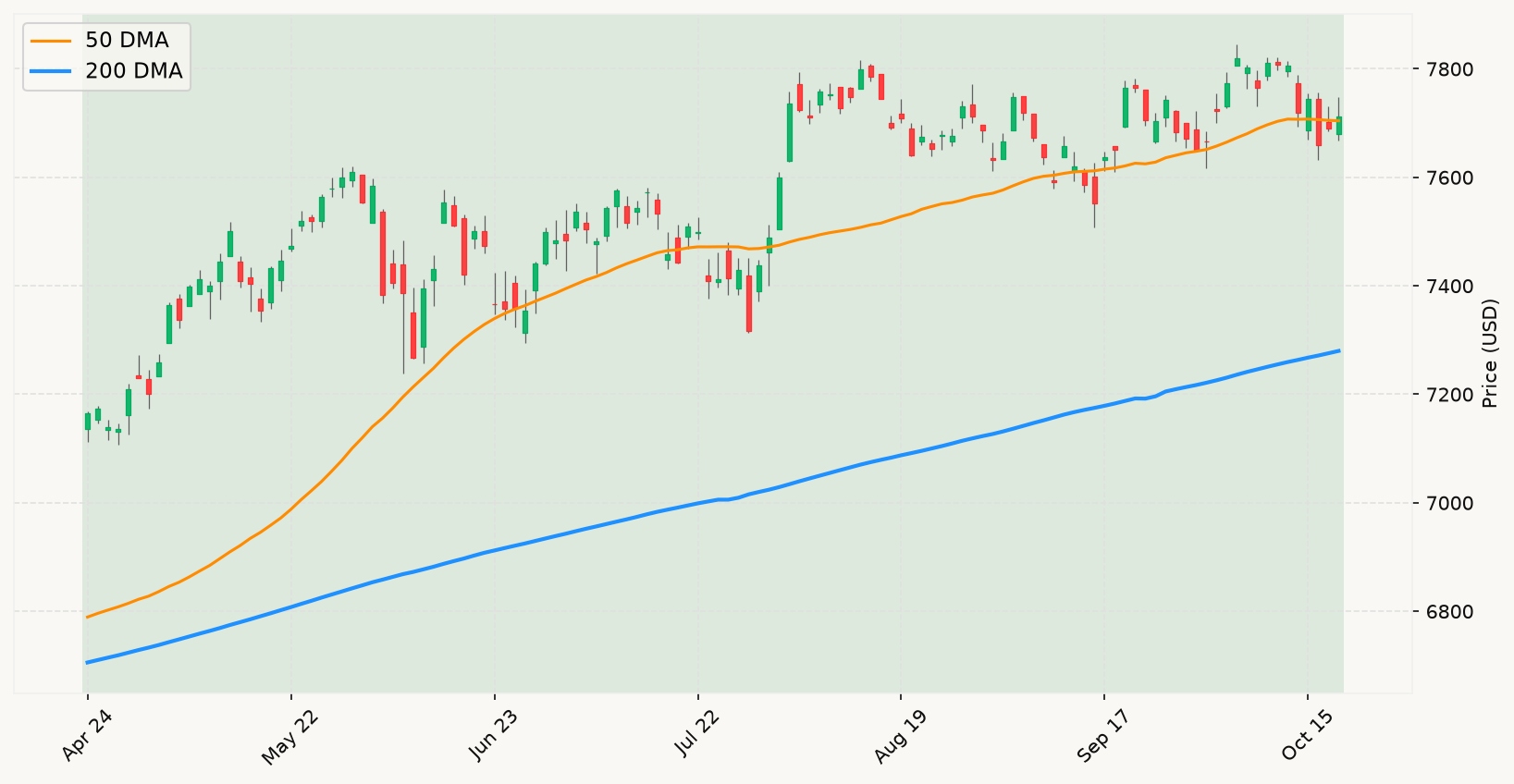
Six Month Chart (SPX)
⊞ Expand
The Ticker Analysis
Bulls in Control, Stay the Course
The primary market trend remains unambiguously bullish. The S&P 500 is trading comfortably above its long-run trend line, and the all-time high was set just fifteen days ago — a configuration that, across the full historical record, has been associated with above-average forward returns, not danger. The current 1.4% drawdown from that peak is statistical noise by any reasonable measure. Nothing in today's news flow changes that assessment. The SpaceX earnings beat and the formal acknowledgment of merger exploration talks with Tesla are fundamentally trend-confirming events: they validate the AI capex cycle's revenue generation thesis and inject fresh speculative premium into the megacap complex. Markets do not roll over at all-time highs when the earnings delivery is this strong.
The Strait of Hormuz situation and oil above $110 is the one development worth watching through a framework lens — not because it is a recession signal on its own, but because it represents a potential secondary tightening mechanism. Persistent energy-driven inflation keeps the Fed in a hawkish posture, and the interest rate environment with a 10-year yield north of 5% already applies real pressure to long-duration assets. That said, the key diagnostic question is not "is this scary?" but rather "is this shifting any recession indicator toward convergence?" Right now the answer is no. Growth nowcasts are solidly positive. Employment conditions remain robust. The monetary policy signal, while restrictive, is not flashing the kind of inversion that has historically led recessions — the spread between long and short rates is actually positive and has been widening. An oil shock is uncomfortable; it becomes a Signal only if it translates into deteriorating leading economic indicators, and we are not there.
Netflix's post-earnings decline — shares down sharply despite beating on Q3 EPS — is exactly the kind of individual stock narrative that this framework explicitly treats as irrelevant to the macro market call. Stock-specific reactions to guidance cuts are priced at the individual name level; they carry no diagnostic weight for the broader regime. If anything, Netflix's ongoing struggles illustrate a point worth internalizing: concentrated single-stock exposure is a structurally losing game for most investors. The platform that disappointed on ad revenue and cut its full-year outlook is not a market-moving signal — it is a reminder of why broad index exposure dominates individual selection over time. The Magnificent 7 cohort tracking 33% collective earnings growth for Q3 further reinforces that the index approach captures the handful of mega-winners that drive nearly all the wealth creation.
The overall positioning call is unchanged and straightforward: stay fully invested. The market is above its primary trend, the all-time high is recent, the velocity of any decline is negligible, economic leading indicators are constructive, and earnings delivery is strong. The SpaceX/Tesla merger story and the AI earnings revivalism visible in overnight Asian markets are the market telling you that risk appetite is healthy. The geopolitical oil risk is real but, per the 80/20 base rate, dramatic-sounding macro events that do not move recession indicators are noise, not signal. The framework's default posture — fully invested until proven otherwise by the convergence of trend deterioration and economic confirmation — remains the right posture today. MoreLess