The Ticker
Bull Market
The sun's shining, the crops are growing, and even the grumpy neighbor can't find much to complain about — this market's got its boots on and it's whistling on the way to work.
Top Story
Hot CPI Keeps Fed on Edge as Warsh Ducks October Rate Call
Inflation is back in the driver's seat. September's core CPI came in hotter than Wall Street expected, and combined with headline inflation running well above the Fed's target — fueled by soaring energy costs tied to the Iran conflict — markets are once again wrestling with how long rates will stay elevated. Fed Chair Kevin Warsh, speaking at the IMF meetings today, declined to pre-commit to either a hike or a hold in October, leaving traders guessing even as rate-hike odds fell sharply on his measured tone.
Q3 earnings season is well underway, and the early read from the big banks is mixed but broadly constructive. Goldman Sachs delivered a blowout quarter, smashing EPS estimates by nearly 30% on the back of surging equities trading revenues, while Citigroup also beat. JPMorgan and Wells Fargo fell short of revenue targets, though rising net interest income across the sector reflects the tailwind from higher rates. The technology sector is the pain point: the Philadelphia Semiconductor Index has shed roughly 12% over six sessions as investors question the cost and sustainability of the AI buildout, erasing over $1.6 trillion in chip-sector market value.
The Fed's policy path remains the central tension. Warsh hiked by 25 basis points in September — the first increase since 2023 — and the market now leans toward a pause in October with a possible final hike in December. His comments today reinforced that the Fed won't pre-judge meetings, even as he acknowledged that AI-driven investment is boosting demand before its supply benefits arrive. Cleveland Fed President Hammack added a hawkish counterpoint, warning that more aggressive hikes may be needed if inflation expectations deteriorate.
Beyond rates and chips, the Anthropic IPO saga is adding a layer of AI valuation anxiety. The company's $2 trillion target is reportedly meeting investor pushback, with some backers pushing for a $1.5 trillion figure — a signal that appetite for richly valued AI names may be cooling amid the current rate environment and chip-sector turbulence. The Q3 advance GDP print is due October 29, the same day as the next FOMC decision, setting up a critical week for markets on multiple fronts. MoreLess
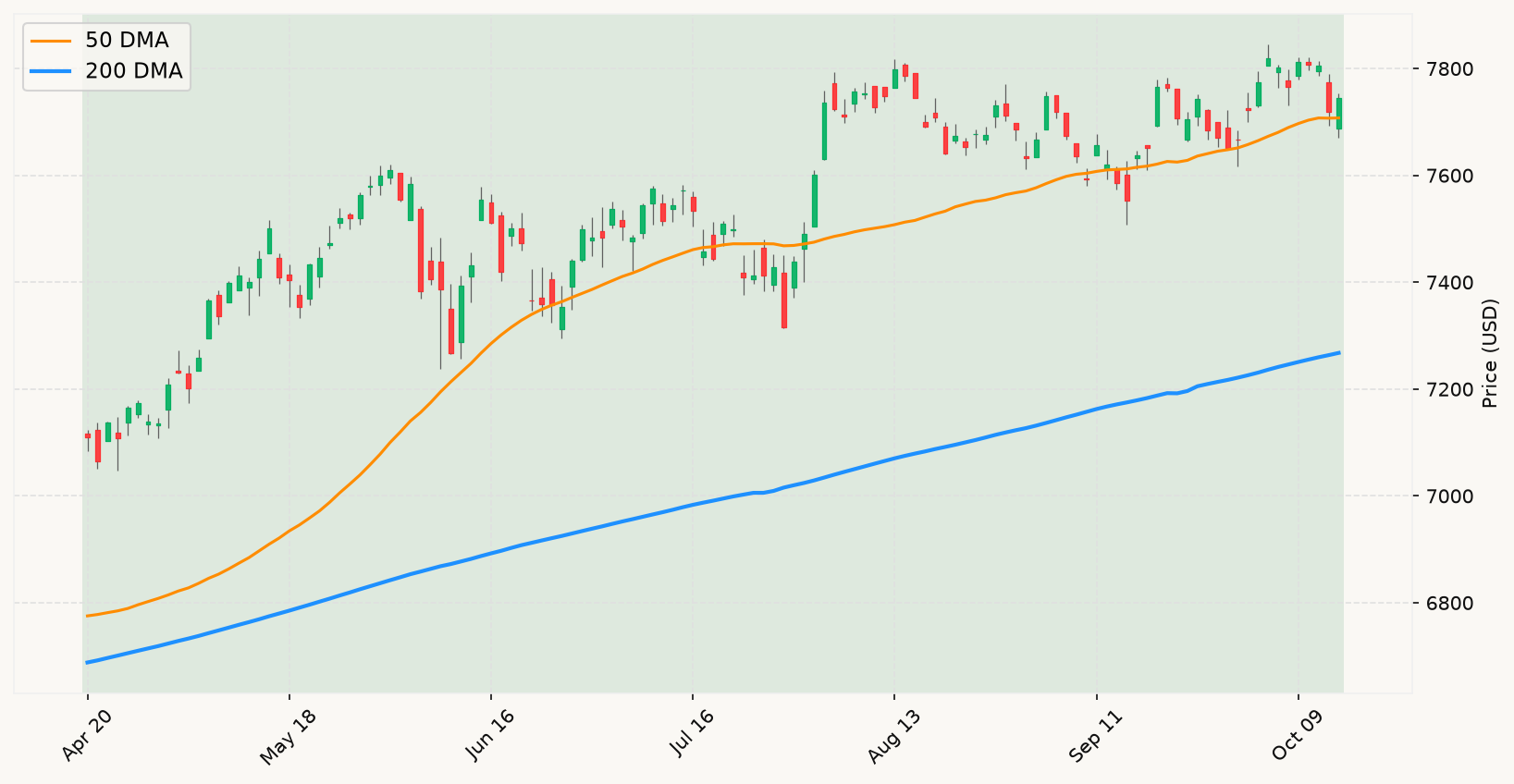
Six Month Chart (SPX)
⊞ Expand
The Ticker Analysis
Noise Is Deafening — The Signal Says Stay In
The inflation-driven noise is loud right now, but the market's own behavior is the real signal — and it's speaking clearly. The S&P 500 remains well above its primary market trend, the broad uptrend is intact, and the drawdown from the all-time high set just ten days ago is less than 1%. The semiconductor selloff is dramatic in headline terms, but the broader index has absorbed it without breaking down. A sector-specific correction driven by valuation anxiety and rate fears is exactly the kind of turbulence that looks alarming from the inside and resolves without becoming something structural. The base rate strongly favors patience here — the market is not sending a distress signal; it's digesting one.
The hot CPI print and Warsh's ambiguous IMF remarks are the kind of news events that feel consequential but rarely alter the market's underlying trajectory once the dust settles. The interest rate environment is genuinely restrictive — there's no question about that — but a positive spread between the 10-year and 3-month Treasury yields means monetary policy signals are not in inversion territory, which historically has been the far more reliable recession precursor. A Fed that hiked in September and may hike again in December is a hawkish Fed operating in a still-growing economy, not a Fed responding to a contraction. That's a very different setup from the conditions that preceded prior recessionary bears.
The Q3 earnings picture reinforces the growth narrative rather than undermining it. Goldman's 30% EPS beat on surging equities trading revenues, strong net interest income gains across the major banks, and broadly positive corporate results in this early stretch of reporting season are not the fingerprints of an economy rolling over. The AI-sector valuation reset is a real event — $1.6 trillion in chip market cap erased in six sessions is not trivial — but it maps to the fast, sentiment-driven correction profile in the historical record, not the slow, grinding deterioration that precedes recessionary bears. Recessionary bears don't start with a vertical sector selloff; they start with a subtle, multi-month fade across a broad front.
The Anthropic IPO valuation drama and the geopolitical energy-price overhang are genuine macro variables to monitor, but neither moves any needle in the current diagnostic. Employment conditions remain healthy, both growth nowcasts are solidly positive, and the primary market trend is unambiguously bullish. The correct posture here is fully invested. The burden of proof falls on the bear case, and right now that case has no evidence in the data that matters — only a wall of alarming-sounding headlines. Historically, that's been exactly the environment where staying put has paid off most reliably. MoreLess