The Ticker
Bull Market
The sun's still shining and the picnic's still going strong — sure, a few storm clouds rolled through yesterday and knocked over the potato salad, but the blanket's still spread, the lemonade is cold, and the party isn't going anywhere.
Top Story
Hot CPI Ignites Rate Hike Fears & Triggers Global AI Selloff
Wednesday's September CPI report landed hotter than Wall Street expected, clocking in at 3.7% year-over-year on the back of a gasoline surge — and it immediately ignited a chain reaction across global markets. The inflation shock revived rate hike bets for the Fed's October 28 meeting, sent chip stocks into a tailspin, and pushed South Korea's Kospi into a circuit-breaker halt. This morning, futures remain under pressure as investors assess the full fallout.
Q3 earnings season is now underway and the early results are mixed. Big banks kicked things off, with Bank of America absorbing a $1.2 billion regulatory fine that hammered its shares more than 6%. Meanwhile, CoreWeave's ballooning debt load — roughly $52 billion in debt and lease obligations — became Wall Street's stress test du jour, with the AI cloud provider's bonds trading near 80 cents on the dollar and CDS spreads exploding. The broader semiconductor complex has now shed more than 10% over just five days, even as ASML's solid results reminded investors that underlying AI hardware demand remains intact.
The Fed is in an increasingly uncomfortable spot. It raised rates for the first time in three years back in September, citing sticky inflation — and now September's CPI delivers precisely the kind of upside surprise that validates a follow-up hike. Core CPI re-accelerated to 2.6% annually, above both the prior month and consensus. With the October 28 FOMC meeting approaching and the blackout period beginning soon, Wednesday's data likely locked in a hawkish posture. Markets are now pricing a better-than-even chance of another move before December.
The macro backdrop is a genuine tug-of-war. Real growth signals remain solid — the economy is running well above stall speed — but energy-driven inflation tied to the ongoing U.S.-Iran tensions is acting as a tax on consumers and a financing headwind for debt-heavy growth sectors. The geopolitical dimension is adding an energy supply premium that could persist, keeping the Fed's anti-inflation credibility in the crossfire. Investors face the uncomfortable combination of a strong economy, rising rates, and a leveraged AI trade that is only now reckoning with what higher-for-longer actually costs. MoreLess
Six Month Chart (SPX)
⊞ Expand
The Ticker Analysis
Hot CPI & AI Debt Fears Are Noise, Not Signal
The dominant story right now is the collision between a still-robust economy and a resurgent inflation print — and the market's verdict on Wednesday was swift. The AI infrastructure trade, which had been priced to perfection, is now absorbing a cost-of-capital repricing that was always the logical consequence of higher-for-longer rates. CoreWeave's bond stress and the broader semiconductor rout are the market doing what it does: discounting the future faster than the headlines can keep up. This is not a systemic credit event — it is the market repricing a leverage-heavy growth trade that had been insulated from rate reality. The distinction matters enormously for how you respond.
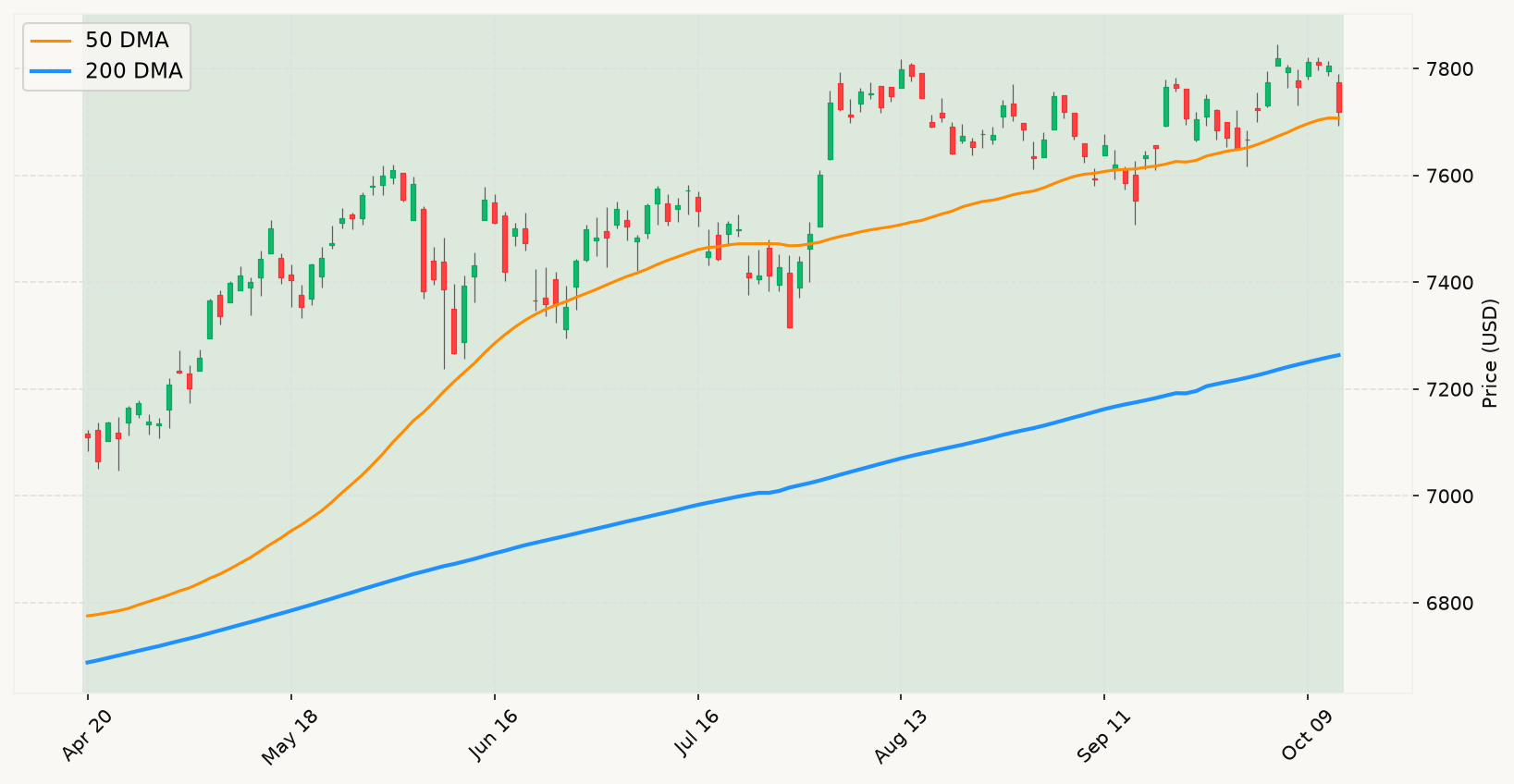
From a pure positioning standpoint, the current signal environment does not support defensive action. The stock market trend remains unambiguously bullish — price sits comfortably above the primary trend line with a drawdown of just over 1% from the all-time high set nine days ago. The interest rate environment, while uncomfortable for debt-laden growth names, is not flashing the kind of inversion that historically precedes recessions; in fact, monetary policy signals have shifted to a clearly positive spread, consistent with an expansionary phase. Employment conditions remain healthy with no indication that the labor market is deteriorating in the systematic way that historically accompanies recessionary bears. All three of the macro confirmation signals point in the same direction: this is a bull market absorbing a difficult piece of news, not a bear market announcing itself.
The AI chip rout and the global contagion into Asian markets are exactly the kind of violent, fast-moving events that the historical record treats as sentiment-driven corrections rather than fundamental repricing. The velocity here — sharp, sudden, concentrated in a single sector — is the signature of a panic, not a grind. The 80% base rate says that the overwhelming majority of sharp, newsdriven selloffs resolve without becoming prolonged declines, and that base rate only applies once a market is down 10% or more from its peak. At a 1.28% drawdown, we're not even in the statistical territory where that question becomes live. Watching the AI funding scare cascade into Korea and Japan is unnerving in real time; it is also exactly what fast corrections look like before they reverse.
The actionable guidance here is straightforward: stay fully invested, don't mistake sector pain for market collapse, and keep your attention on the macro gauges rather than the daily narrative. If energy-driven inflation keeps the Fed hiking aggressively into a slowing consumer, that's where you'd start watching for the gradual grinding deterioration in both prices and economic data that would eventually demand a different response. Right now, that convergence isn't there. A hot CPI print and a leveraged AI cloud company under bond-market stress are legitimate news stories — they are not, by any analytical measure, a signal to reduce equity exposure. The burden of proof remains squarely on the bear case, and the bear case has not made it. MoreLess