The Ticker
Bull Market
The economic engine is humming, the bulls are kicking up dust near the summit, and the whole parade is marching to the beat of a strong paycheck and a kitchen table that still has groceries on it — it's a sunny day out there, folks, even if a few clouds are drifting in from the Middle East.
Top Story
Big Banks Hit the Tape as Earnings Season Fires Up
Wall Street is bracing for its biggest week of the young earnings season, with the nation's largest banks — JPMorgan Chase, Goldman Sachs, Citigroup, and Wells Fargo — all set to report third-quarter results Tuesday morning, followed by Bank of America and Morgan Stanley on Wednesday. The results arrive with the S&P 500 hovering just below all-time highs, and investors are counting on corporate profits to validate equity valuations in the face of still-elevated interest rates.
This is the first major earnings round since the Federal Reserve raised rates in September, putting banks in an awkward spot: financials have lagged the broader market by roughly seven percentage points since that hike, yet analysts still project roughly 10% earnings growth for the sector. Key watchpoints include net interest income trajectories, investment banking fee momentum — Goldman's equities revenue surged 72% last quarter — and management commentary on credit quality and loan demand as higher funding costs bite deeper.
The Fed's next policy decision lands October 27–28, and Wednesday's September CPI report will land squarely in the middle of bank earnings, making for a uniquely compressed information window. Markets are currently pricing only a slim probability of another hike at the October meeting, but a hot inflation print could rapidly reprice that expectation. Core CPI is seen edging higher, and with headline readings being lifted by energy costs, the Fed faces the familiar challenge of looking through oil-driven noise without losing credibility on inflation.
On the macro periphery, the Middle East remains a source of volatility. Houthi drone strikes on Saudi Arabia's main airport over the weekend pushed oil briefly higher, but a parallel deal allowing Russian diesel exports under a Treasury sanctions waiver through April 2027 helped ease some energy-market tension. Separately, SpaceX's announced $8 billion acquisition of a nationwide low-band wireless spectrum portfolio rattled telecom stocks globally, adding a technology-disruption subplot to an already eventful week. MoreLess
Six Month Chart (SPX)
⊞ Expand
The Ticker Analysis
Bulls Hold the High Ground — Stay the Course
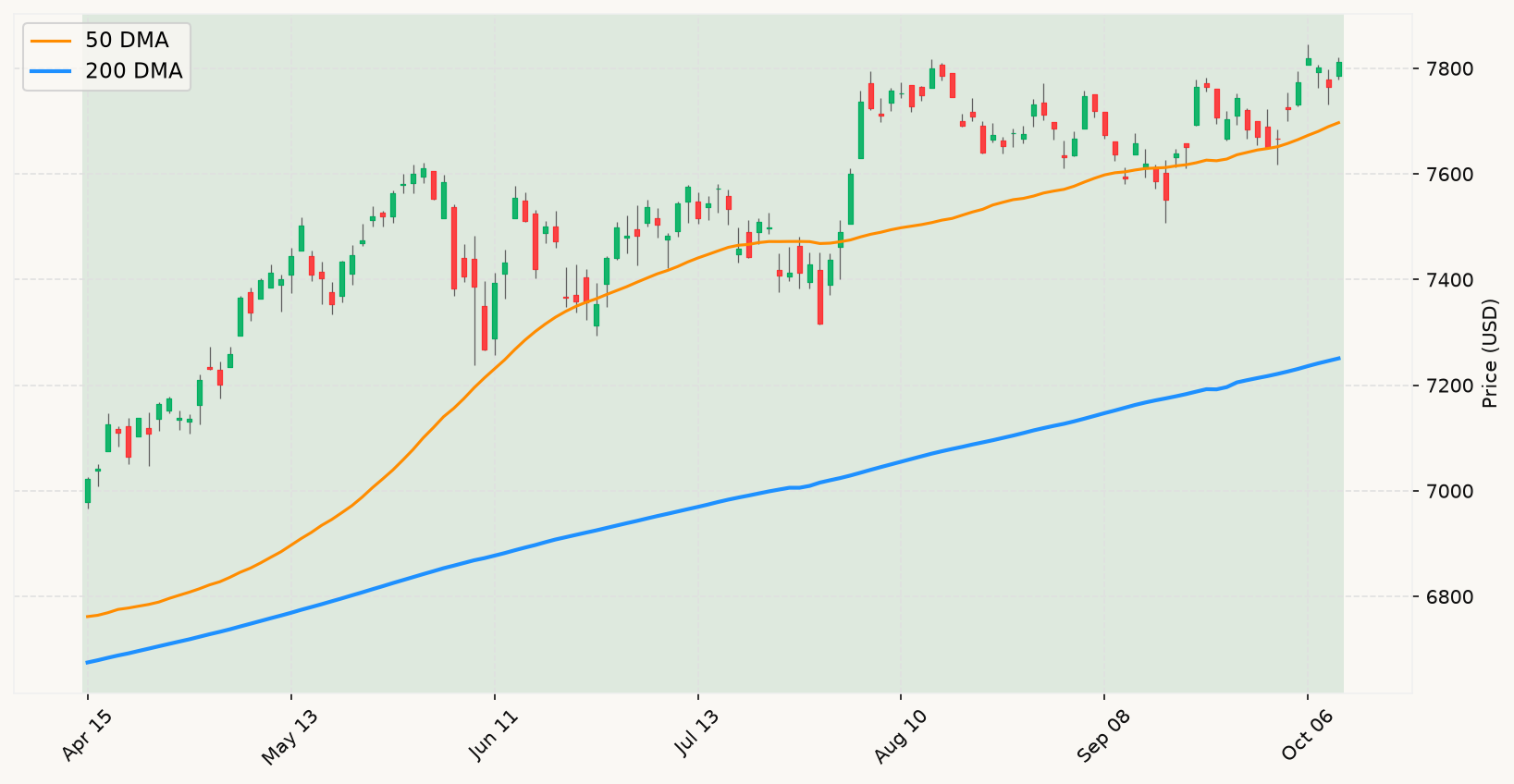
The market's primary trend is unambiguously bullish. The S&P 500 is trading well above its long-term trend line, sitting within a fraction of a percent of its all-time closing high set just six days ago. That kind of nearness to a peak is not a warning signal — historically, new all-time highs have been associated with above-average forward returns at one-, three-, and five-year horizons. The burden of proof remains firmly on the bear case, and right now that case has almost nothing to work with on the price-action side of the ledger.
The interest rate environment adds complexity but not alarm. The 10-year yield pressing toward multi-year highs reflects genuine tension between resilient growth and sticky inflation — the kind of backdrop that the Fed has been navigating since its September hike. A hot CPI print Wednesday could stir rate-hike repricing for the October meeting, but monetary policy signals remain more ambiguous than recessionary: the spread between short- and long-term rates is firmly positive, which is the opposite of the inversion pattern that has historically presaged recessions. With the curve in positive territory and both real-time growth trackers solidly above zero, the recession-confirmation leg of any bearish thesis simply isn't there.
Earnings season is the real test this week, and the setup is reasonable. Banks walking in as sector laggards — underperforming the broader market since the September hike — means expectations have been partially reset. If JPMorgan, Goldman, and peers deliver results broadly in line with the roughly 10% growth consensus, financials could close that gap quickly. The more important data point will be forward guidance: management commentary on credit quality, NII outlook, and loan demand will tell us more about where the real economy is headed than any single data point. And critically, analysts are tipping 30% EPS growth for the upcoming quarter across the full S&P 500 — a figure that, if even partially delivered, would give the bull case substantial fundamental reinforcement.
The geopolitical noise — Houthi strikes, Russia-Ukraine energy ceasefire disputes, Middle East escalation — fits neatly into the category of events the market consistently looks through when underlying economic conditions are intact. Oil above $100 is a real cost, but it is not the same as a demand-destruction event or a credit-market seizure. Employment conditions remain strong, both real-time growth models are showing solid positive readings, and the stock market itself — the most comprehensive aggregator of informed opinion on systemic risk available — is sitting at the doorstep of all-time highs. The correct posture here is fully invested. Stay the course. MoreLess