The Ticker
Bull Market
The economy's humming like a well-oiled jukebox, the jobs report handed Wall Street a hall pass from the Fed's paddle, and the bulls are out there doing the cha-cha in the end zone — but with oil hovering like a storm cloud just over the ridge, this party has a bouncer keeping one eye on the door.
Top Story
Blowout Jobs Miss Kills October Rate Hike & Sends Stocks Higher
Wall Street ended last week on a high note after a shockingly weak September jobs report all but buried any chance of a Federal Reserve rate hike this month, with traders cheering the bad news as good news for equities and sending stocks broadly higher into the weekend.
The labor market picture has shifted meaningfully: just 29,000 jobs were created in September against expectations north of 80,000, and prior months were revised lower by a combined 60,000 positions. Wage growth also softened to its slowest annual pace since 2021. The Fed hiked rates for the first time since 2023 in September, bringing the funds rate to 3.75%–4.00%, and now markets see barely an 18% chance of a follow-on hike in October — a dramatic repricing from roughly 70% probability earlier in the week.
The relief rally comes with a catch, however: the ISM Manufacturing survey's prices-paid component surged to 77.9 in September, its highest reading since May, signaling that factory input costs are still climbing fast. That tension — softer hiring alongside stubborn cost pressures tied in part to elevated oil prices above $100 a barrel — puts the Fed in a genuinely difficult spot. Officials have flagged that September CPI data, due October 14, and geopolitical developments in the Middle East will heavily influence the October 28 rate decision.
With the September jobs report now in the rearview, markets pivot to the unofficial start of Q3 earnings season. Reports from PepsiCo, Delta Air Lines, and a handful of other bellwethers arrive this week, offering the first real read on how corporate America weathered a quarter shaped by higher rates, energy-cost inflation, and a resilient but slowing consumer. Manufacturing has been a bright spot — the ISM headline has held above 54 for months — but whether that strength flows through to earnings beats will set the tone for a pivotal October. MoreLess
Six Month Chart (SPX)
⊞ Expand
The Ticker Analysis
Bull Trend Intact — Payroll Miss Is Just Noise
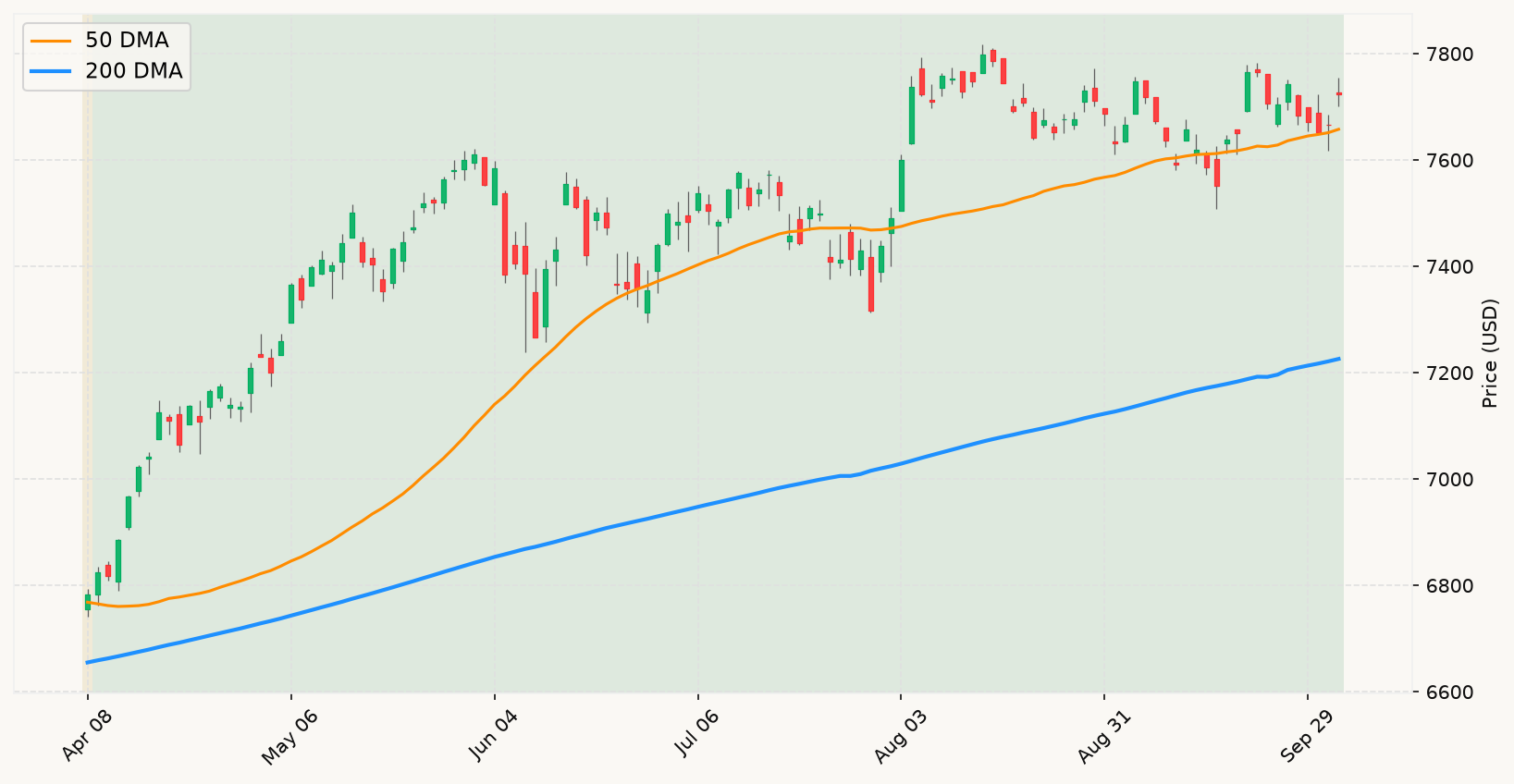
The September payroll miss is commanding all the headlines this morning, and the market's reaction — broad gains, rate-hike odds collapsing — is exactly the kind of "bad news is good news" dynamic that makes equities feel untethered from economic reality. But viewed through the lens of what actually matters for long-term positioning, this jobs report is best categorized as noise rather than signal. Labor market data is inherently backward-looking and subject to revision — the 60,000 downward revision to July and August is a reminder of how unreliable any single print is as a real-time read. Nothing in Friday's release shifts the primary market trend, which remains unambiguously bullish: the S&P 500 is well above its long-term trend line, sitting less than 1% from an all-time high set just seven weeks ago. That is not a market flashing distress signals.
The more analytically interesting datapoint from last week is the ISM prices-paid component screaming higher even as headline job creation cools. That combination — robust manufacturing activity with accelerating input costs alongside a softening labor market — is precisely the split signal that keeps the Fed from delivering the all-clear the bond market desperately wants. The interest rate environment remains the most consequential macro variable for equities right now. A positive 10Y-3M spread means the monetary policy signal is not flashing recession warning, but yields above 5% on the long end represent a genuine cost-of-capital headwind that limits how much multiple expansion can do the work for equities going forward. The bull case depends on earnings growth doing the heavy lifting — which is exactly what the upcoming Q3 reporting season will put to the test.
On the geopolitical front, the ongoing Middle East conflict and its effect on oil prices deserves acknowledgment but not overreaction. The G7 strategic reserve release and recovering Gulf export flows are capping the upside on crude, and Brent pulling back from its highs is a marginal positive for the disinflation narrative. But oil north of $100 a barrel is a persistent inflation headwind that complicates Fed messaging, and any renewed escalation near the Strait of Hormuz would quickly revive rate-hike bets. None of this changes the core framework assessment: employment conditions have not deteriorated sharply enough to trigger a recession signal, economic growth remains solidly positive by every real-time measure, and the stock market itself — the best leading indicator available — continues to confirm the bull trend. The base rate here is overwhelmingly favorable to staying fully invested.
The correct posture heading into earnings season is to hold position and let the data accumulate. The market is in a regime where corrections are noise and the burden of proof falls entirely on the bear case — and right now, that case requires a recession signal that simply isn't present. Manufacturing is expanding for the ninth straight month, the consumer is still spending, and the primary trend is intact. Q3 earnings reports starting this week will either confirm or begin to challenge that picture. Until the trend line breaks and economic indicators converge on deterioration, defensive repositioning is not warranted — it would mean betting against a market that has consistently rewarded patience over the past two-plus years of this bull run. MoreLess