The Ticker Analysis
Bull Case Intact — Noise Is Not a Signal
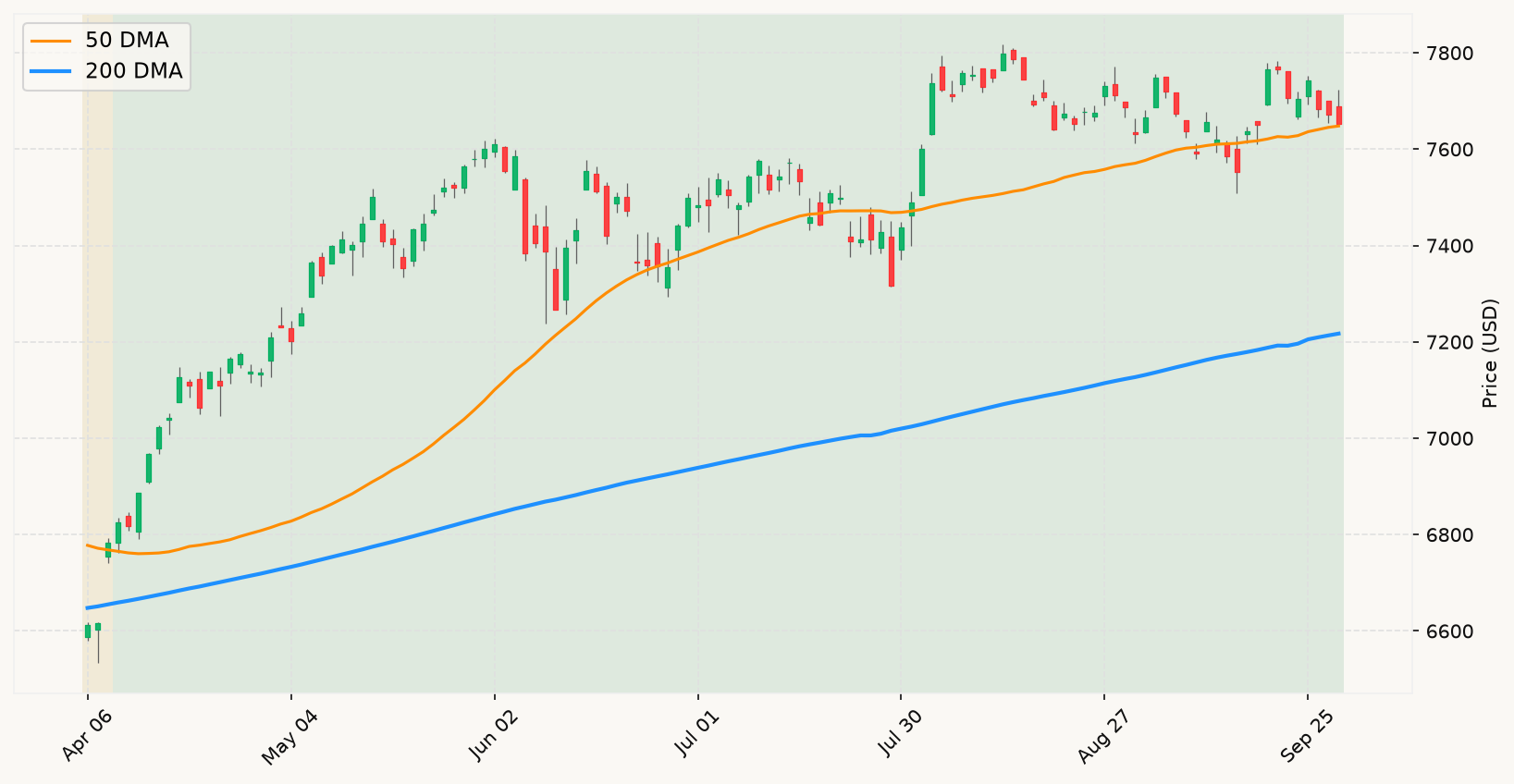
Micron's blowout quarter is making headlines, but it's worth stepping back and applying the right lens. Blockbuster earnings from a single name — even one as emblematic of the AI buildout as Micron — fall squarely in the category of things that feel significant but carry no diagnostic weight for the broader market regime. The primary market trend remains firmly bullish: the S&P 500 is trading comfortably above its long-run trend line, sitting less than 2% from an all-time high set just seven weeks ago. In that environment, the framework is unambiguous — stay fully invested. Single-quarter earnings beats, however spectacular, do not alter that posture. They are signal amplifiers for stocks already in a bull trend, not independent reasons to change allocation.
The PCE inflation data and Fed commentary deserve more careful parsing. Core PCE coming in below expectations, combined with NY Fed President Williams explicitly signaling no urgency for an October hike, represents a meaningful shift in the near-term interest rate environment. Elevated yields had been the primary headwind to equity multiples all quarter, and any credible softening in that trajectory is a genuine tailwind. That said, core PCE still running at 3% — 100 basis points above the Fed's target — means the tightening cycle is not over. The market is not pricing a pivot; it is pricing a pause. A pause is constructive for equities, particularly when the primary trend is intact, but it is not the same as a green light for duration or rate-sensitive sectors to fully recover. Employment conditions remain solid, there is no Sahm-style deterioration in the labor market, and monetary policy signals — while elevated — are not at a level historically associated with recession-triggering financial tightening.
The Strait of Hormuz impasse is the one story worth monitoring through a proper framework lens, not because the diplomatic deadlock is itself a market signal, but because of its pathway to becoming one. A prolonged closure keeping Brent crude near $100 per barrel would feed directly into headline inflation, complicate the Fed's calculus, and put renewed upward pressure on long yields. None of that has yet produced a sustained, grinding equity decline — the signature of a market beginning to price a recessionary outcome. The current drawdown from the August all-time high is under 2%, and the decline profile is nothing resembling the slow, methodical erosion that historically precedes a prolonged bear. This is not a situation calling for defensive repositioning. It is a situation calling for watchfulness on the energy-inflation feedback loop.
Bottom line: the overall market posture today maps cleanly to the bull scenario. The primary trend is up, economic growth nowcasts are positive and solid, employment conditions show no deterioration, and the velocity of the current pullback from the August high is negligible — not remotely approaching the thresholds that would trigger a framework diagnostic. Micron's earnings and the softer PCE print reinforce, rather than complicate, that picture. The noise level is high — geopolitical headlines, yield anxiety, Fed speculation — but the signal is clear. There is no case in the current data for reducing equity exposure. The burden of proof remains firmly on the bear case, and that case has not come close to meeting it. MoreLess