The Ticker Analysis
Scary Headlines, Solid Footing — Stay the Course
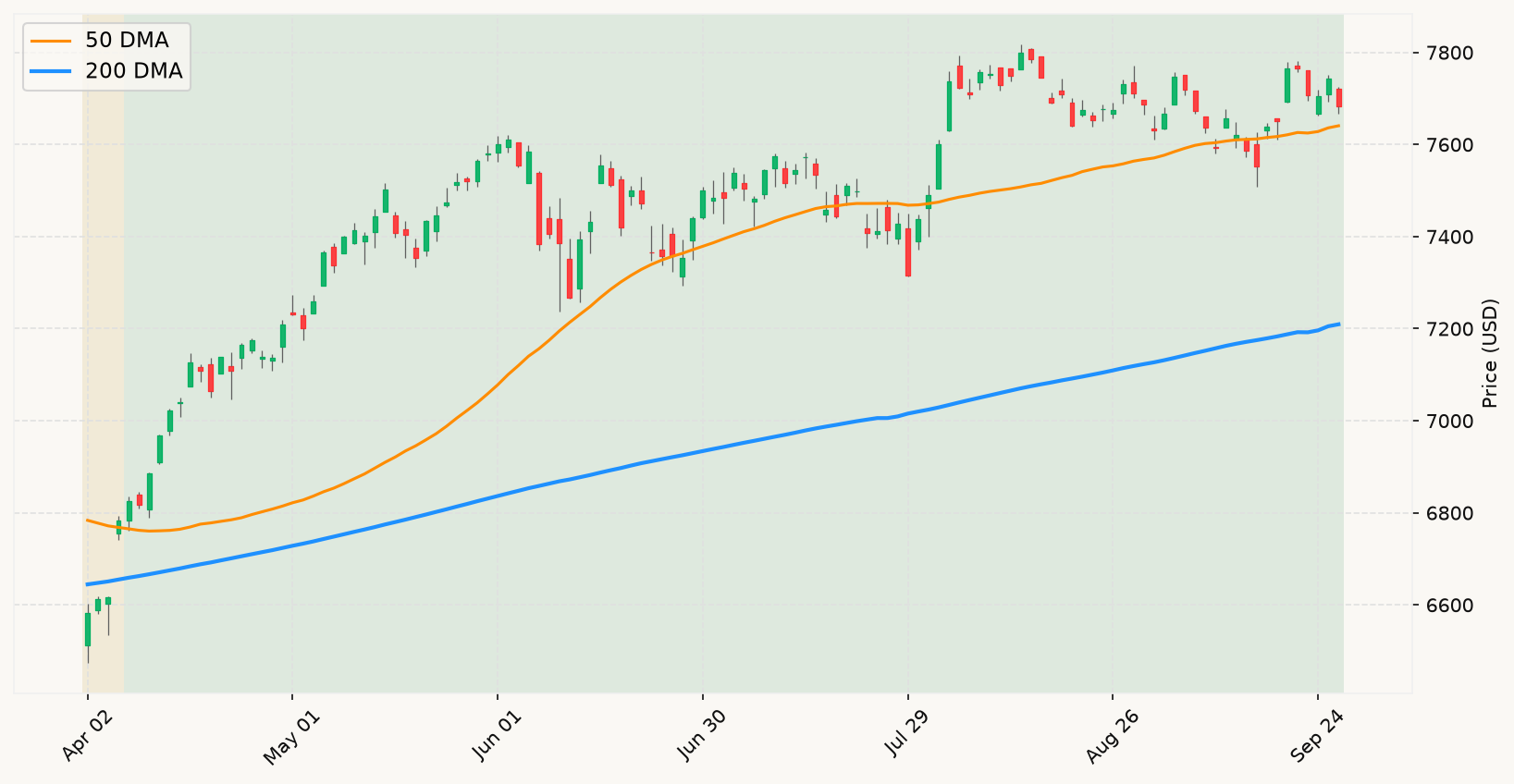
The dominant story right now — Trump's rejection of Iran's Hormuz proposal, surging crude, and a Fed that has re-entered tightening mode — makes for alarming headlines, but the signal-versus-noise test cuts through the noise quickly. The S&P 500 sits comfortably above its primary market trend line, the drawdown from the all-time high is a rounding error at under 2%, and the 80% historical base rate says that absent a confirmed recession, pullbacks of this magnitude are routine. Nothing in the current setup — not the geopolitical headlines, not the rate hike, not the tech selloff in Arm — overrides the basic read: this is a bull market regime, and the burden of proof for going defensive remains squarely on the bear case.
The rate environment is the one area worth watching carefully. The Fed's unanimous September hike and the dot plot's signal of more to come confirm that the interest rate environment has shifted from accommodative to actively tightening for the first time since 2023. Historically, equity markets have absorbed initial hiking cycles reasonably well when the economy is growing and labor markets are healthy — and on both counts, the current backdrop holds. Employment conditions remain solid: the unemployment rate is holding near 4.1%, payrolls are still expanding, and there is no sign of the rapid deterioration that would be needed to trigger a recessionary bear signal. A hawkish Fed is not, by itself, a sell signal.
The Iran-Hormuz premium embedded in oil prices is the wild card that bears the closest watching — not because it is a direct market signal, but because sustained elevated energy costs are the fuel feeding the Fed's inflation problem. If crude stays elevated, it extends the tightening cycle, pushes long-end rates higher, and compresses multiples on high-duration equities like the AI-linked semiconductors that have led this rally. The Arm selloff and the broader tech weakness are rational repricing responses to a higher-rate world, not harbingers of systemic failure. The market is doing exactly what it should: recalibrating sector weights without abandoning the primary uptrend.
The positioning guidance is unchanged: stay fully invested in a diversified, index-based portfolio. The current decline profile — shallow, recent, with no economic deterioration confirmed — maps cleanly to the correction regime in which history argues overwhelmingly for patience over action. The economic growth backdrop, with both nowcasting models pointing to positive Q3 output and labor markets still constructive, provides no second-leg confirmation of a recessionary bear. Watch for the primary market trend to hold; watch for employment conditions to remain stable; and watch oil — if Hormuz disruptions escalate materially and the economic data begin to deteriorate in tandem, the calculus changes. Right now, it hasn't. MoreLess