The Ticker
Bull Market
The market's riding a well-fed bull through a smoky saloon — oil's on fire, the geopolitical jukebox won't quit, and the bartender just raised the tab again, but that bull isn't budging an inch from its barstool.
Top Story
Trump Rejects Iran Truce, Oil Spikes & Inflation Fears Return
President Trump's flat rejection of Iran's proposal to reopen the Strait of Hormuz in seven days sent oil prices surging more than 3% Monday morning, reigniting inflation fears and rattling bond markets heading into a pivotal week of U.S. economic data.
The geopolitical flashpoint comes at a fragile moment for markets. The Federal Reserve already hiked rates by 25 basis points in September, and futures markets are now pricing roughly a 65% probability of another hike at the October 28 meeting. This week's PCE inflation print and Friday's September jobs report will be closely watched by Fed officials and investors alike — strong readings would further cement the case for continued tightening, while any softness could ease the pressure on Chair Kevin Warsh to move again so quickly.
On the earnings and corporate front, Nvidia stole the spotlight with its announcement of the largest single share repurchase authorization in U.S. history — a $150 billion addition that takes its total buyback capacity to $235 billion. CEO Jensen Huang cited the company's AI-driven cash generation as the engine behind the move, and the stock climbed in premarket trading even as the broader tech sector came under pressure from risk-off sentiment tied to the Iran headlines.
The macro picture carries a significant countervailing tailwind: the U.S. and China followed up last week's Trump-Xi summit with a formal agreement to cut tariffs on $60 billion worth of goods and extend their trade truce through January. That deal — covering everything from American corn and wheat to Chinese appliances and toys — represents the most concrete step forward in trade normalization in months, offering businesses a more stable operating environment even as energy markets remain volatile. MoreLess
Six Month Chart (SPX)
⊞ Expand
The Ticker Analysis
Bull Trend Intact, Geopolitical Noise Notwithstanding
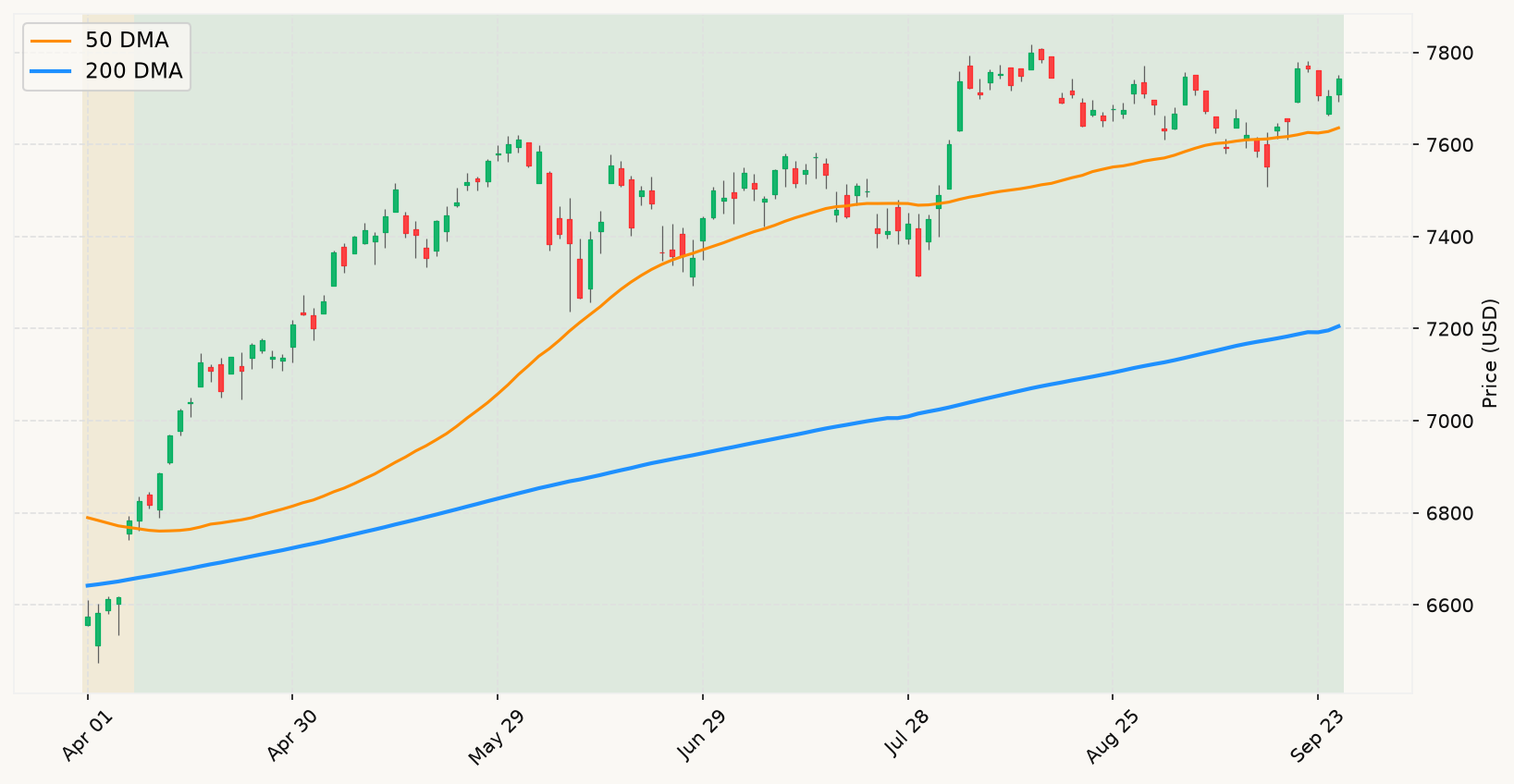
The dominant headline today — Trump rejecting Iran's Strait of Hormuz proposal and the resulting oil spike — lands squarely on the "noise" side of the ledger when evaluated through the lens of disciplined market analysis. The market is well above its primary trend line, consumer sentiment surveys notwithstanding, and the Strait of Hormuz conflict has been an ongoing geopolitical backdrop since February. Geopolitical events of this type are routinely and efficiently priced by the institutional participants whose collective judgment shows up in equity prices every day. The tell is always in the market's sustained price action, not the headline itself — and a market sitting within 1% of all-time highs is telling you something very different from what the oil futures spike this morning might suggest.
The Fed story is the more substantively interesting development. The September hike was the first since 2023, and markets are now pricing meaningful odds of a follow-on move in October. The interest rate environment has shifted meaningfully — the 10-year yield is back above 5% and the short end is climbing — but the critical observation is that the spread between the 10-year and 3-month yields remains firmly positive. That's not the configuration that historically precedes recessions. Inverted curves — where short rates exceed long rates — have preceded every modern U.S. recession with a 6–18 month lead time. A positively sloped curve at these levels signals that the bond market, despite all the rate anxiety, is not pricing a contraction. That matters more than the Fed's next meeting date.
The Nvidia buyback and the U.S.-China tariff deal are noise in the strictest sense — neither materially moves the two diagnostic needles that matter: the stock market's trend and the convergence (or non-convergence) of leading economic indicators toward a recessionary signal. Nvidia's capital return announcement reflects extraordinary cash generation and management confidence in forward AI demand; it's a corporate finance event, not a macro one. The trade truce extension through January removes a specific tail risk from the calendar and is modestly constructive for corporate planning horizons, but trade policy volatility has been a persistent feature of the environment for years and has not derailed the primary bull trend.
The overall posture here is unchanged and clear: the market is in bull market territory, the primary trend is intact and healthy, employment conditions remain solid, monetary policy signals are firm but not recessionary, and the panic buying signal is inactive because the drawdown from the all-time high is trivially small. Every one of the four prolonged bear markets in the modern dataset coincided with a confirmed recession — and nothing in the current data mosaic, from labor markets to the nowcasts to the interest rate environment, is pointing toward one. The correct response to an Iran headline, a Fed hike cycle, and a tech buyback announcement, all arriving on the same Monday morning, is to stay fully invested and resist the gravitational pull of dramatic-sounding news. MoreLess