The Ticker Analysis
Bull Market Intact — Yield Noise, Not a Regime Change
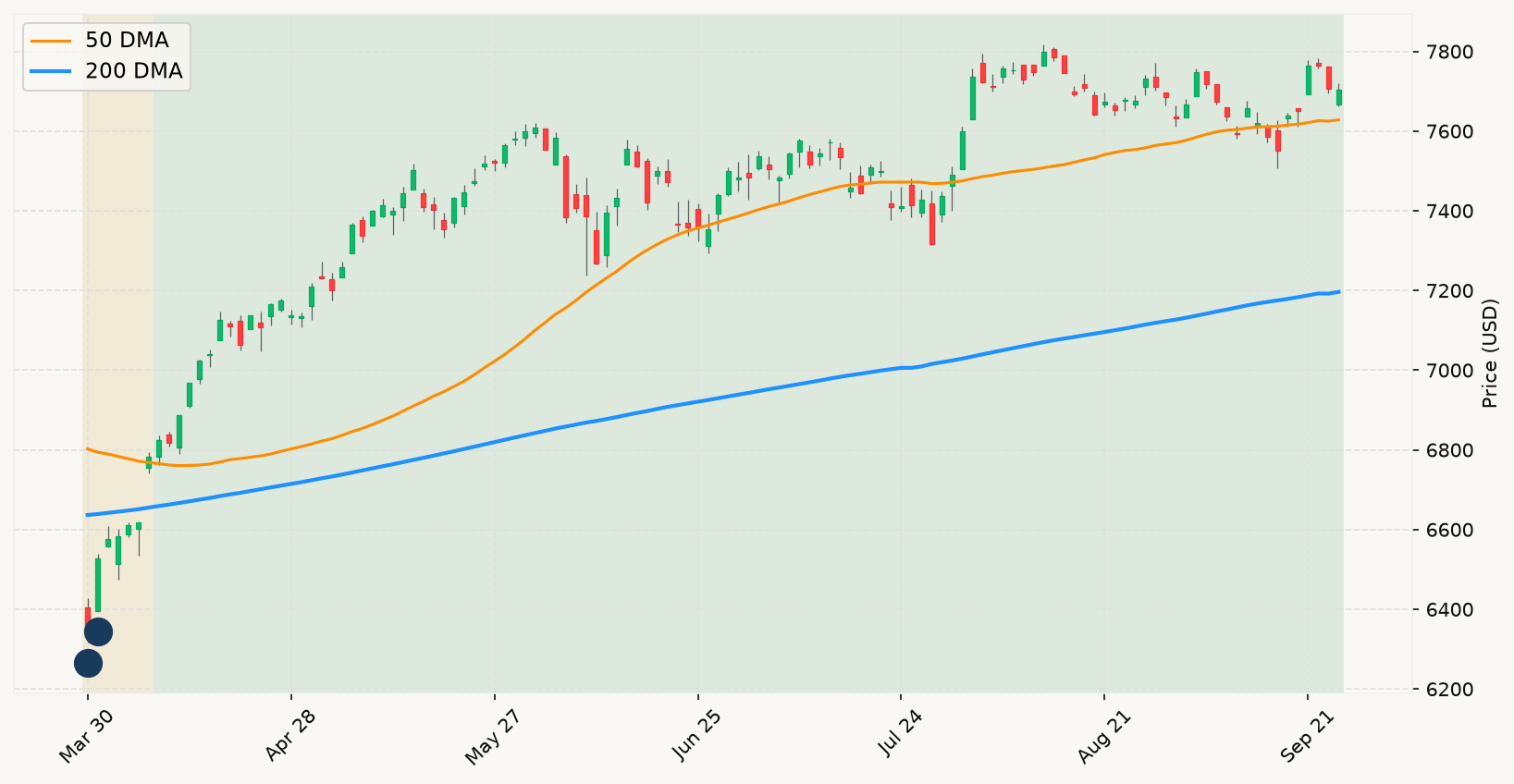
The bond market rout is the loudest noise in the room right now, and it is worth being precise about what it is and what it isn't. Surging yields — driven by a hot manufacturing PMI, persistent oil-fueled inflation, and weak Treasury auction demand — have rattled markets and put Fed Chairman Warsh in the uncomfortable position of potentially hiking rates again in October, barely a month after the first hike in three years. That is a genuinely unsettling interest rate environment. But unsettling is not the same as dangerous, at least not within the context of what the primary market trend is actually telling us. The S&P 500 sits comfortably above its long-run trend line, which is the single most important piece of information any investor should be tracking. The burden of proof remains squarely on the bear case, and that burden has not been met. High yields are a headwind, not a regime change — and the historical record is littered with episodes where rising rates coincided with continued equity gains, particularly when the economy is generating the kind of Q3 growth that both nowcast models are currently projecting.
The Trump-Xi summit outcome is a useful case study in how to filter geopolitical noise. A two-month trade truce extension sounds alarming when framed as a "failure to reach a comprehensive deal," but the market priced the most likely outcome long before the leaders shook hands in the Oval Office. The analytical question is never whether news is good or bad — it is whether it changes anything material in the economic picture. A short-extension on an existing truce, with talks continuing, does not represent a fundamental deterioration in trade conditions. Rare-earth access remains a genuine structural watch item, and if that situation deteriorated sharply, it would deserve a second look through the lens of leading economic indicators. As of now, it is not moving the needle. Similarly, the Iran-Hormuz situation and elevated oil above $100 per barrel are real inflation inputs, but the employment picture remains solid — unemployment at 4.1% with no signs of the broad labor market deterioration that historically precedes recessions — and those two conditions together argue strongly against a recession call.
The AI story — Meta's Muse pulling chip stocks higher, Anthropic locking in an $11.6 billion infrastructure deal with Akamai — represents exactly the kind of sustained demand signal that has been driving the AI capital expenditure supercycle throughout 2026. This matters not because any individual news item is a buy signal (it isn't, on its own), but because it confirms that the business investment underpinning the Q3 growth surge is not a statistical artifact. When the Atlanta Fed's model shows growth tracking north of 5% for the quarter, driven by inventory rebuilding and business equipment spending, and you can point to concrete multi-billion-dollar AI compute commitments as the real-world confirmation of that investment, the two stories reinforce each other. The market's primary trend is bullish, the economic data is strong, employment conditions are healthy, and the AI investment cycle is accelerating. That is a confirmed bull regime, full stop.
The right posture here is to resist the instinct to hedge aggressively in response to headlines that feel uncomfortable. The interest rate environment is tighter, yes. The geopolitical backdrop carries real risk, yes. But the S&P 500 is only about 1.2% off its all-time high, still well above its primary trend line, with an RSI in neutral territory and no recessionary signal from any of the leading economic indicators. The historical base rate is clear: in the vast majority of episodes where the market sells off modestly from a peak while the underlying economy remains robust, investors who stay put come out dramatically ahead of those who don't. The declines that end careers are the slow, grinding ones that begin while everyone is debating whether yields are too high — and they are always, without exception, confirmed by simultaneous deterioration in employment conditions and growth data. None of that is present today. Stay invested and let the evidence come to you before acting. MoreLess