The Ticker Analysis
Bull Market Intact — Headlines Are Just Noise
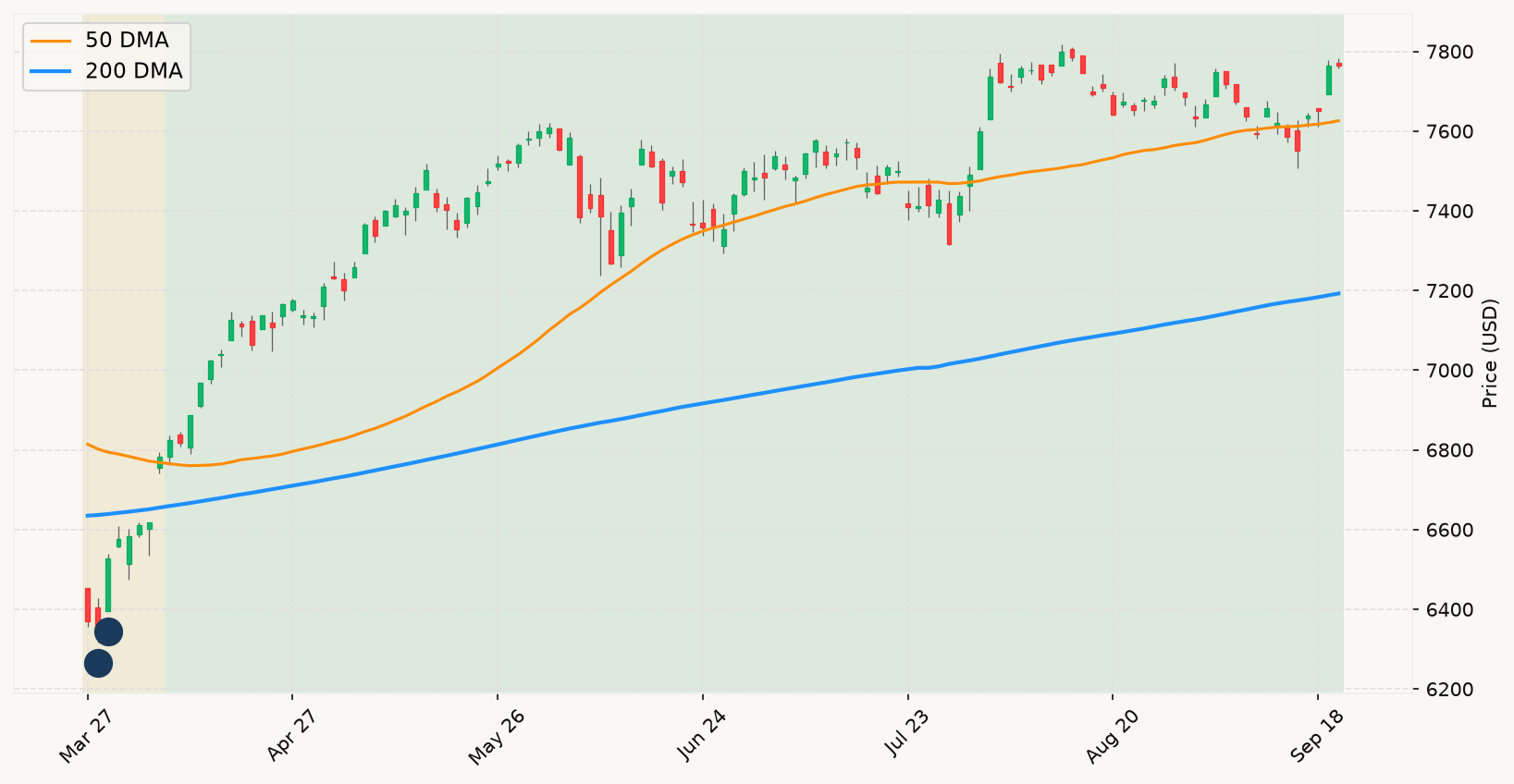
The dominant signal right now is unambiguous: the S&P 500 is trading well above its primary market trend line, sitting a fraction of a percent below an all-time high set just six weeks ago. That is a bull market. Full stop. Everything flowing out of this week's news — the AI chip frenzy, the Iran diplomatic flicker, the Fed's hawkish pivot, the Trump-Xi summit positioning — needs to be evaluated against that baseline, not against fear. The primary trend is the senior signal, and it is firmly bullish. Everything else is context.
The AI/semiconductor surge is noise in the most technically precise sense of that word — it does not move any needle in the analytical framework that separates corrections from recessionary bears. A roaring Nasdaq, AMD cracking $1 trillion, and Meta's Muse sparking a chip cascade are spectacular market color. They are not economic leading indicators. What they do confirm is that the primary uptrend has momentum and that capital is aggressively rotating into growth. That is the market's real-time verdict on forward prospects, and it is a positive one. The market as a collective institution has decided that the AI capex cycle is durable. Arguing against that with a macro thesis is a losing game — the market aggregates more information than any single view.
The Fed's rate hike and the hawkish tone from Barkin deserve more careful attention — not because they threaten to break the bull market today, but because they alter the interest rate environment in ways that matter for positioning. A 3.75%–4.00% funds rate with another hike signaled is not a recession trigger on its own; the economy is clearly running hot, with the Atlanta Fed tracking Q3 growth at an extraordinary pace. But the transmission to mortgage rates, credit conditions, and eventually consumer spending is real and cumulative. The relevant question for the framework is whether the rate environment is tightening enough to flip the employment and growth signals negative. Right now, the answer is no — labor conditions remain solid, and the nowcast models are not flashing contraction. The monetary policy signals are tighter than they were a year ago, but they are not convergently bearish alongside the market and employment data.
The Iran talks and Trump-Xi summit are classic examples of the kind of geopolitical noise that feels enormously consequential in the moment and is almost always irrelevant to the medium-term market outlook. If Iran diplomacy collapses next week, oil spikes, and the market sells off sharply — that selloff, if it stays fast and steep, would historically be a buying opportunity, not a signal to exit. If the Trump-Xi summit produces a trade truce extension, it is a mild positive for sentiment already priced into the rally. Neither outcome changes the primary market trend, neither flips the economic leading indicators toward recession, and neither alters the positioning prescription: stay fully invested, let the trend do its work, and resist the narrative pull of the daily headline feed. The data says bull market. Own it. MoreLess