The Ticker Analysis
Bull Trend Intact — Stay the Course
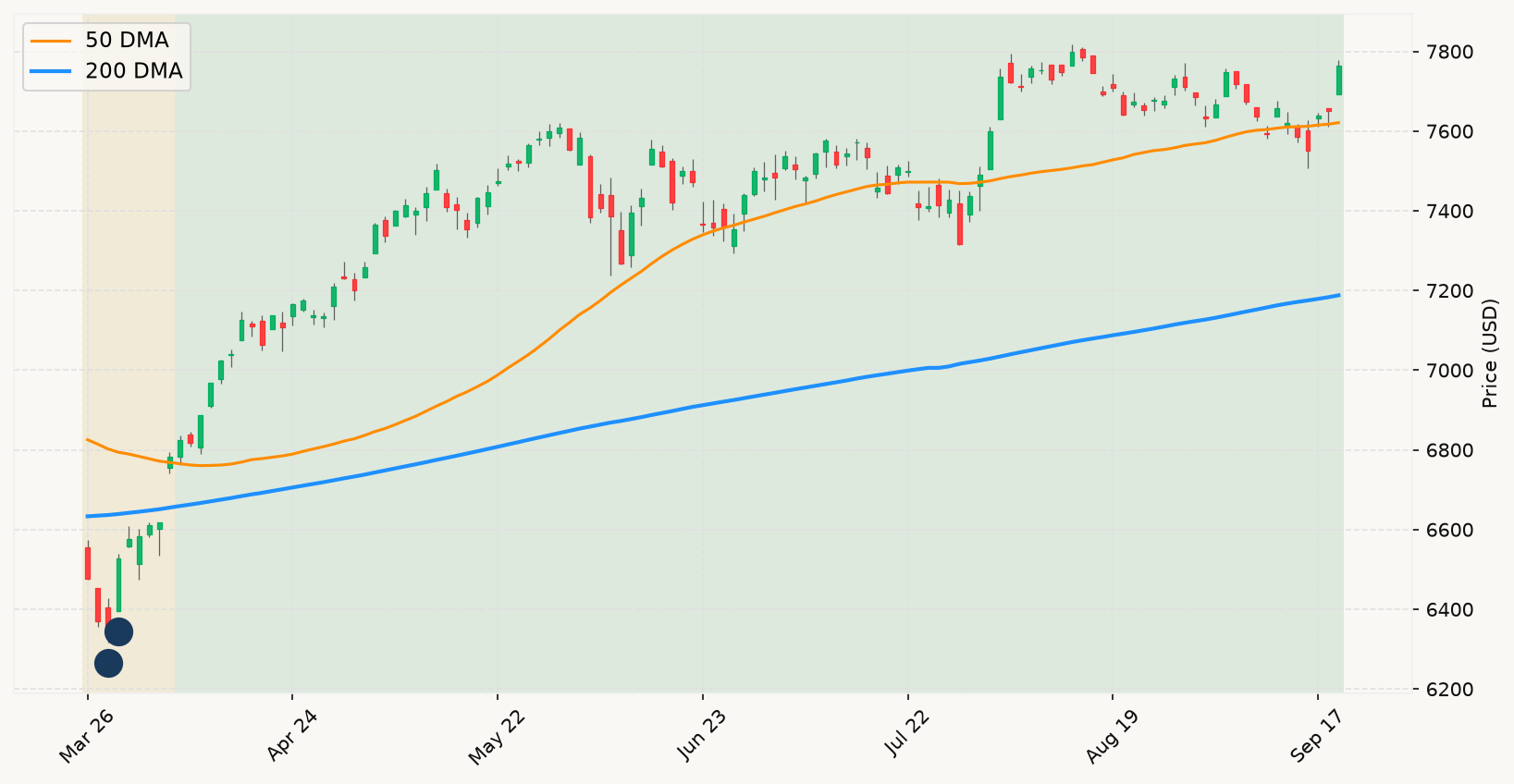
Monday's monster rally was led by the right things for the right reasons, and the primary market trend reads it the same way: the S&P 500 remains comfortably above its long-term trend line, near an all-time high, and the broad advance on September 21 was driven by genuine fundamental enthusiasm — early evidence of consumer adoption for Meta's Muse AI agent — rather than a short-covering bounce or a relief rally with nothing underneath it. When the market surges on legitimate product news that has sector-wide earnings implications, that is not noise. That is the primary trend confirming itself. The bull case here is not complicated: the market is near record highs, the trend is intact, and the historical data is unambiguous that new all-time highs are associated with above-average forward returns, not exhaustion.
The Federal Reserve's hawkish pivot — a unanimous 25-basis-point hike and dot-plot signals pointing to more — deserves to be evaluated honestly rather than dramatized. Yes, the interest rate environment has shifted meaningfully: what began the year priced as a cutting cycle is now a tightening cycle, with a 10-year Treasury yield above 5%. That is a real headwind for valuations at the margin, and it deserves monitoring. But the interest rate environment flashes a warning only when it tips into economic contraction, and the current growth readings don't support that conclusion. The Atlanta Fed's real-time growth tracker is running at a robust pace for Q3, and the NY Fed's own model remains solidly positive. A hawkish Fed fighting above-target inflation in a strong growth environment is uncomfortable but is not, by itself, a recession signal. The labor market remains solid — employment conditions show no meaningful deterioration that would trigger a recession alarm under any reliable framework. Two of the four leading indicators the serious bear case requires are not moving in a recessionary direction.
The Iran war and its energy market consequences are the most legitimate macro risk on the board right now — and they are already priced into the inflation data the Fed is reacting to. The critical development to watch is Iran's reported offer to reopen the Strait of Hormuz. If that materializes, it would mechanically reduce the single biggest upward driver of both inflation and the Fed's hawkish posture. Markets are beginning to price in that scenario, which is why oil broke sharply lower and equities surged simultaneously on Monday. The Trump-Xi summit carries the same logic: any positive development on tariffs or AI policy removes another headwind. These are not guarantees — but they are exactly the kinds of tail-risk resolution events that the market sniffs out early. The broad-based nature of Monday's advance, spanning chipmakers, comm services, and even airlines benefiting from cheaper jet fuel, suggests this is more than a one-day sentiment bounce.
The positioning guidance here is straightforward. The market is above its primary trend, within a fraction of an all-time high, with employment conditions intact, growth tracking positively, and a plausible diplomatic off-ramp for the biggest macro overhang. None of the indicators needed to justify defensive repositioning are flashing. The drawdown from the August all-time high is less than half a percent — this is not a correction; it is a pause. Staying fully invested is the correct posture. The only honest note of vigilance is the Fed's explicit signal of continued tightening: if further hikes ultimately crack consumer spending or the labor market, the leading indicators will show it before the market rolls over in a sustained way. Watch the monthly payroll data and any shift in jobless claims trends — not because they are worrisome now, but because that is where the first real signal of deterioration would appear. Until then, the weight of the evidence says the bull market is intact and the right move is to ride it. MoreLess