The Ticker
Bull Market
The sun is shining, the band is playing, and even the grumpy old Fed showing up with a tighter wallet can't stop the party — the bulls are still dancing, the chips are flying, and oil's headed back down where it belongs.
Top Story
Fed Hikes for First Time in 3 Years & Signals More to Come
The Federal Reserve just made its boldest policy move since 2023, delivering a unanimous quarter-point rate hike that surprised markets not with the hike itself — which was widely expected — but with what comes next. Chairman Kevin Warsh signaled that another increase is likely before year-end, cementing a hawkish pivot that sent shockwaves through bond markets even as stocks initially cheered the Fed finally "backing words with action" on inflation.
The rate hike comes against a backdrop of stubbornly elevated inflation fueled by energy prices that have surged dramatically this year. Core PCE has accelerated from 3.0% in December 2025 to 3.3% by July 2026, and oil prices — though easing this week — remain well above $100 per barrel amid Middle East supply disruptions. The Fed's dot plot now projects an additional hike this year, with 16 of 18 participants in agreement, while future years currently show no additional increases — just modest cuts in 2028 and beyond.
The rate decision adds a fresh layer of complexity to an equity market that has managed to hold near all-time highs despite the tightening backdrop. Stocks initially rallied after the hike on a combination of relief, declining oil prices, and a drop in bond yields — a "buy the news" reaction after weeks of anxious anticipation. Tech and AI infrastructure names led the gains, with chip-related stocks and semiconductor plays outperforming, buoyed partly by carry-through enthusiasm from Nvidia's blowout August earnings report that showed revenue more than doubling year-over-year.
The macro picture, however, carries real tension. The Bank of Japan's own 25-basis-point hike — bringing its rate to a 30-year high of 1.25% — adds a global policy tightening dimension that could pressure yen-funded carry trades. Closer to home, Lennar's earnings miss and lowered guidance point to growing cracks in rate-sensitive sectors like housing, where "deterioration" in market conditions is now the builder's own word. The interplay between a resilient labor market, still-hot inflation, and the Fed's newly confirmed hawkish path will define the market's next chapter. MoreLess
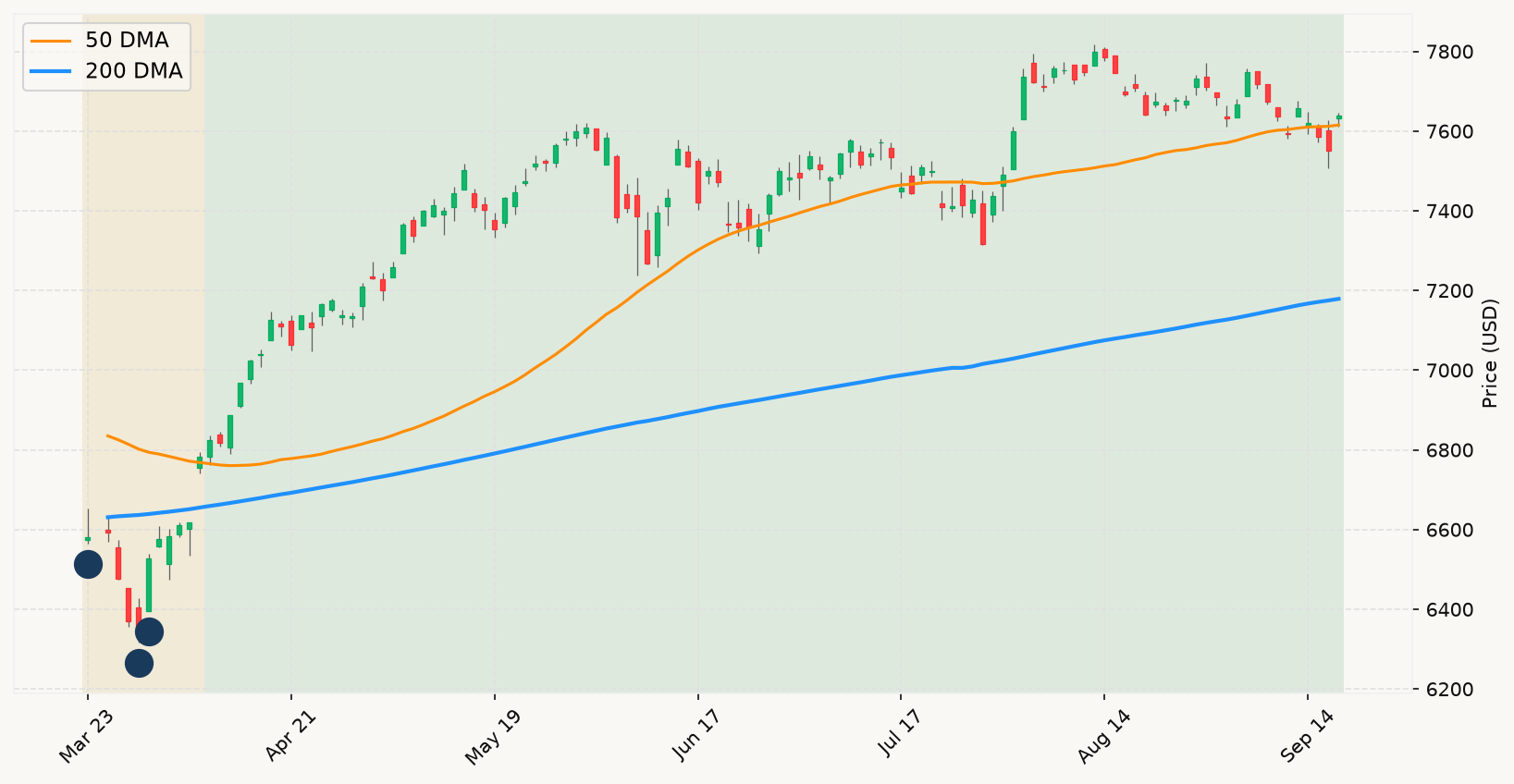
Six Month Chart (SPX)
⊞ Expand
The Ticker Analysis
Bulls Hold the Edge Despite Fed's Hawkish Turn
The single biggest development this week — the Fed's first rate hike in over three years, paired with a clear signal of more to come — is unambiguously the kind of news that sounds alarming in a headline but means very little within a disciplined analytical framework. The primary market trend remains firmly bullish: the S&P 500 is sitting comfortably above its long-term trend line and is only about 2% off its all-time high. That positioning alone answers the core question. When price is above the primary trend and near all-time highs, the verdict is clear: stay fully invested. The Fed's hawkish pivot is noise within that regime, not a signal to act defensively.
The interest rate environment does deserve attention — not as a reason to exit equities, but as a factor to monitor for its downstream effects. A Fed that is tightening into a commodity-driven inflation shock, with another hike potentially on deck before year-end, is a headwind for duration-sensitive assets and rate-sensitive sectors. Lennar's earnings miss and slashed guidance are the first concrete datapoint confirming what most already suspected: housing is cracking under the weight of elevated borrowing costs. But one sector's pain is not a recession signal. The leading indicators that actually matter — employment conditions, GDP growth momentum, and the overall direction of equity prices — are all still pointing the right way. There is no convergence of deteriorating signals that would justify moving to a defensive posture.
The AI and semiconductor complex bears watching not as a trading call but as a macro read. Nvidia's blowout August earnings — with data center revenue up triple-digits year-over-year and rare full-year fiscal 2028 guidance that blew past Street estimates — tells you that the single most important capital expenditure cycle in the global economy is still accelerating. When the most visible leading indicator of AI infrastructure spending delivers a report like that, it is hard to construct a credible near-term recessionary narrative. The tech rally carrying over into Asia, with chipmakers broadly surging, reinforces the signal: the underlying demand story remains intact despite the tighter monetary policy backdrop.
The Bank of Japan's rate hike to a 30-year high introduces a real tail risk — a sudden, sharp strengthening of the yen could unwind yen-carry trades and create the kind of rapid, cross-asset turbulence that we saw briefly in August 2024. That is worth monitoring. But here's the critical nuance: fast, sharp, sentiment-driven dislocations — the kind that could emerge from a carry-trade unwind — are historically the declines that recover most quickly. The current setup, with the market above its primary trend, well above its long-term moving average, and only modestly off all-time highs, means the base rate strongly favors bulls. The burden of proof remains squarely on the bear case, and that case is not yet making a compelling argument. MoreLess