The Ticker
Bull Market
The economy's engine is humming like a well-fed diesel truck — even as that diesel costs a small fortune — and the bulls are holding the pasture with a firm grip, too stubborn to scatter despite all the smoke blowing in from the Middle East and Capitol Hill.
Top Story
Fed Set to Hike Rates for First Time in 3 Years as Saudi Oil Shock Ignites Inflation
The Federal Reserve is widely expected to raise interest rates Wednesday for the first time since 2023, as a drone strike on a critical Saudi Arabian oil pipeline has sent crude prices surging more than 20% this month and reignited inflation fears across global markets. With WTI crossing $104 and diesel topping $6 a gallon for the first time on record, the energy shock has given Fed Chair Kevin Warsh a politically charged but economically compelling reason to tighten — even as President Trump publicly calls for rate cuts.
Q3 earnings season is still in early innings, but the macro backdrop is complicating the picture for corporate guidance. Energy costs feed through supply chains quickly, compressing margins in transportation, consumer staples, and retail — sectors that had only recently recovered from the 2022 inflation cycle. Analysts are watching forward guidance closely for any signs companies are pulling back on investment or hiring plans in response to the energy-price shock.
For Warsh, Wednesday's decision represents his most consequential move since taking the Fed chair in May. His hawkish tone at Jackson Hole — where he said he saw "little evidence" inflation trends had meaningfully improved — telegraphed this hike weeks in advance. Markets have had ample time to price it in, but the real suspense lies in what the updated dot plot and press conference signal about the path from here: whether this is a one-and-done move or the start of a renewed tightening cycle.
Beyond the Fed, the geopolitical dimension is impossible to ignore. Saudi Arabia's East-West pipeline — the bypass route that moves oil to the Red Sea without transiting the Strait of Hormuz — remains offline following the September 10 drone attack. With Hormuz ship traffic already severely curtailed by the US-Iran conflict and strategic reserves now described by Chevron's CEO as exhausted, the supply crunch has no near-term relief valve. That combination of fiscal pressure, energy disruption, and a hawkish Fed adds up to a macro environment where the ceiling on risk assets is harder to see than it was just weeks ago. MoreLess
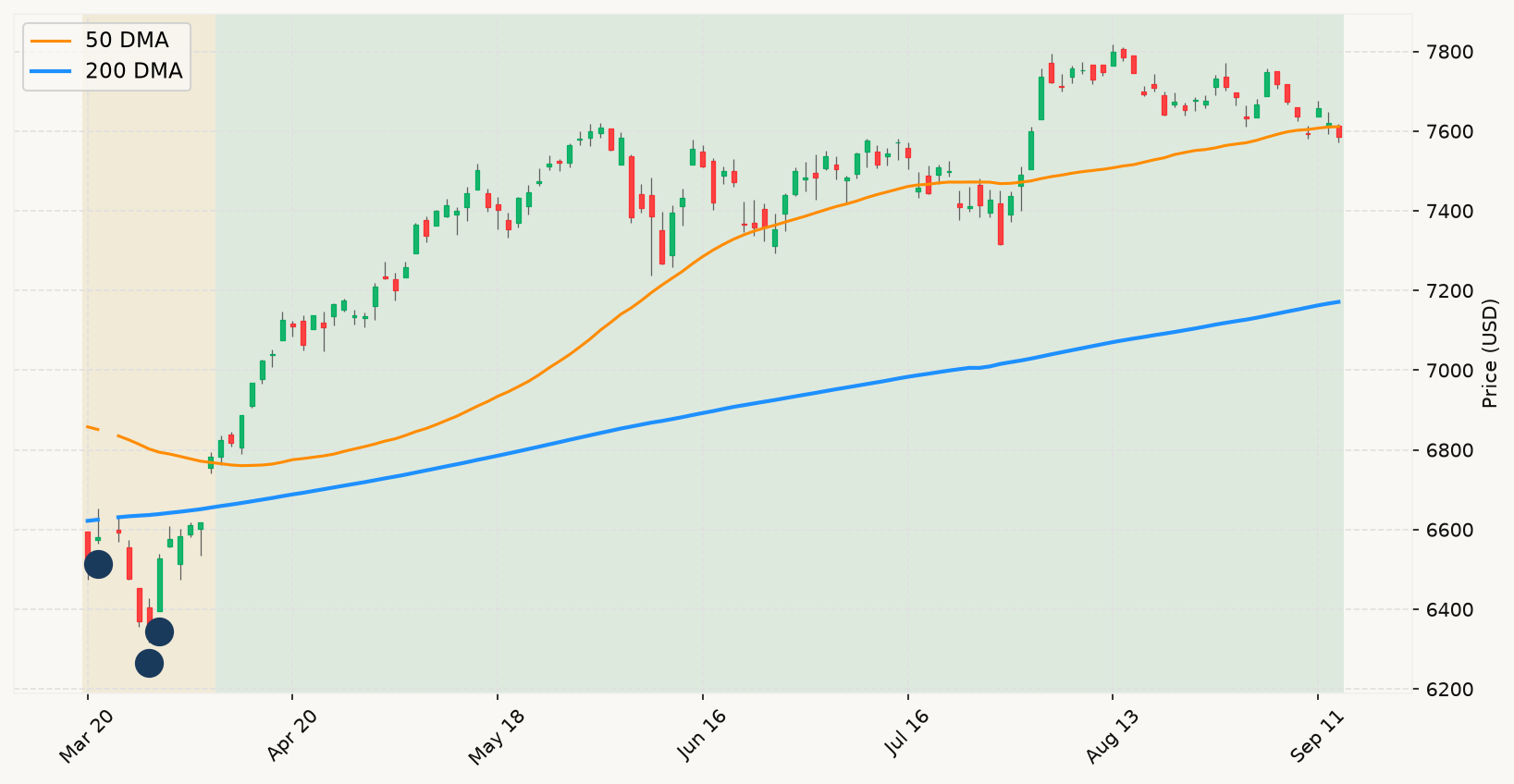
Six Month Chart (SPX)
⊞ Expand
The Ticker Analysis
Bull Trend Intact — Headlines Are the Distraction
The single biggest story this week — an imminent Fed rate hike driven by an energy supply shock — is noise in the context of the analytical tools that actually matter for long-term positioning. The market is still comfortably above its primary trend indicator, the economy is expanding at a healthy clip by any objective measure, and the drawdown from the August all-time high remains a modest 2.7%. That is not the profile of a market under fundamental stress. It is the profile of a market digesting a geopolitical event and a policy announcement that were both well-telegraphed. Markets that are pricing in 94% odds of a hike weeks in advance are markets that have already absorbed the shock — the surprise risk is now to the dovish side, not the hawkish one.
The oil shock and the AI safety debate are genuinely important macro and sector-level stories, but they need to pass through the right filter before triggering any portfolio action. Neither moves the primary trend signal. Neither is producing the kind of gradual, grinding, multi-month equity deterioration that historically precedes a recessionary bear. What you're seeing instead is a market oscillating within a bull trend — the 10-year yield hitting 19-year highs, oil at three-digit prices, a contentious Bessent hearing on Capitol Hill — all of it generating noise and headlines while the underlying trend holds. The S&P remains well above its long-term trend line, and the interest rate environment, while hawkish, has not inverted in the direction that historically signals recession. The monetary policy signal remains in the bullish column.
On the AI slowdown call from Amodei and the chorus of industry voices joining him: this is worth monitoring as a sector-level development for tech and AI-related equities, but it does not register as a systemic signal. Technology sector rotations — even sharp ones — do not change the market's overall regime assessment. The 2000 dot-com bust is the cautionary counterexample, but that episode was accompanied by a simultaneous deterioration in the yield curve, labor market, and leading indicators. Today's labor market signals are firmly bullish, and there is no convergence of deteriorating economic data alongside the sector noise. A bad week for AI stocks is not a bear market in the making. The base rate still says 80% of 10%+ corrections resolve without becoming prolonged declines — and this market isn't even in correction territory yet.
The practical positioning guidance is straightforward: stay fully invested and resist the gravitational pull of the headlines. The Bessent hearing, the pipeline attack, the AI safety debate, the 5% 10-year yield — these are the kinds of events that feel significant in the moment and prove to be irrelevant noise in retrospect. The market's own price action is telling you something more reliable than any of those narratives: it held up. Two consecutive down days with the index still within 3% of an all-time high is not a distress signal — it's a buyable dip in a functioning bull market. The moment to reconsider that posture is when the primary market trend breaks down in a sustained way and economic leading indicators begin confirming a contraction. Neither condition is present today. MoreLess