The Ticker Analysis
Bull Trend Intact — Don't Mistake Noise for Signal
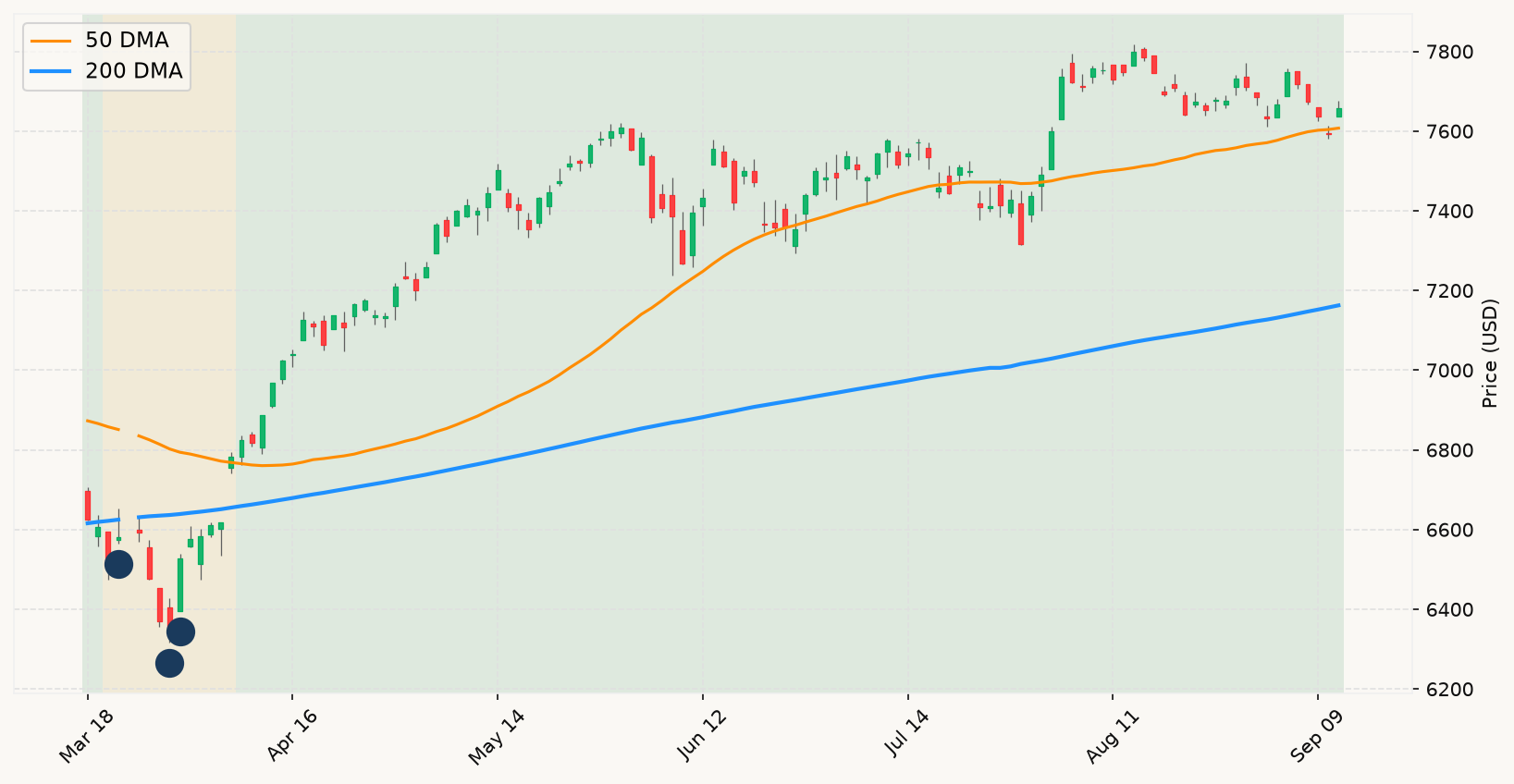
The dominant story today — leading AI executives calling for a coordinated slowdown in frontier development, chipmakers selling off globally, and the OpenAI IPO shelved — is generating significant headline risk. But the analytical question isn't whether the news sounds alarming; it's whether it moves any needle that matters for portfolio positioning. Right now, the primary market trend is unambiguously bullish. The index is trading well above its long-term trend line, and the all-time high was set less than five weeks ago. That configuration has historically been associated with above-average forward returns, not the beginning of prolonged declines. A drawdown of less than 2% from that high doesn't even register as a correction in any meaningful sense — it's well within the range of routine intra-session noise.
The AI slowdown call is significant as a narrative event, but the framework's signal-versus-noise test is clear: the relevant question is whether it alters the recession probability or the gradual-decline profile of the market. It does neither — at least not yet. What it does do is raise a legitimate medium-term question about capex. AI investment has been estimated to account for a meaningful share of U.S. growth in the first half of 2026, so a genuine, sustained deceleration in the buildout of data centers and chips could eventually show up in the economic data. But "could eventually" is not an actionable signal today. The market is the best real-time aggregator of that risk — and right now, despite the pre-market futures weakness, the index remains solidly in bull territory. The semiconductor complex selling off is a sector story, not a regime-change story.
The oil shock and the Fed meeting deserve to be treated as a paired risk. Brent surging past $107 on fresh Middle East supply disruptions, combined with a near-certain rate hike Wednesday and the prospect of additional tightening in the dot plot, creates a genuine stagflationary headwind. The interest rate environment has tightened considerably — a positive 10-year/3-month spread of nearly 100 basis points confirms the curve has steepened back out of inversion, which is the historically benign configuration for equities. That said, the absolute level of yields matters: a 10-year near 5% raises the hurdle rate for equity valuations and makes the risk-free alternative increasingly competitive. The key watch item from Wednesday isn't the hike — that's priced — it's the projected terminal rate. If the dot plot signals more tightening than markets currently expect, that's the near-term pressure point.
For a fully invested, long-horizon equity holder, the posture prescribed by the weight of evidence here is to stay the course. Employment conditions remain constructive, the primary trend is intact, and the 80% base rate says that absent a recession confirmation, corrections resolve. The AI selloff, the oil spike, and the Fed meeting uncertainty are exactly the kind of multi-headline confluence that historically feels like the start of something much worse — and historically, that feeling has been wrong four times out of five. The tells for a genuine regime change — a sustained breach of the long-term trend line paired with deteriorating leading economic indicators — are not present. Watch the economic data through the quarter, watch how the market absorbs the Fed's projections Wednesday, and resist the temptation to treat a pre-market futures dip as evidence of structural breakdown. MoreLess