The Ticker
Bull Market
The bulls are still very much in the saddle — the economy's engine is humming like a brand-new pickup, AI money is raining down like a summer thunderstorm, and even a shooting war in the Persian Gulf can't knock this rodeo off its stride.
Top Story
Oil Above $100 as US-Iran War Escalates & ECB Hikes Again
A volatile energy market is front and center this morning as Brent crude holds above $101 a barrel following a fresh round of U.S.-Iran military exchanges in the Persian Gulf. The escalation — which saw the U.S. military destroy Iranian tankers in retaliation for attacks on American warships — has reignited inflation fears globally and rippled through bond markets, equity futures, and central bank deliberations on both sides of the Atlantic.
On the earnings front, the AI investment cycle continues to look remarkably durable. Broadcom's fiscal Q3 results, released September 2, showed revenue surging 86% year-over-year to $29.6 billion, with AI semiconductor revenue up 221% to $16.7 billion. Perhaps more striking, the company's contracted revenue backlog hit $179 billion — nearly $15 billion more than the prior quarter — underscoring that hyperscaler demand for custom AI accelerators remains in full sprint. Management guided for AI chip revenue of $21.7 billion in Q4, and laid out a roadmap to $115 billion in AI revenue for fiscal 2027. Adobe reports its own quarterly results after today's close, with Wall Street watching for signs of whether AI monetization is flowing through to software revenue.
The Federal Reserve's September 16 meeting has become the week's most critical macro event. Persistent energy-driven inflation — U.S. headline CPI ran at 3.4% in July — has kept the Fed in a hawkish posture even as core inflation has cooled to 2.5%. Markets are now watching whether the energy re-acceleration from the Iran conflict forces policymakers to maintain a tighter stance longer than previously anticipated. The ECB's decision today to hike again by 25 basis points, citing energy-driven inflation well above its 2% target, sets a hawkish tone that the Fed will be unable to ignore.
Beyond central banks, the structural macro backdrop remains two-sided. Real GDP growth forecasts for Q3 are running solidly positive, and the labor market has shown little sign of stress. But oil above $100 per barrel introduces a meaningful stagflationary risk — squeezing consumer purchasing power while keeping rate-cut expectations firmly off the table. Goldman Sachs has warned that Brent could surge above $120 if Gulf output remains constrained, a scenario that would pressure both corporate margins and consumer spending heading into year-end. MoreLess
Six Month Chart (SPX)
⊞ Expand
The Ticker Analysis
Stay the Course — This Isn't a Bear Signal
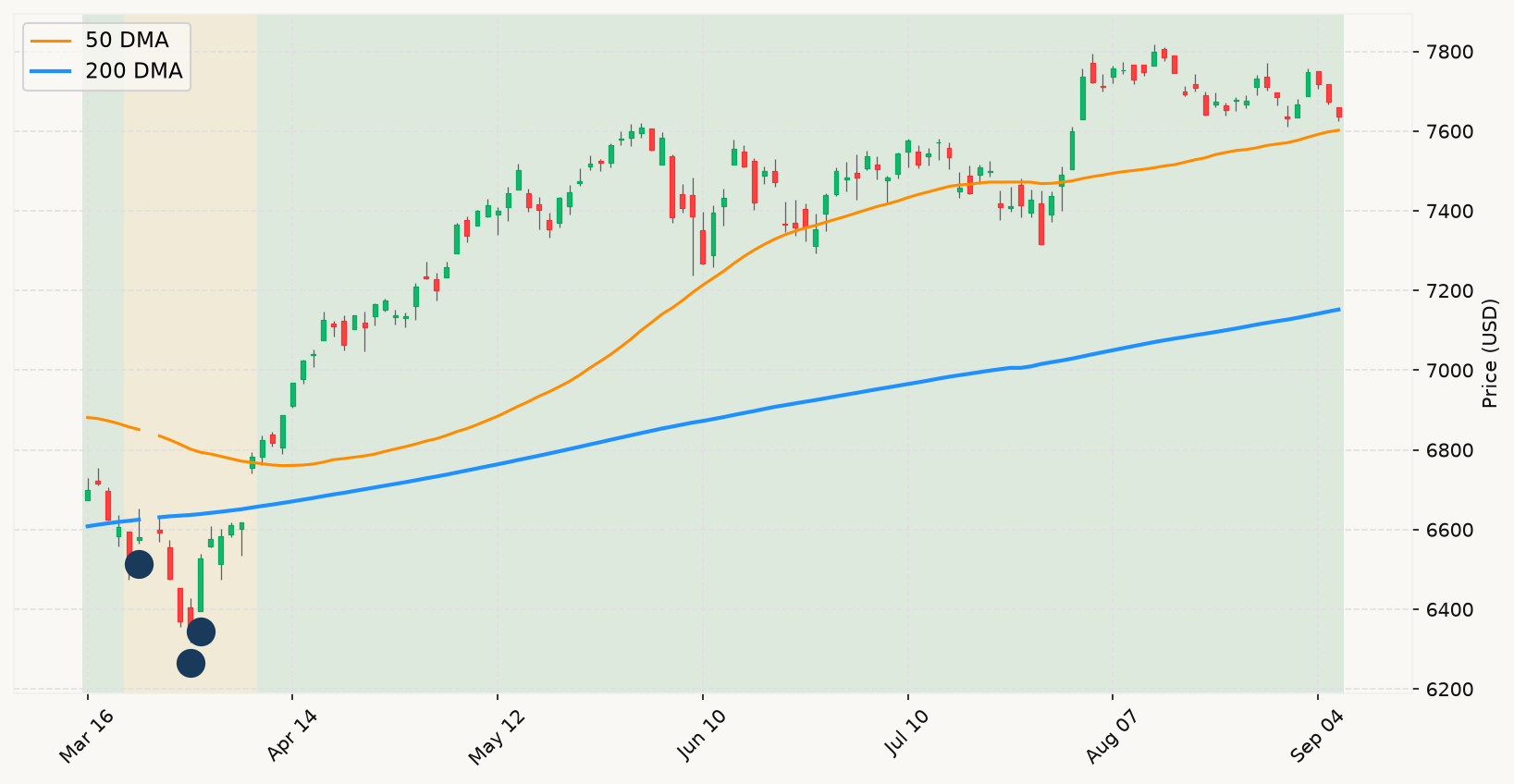
The two dominant narratives competing for attention right now are an oil shock driven by genuine geopolitical escalation and an AI earnings cycle that continues to post numbers that defy skepticism. Neither is a reason to alter a fully invested posture. The primary market trend remains intact — the S&P 500 is trading comfortably above its long-term trend line, and the drawdown from the August all-time high remains a modest single-digit figure. That is the only scoreboard that matters for the tactical posture. Geopolitical shocks — wars, supply disruptions, tanker attacks — are exactly the kind of scary-headline events that the market tends to price quickly and move past, provided they do not translate into a sustained deterioration in economic fundamentals. So far, they have not.
The energy story is worth watching carefully, but the right framing is: does $100+ Brent represent a genuine growth shock, or is it primarily an inflation tax that slows but does not invert the economic cycle? The current data argues for the latter. Real GDP growth nowcasts are solidly in expansionary territory, employment conditions show no signs of the broad deterioration that would signal a recessionary inflection, and the interest rate environment — while elevated — is positively sloped, with the 10-year above the 3-month. None of the recession confirmation signals are flashing. The ECB hike today and the approaching Fed decision are consistent with a central bank fighting inflation from a position of economic strength, not one scrambling to contain a recession. That is a meaningfully different environment than the one that preceded past bear markets.
Broadcom's $179 billion backlog is the clearest real-time signal that hyperscaler AI capex is not softening. The number matters not as a stock-picking tip — individual stock concentration is a risk the data consistently punishes — but as a leading indicator of the broader technology investment cycle. When the largest buyers of custom silicon are locking in multi-year commitments at this scale, the probability that AI-driven capital expenditure suddenly craters is low. That spending flows into data center construction, networking, power infrastructure, and software — a broad enough footprint to remain a meaningful tailwind for earnings across the index. It is a fundamentals read, not a momentum trade.
The positioning guidance here is unchanged: stay fully invested. The market is above its primary trend, the velocity of the recent pullback from the all-time high is well within normal correction territory, economic signals are not converging on recession, and employment conditions remain healthy. The noise — ECB hikes, tanker strikes, pre-Fed jitters — is exactly what markets process in real time. There is no diagnostic within the analytical framework that supports a defensive move at this juncture. The base rate overwhelmingly favors patience. The investors who tend to destroy value in environments like this are the ones who confuse a scary news cycle for a structural bear market signal. This is not that. MoreLess