The Ticker Analysis
Bull Trend Intact — Geopolitical Drama Is Noise
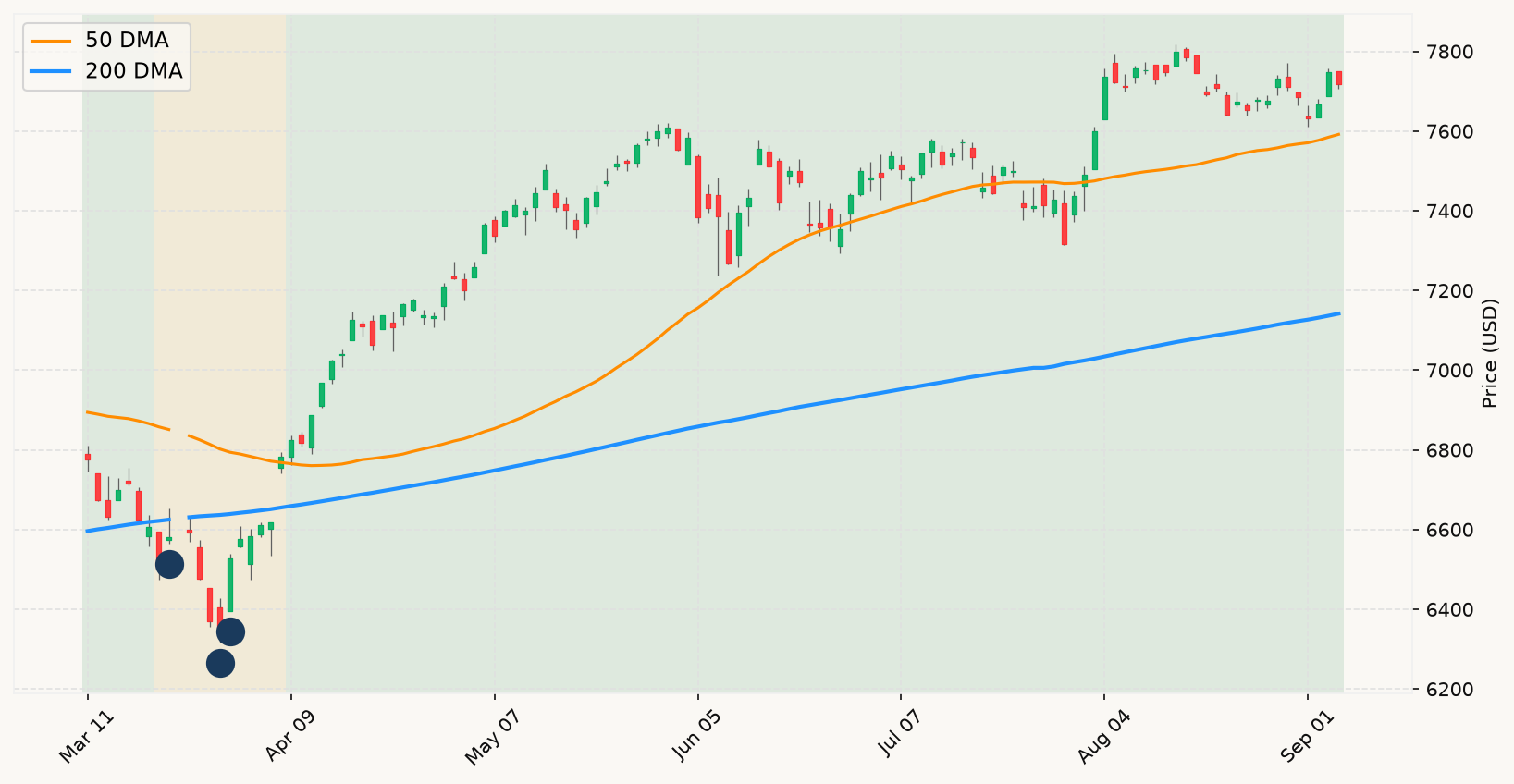
The weekend's escalation in the Strait of Hormuz — U.S. strikes on Iranian tankers, Iranian ballistic missiles targeting American warships, and a new restricted maritime zone — is generating the kind of dramatic, fear-laden headlines that historically test investor discipline. The analytical question is whether this development moves any structural needle, and the honest answer is that it does not — yet. The stock market is trading within a whisker of its all-time high, well above its primary market trend, and the broader economic signals remain firmly constructive. A geopolitical event, however alarming, is noise until the market begins pricing it as a sustained fundamental shift. It hasn't. Energy stocks are catching a bid, oil is higher, but the tape is not showing the grinding, broad-based deterioration that precedes genuine recessionary damage. The ruling here is noise — dramatic noise, but noise.
The blowout August payrolls print is the more structurally significant data point this week, and it deserves a clear-eyed read. A jobs number nearly three times expectations, combined with upward revisions that erased prior losses, tells you the labor market is not rolling over. Employment conditions remain robust — the slow, grinding deterioration in hiring that has historically preceded recessionary bears is simply not present. The market initially softened on the print because strong jobs data raises Fed tightening risk, and that's a legitimate near-term headwind for rate-sensitive sectors. But from a framework standpoint, strong employment conditions are net-positive signal. The only scenario in which that changes is if the Fed overtightens into a stall — and with the primary market trend intact and above its long-term average, the market is not currently sending that warning.
The Fed's next move has become the dominant tactical storyline. Market-implied odds of a September hike moved above 50% post-payrolls, and the CPI print next week is now the pivotal swing factor. The interest rate environment is the one area where investors need genuine vigilance. A hawkish surprise — hot CPI plus a hike — could generate short-term volatility. But here's the key context: the current interest rate environment, with the 10-year yield comfortably above the 3-month yield, is not flashing recession risk. The spread is positive and widening — the opposite of the inversion pattern that has historically preceded every modern recession. Monetary policy signals are tightening at the margin, but not in a configuration that historically coincides with the kind of economic contraction that produces prolonged bear markets.
OpenAI's GPT-6 Astra launch and Jensen Huang's AGI declaration are generating significant sentiment energy in the tech sector. From a framework standpoint, this is squarely in the noise category — AI releases are not leading economic indicators, and even a genuine technological breakthrough does not change the recession probability calculus in real time. What it does do is reinforce the capex supercycle narrative that has been a tailwind for large-cap tech and semiconductor names throughout this bull run. The posture here remains fully invested. The primary market trend is intact, employment conditions are healthy, the interest rate environment is not flashing systemic risk, and the market sits near all-time highs — a historically bullish setup, not a warning. The Iran conflict bears watching if oil sustains above $100 and starts feeding materially into inflation prints, but that's a condition to monitor, not a trigger to act on today. MoreLess