The Ticker
Bull Market
The economy's engine is purring like a muscle car on an open highway — sure, there's some smoke from the Middle East on the horizon and a hawk circling the Fed's flagpole, but the road ahead is wide open and the bulls are still very much in the driver's seat.
Top Story
Iran Mines Strait of Hormuz as US-Iran War Rocks Oil Markets & Rates
Iran's overnight missile and drone strikes on U.S. allies — and the mining of two oil tankers in the Strait of Hormuz — have jolted global markets to open September, pushing oil prices higher and reviving inflation fears just as the Federal Reserve weighs whether to raise interest rates at its meeting later this month.
The conflict's market shadow is falling across an otherwise impressive earnings season. Broadcom's revenue nearly doubled year over year and Snowflake delivered a stunning beat-and-raise quarter, with AI product adoption accelerating for the third straight period — evidence that corporate America's AI investment cycle remains firmly intact. The Magnificent Seven collectively posted roughly 120% earnings-per-share growth this season, a remarkable figure by any historical measure.
Fed Chair Kevin Warsh, making his debut at the Kansas City Fed's Jackson Hole symposium just days ago, made clear that "price stability is not self-executing" and that the Fed still has "work to do" on inflation. Markets have taken that as a hawkish signal, now pricing roughly a two-in-three chance of a quarter-point hike at the September FOMC meeting — a dramatic shift from just weeks ago when a hike seemed unlikely.
The macro crosscurrents are sharp: an economy tracking strong growth in the third quarter is colliding with energy-driven inflation risk from an escalating Middle East conflict, a softer-than-expected private payrolls print ahead of Friday's jobs report, and a new Fed chair who is clearly signaling that easy money is not coming back anytime soon. MoreLess
Six Month Chart (SPX)
⊞ Expand
The Ticker Analysis
Headlines Are Noise — The Trend Still Says Stay In
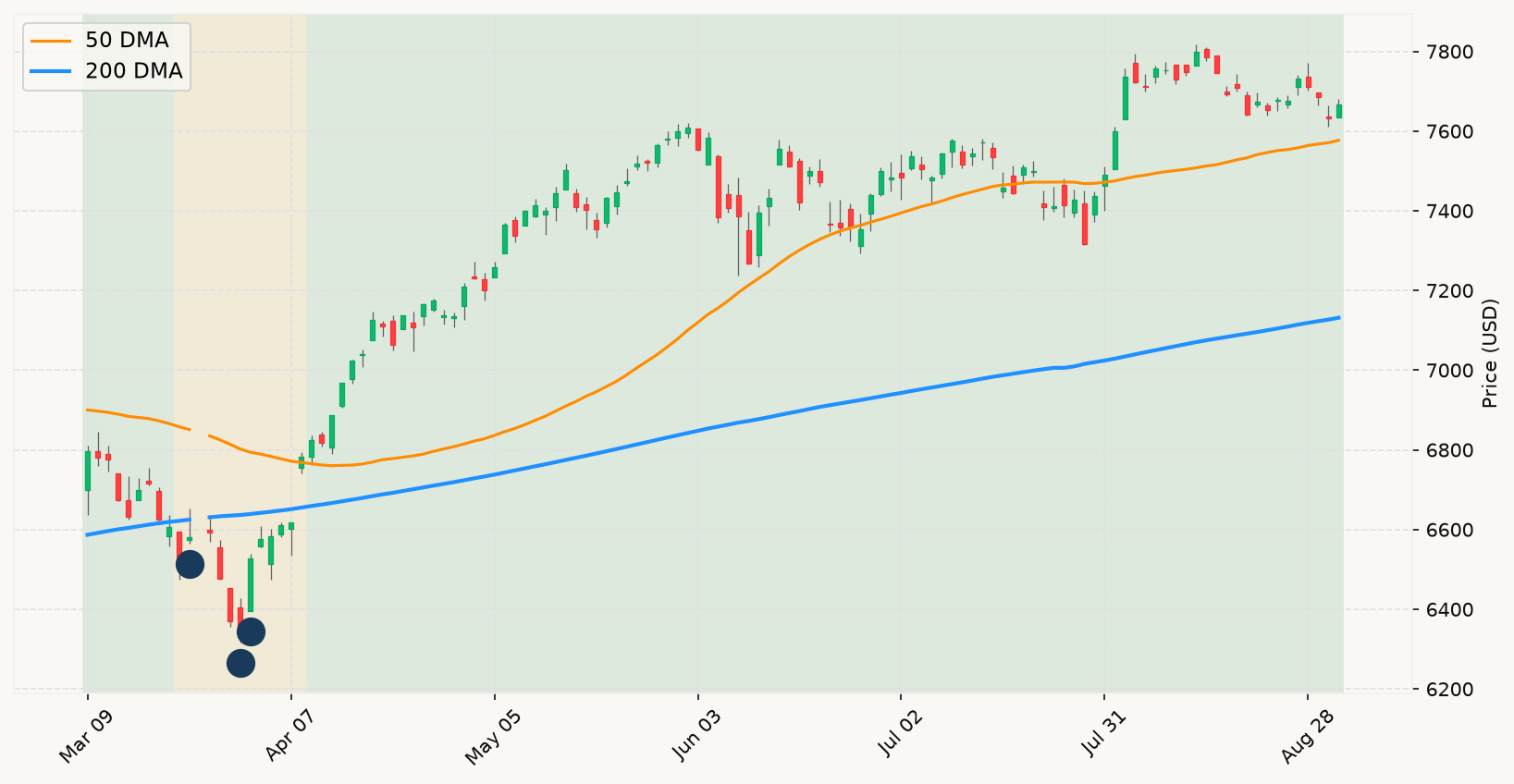
The dominant headline — Iranian missile strikes, mined tankers, and spiking oil prices — is exactly the kind of geopolitical drama that feels like it should change everything. It doesn't. From a pure signal-versus-noise standpoint, geopolitical shocks of this kind have a near-perfect historical track record of being noise. Markets reprice energy risk quickly, and the equity market itself — the best real-time aggregator of all known information — is sitting a mere 1.7% off its all-time high with the primary market trend pointing firmly upward. If this conflict represented a genuine systemic threat to corporate earnings and economic growth, the market's price action would be telling a very different story. It isn't. The sell signal is simply not present.
The interest rate environment deserves more attention than the geopolitics. New Fed Chair Warsh's hawkish Jackson Hole debut and the market's sharp repricing toward a September hike represent a genuine shift in monetary policy signals — but not a bearish one from a positioning standpoint. The interest rate environment remains constructive: the 10-year/3-month spread is comfortably positive, meaning monetary policy signals are not flashing the kind of inversion that has historically preceded every modern U.S. recession. A single rate hike into a strong economy, driven by energy-price inflation rather than demand destruction, is a very different animal from the tightening cycles that historically preceded recessionary bears. Rate hikes that accompany robust growth are not reliable bear market triggers — the data simply doesn't support that narrative.
The earnings picture reinforces the bull case. Broadcom's 86% revenue growth and Snowflake's accelerating AI monetization — a third straight quarter of acceleration — are not the earnings profiles of an economy rolling over. The Magnificent Seven delivering roughly 120% EPS growth this season is the kind of fundamental momentum that historically supports equity prices well above current levels. Yes, Broadcom's guidance disappointed relative to lofty expectations, and HPE flagged margin pressure. But mixed guidance from individual names is characteristic of a mid-cycle correction in expectations, not the broad-based earnings deterioration that historically accompanies recessionary bears. Employment conditions, meanwhile, remain supportive — the ADP miss is worth watching ahead of Friday's payrolls number, but a single soft private-payroll print does not move the needle on labor market signals.
The positioning conclusion is straightforward: the market is above its primary trend, employment conditions are healthy, the interest rate environment shows no recession-warning inversion, and growth nowcasts are strongly positive. Every cell of the diagnostic points to the same answer — stay fully invested. The drawdown from the all-time high is minimal and within the range of routine noise that occurs in virtually every calendar year. The geopolitical headlines are vivid and scary in exactly the way that market noise tends to be. History is unambiguous on this point: the investors who act on geopolitical fear rather than on the actual price trend and economic data consistently underperform those who hold. The burden of proof for defensive action rests entirely with the bears, and right now, that case simply has not been made. MoreLess