The Ticker Analysis
Bulls in Command — Stay the Course
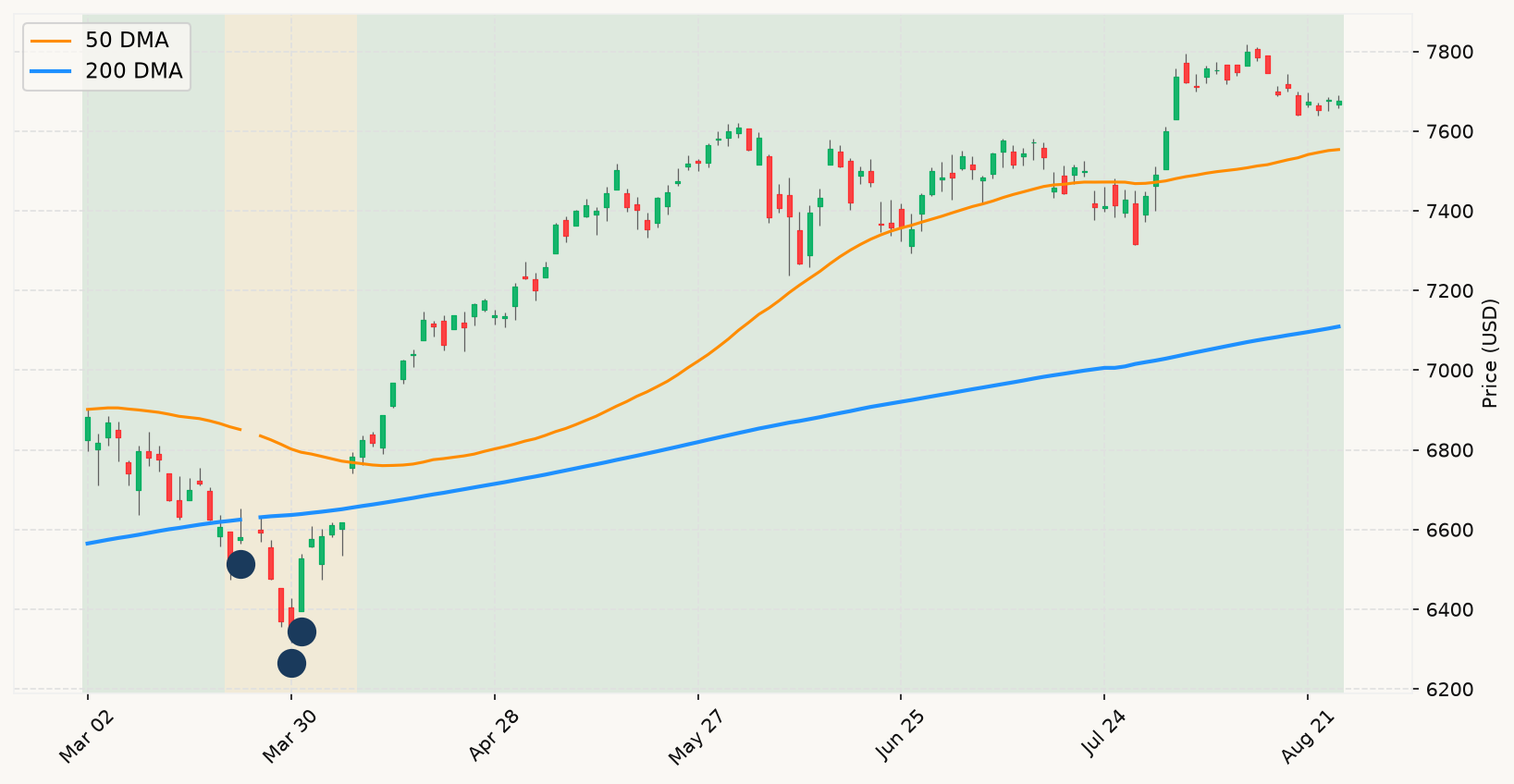
The Nvidia earnings print this morning is exactly the kind of event worth categorizing clearly: it is noise for the purpose of market regime assessment, and a confirming signal for the bull case as a real-world data point. The distinction matters. Nvidia's blockbuster results do not change the stock market's primary trend — that is already established by where prices sit relative to their long-run trend line, and the picture there is unambiguously bullish. What the print does do is validate the fundamental backdrop that has been powering this market: AI capital expenditure is real, it is accelerating, and the earnings are showing up. Q2 S&P 500 earnings growth on pace for 50% year over year is not a number you dismiss. That is the economy delivering, not just sentiment speculating. The bull trend above the primary market trend, combined with earnings of this magnitude, is precisely the environment where the historically correct posture is fully invested and patient — not searching for reasons to hedge.
The PCE inflation data deserves a candid read. Headline at 3.7% annually with core stuck at 3.3% for four consecutive months is not a "mission accomplished" moment for the Fed, and Chair Warsh's Jackson Hole remarks Friday will be parsed for any shift in tone. But here's what actually matters for the market regime: the interest rate environment is constructive, not threatening. The spread between long and short rates is positive and widening — that is the classic posture of a growth-supportive curve, not an inverted one flashing recession risk. Markets are pricing less than a coin flip on a September hike, with December as the most likely inflection point. Inflation that is sticky but not reaccelerating, combined with a positive monetary policy signal, is a regime where equities historically perform well. The discomfort in the PCE print is real; the threat it poses to the current bull market is not.
The U.S. sanctions escalation against Iran — targeting oil, aviation, shipping, and digital assets simultaneously — is the macro wildcard that demands monitoring, not panic. Energy market volatility is a legitimate tax on growth if it persists or worsens, particularly given the Strait of Hormuz exposure. But look at what the market itself is telling you: it is sitting less than 2% off an all-time high reached just two weeks ago, with the primary market trend firmly intact and the RSI in neutral territory — not in exhaustion, not in panic. If the Iran conflict were a genuine systemic threat to economic growth, you would expect to see that grinding, gradual deterioration in equity prices that is the actual early warning signal. You are not seeing it. The market, which aggregates the judgment of every well-resourced institutional player in real time, is not treating Iran as a recessionary catalyst. Until the price action says otherwise, neither should you.
The composite picture today maps cleanly to a single cell: market above the primary trend, employment conditions solid, monetary policy signals constructive, earnings accelerating at a generational pace. That is a bull market with a constructive fundamental backdrop, not a fragile one teetering on the edge. The drawdown from the all-time high set two weeks ago is minimal and within the range of routine noise. Historical data on markets at or near all-time highs is unambiguous — they have outperformed all other starting points over one-, three-, and five-year horizons. The correct posture is fully invested. The burden of proof for any defensive repositioning lies with a gradual deterioration in prices combined with converging deterioration in leading economic indicators — and neither condition is present today. Stay the course, let the earnings cycle do its work, and resist the urge to treat geopolitical noise as a portfolio signal. MoreLess