The Ticker Analysis
Bull Market Intact — Ignore the Drama
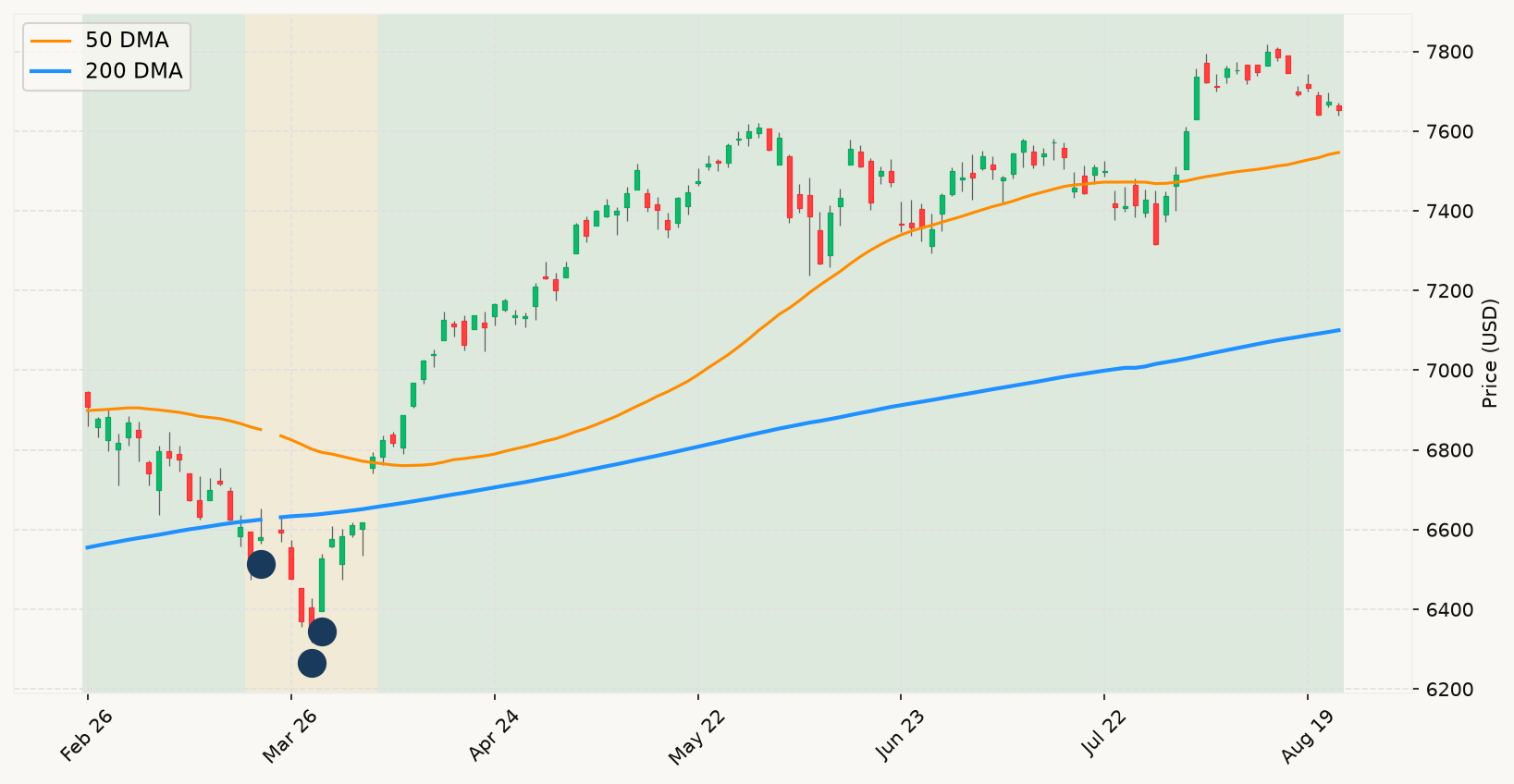
The market's primary trend is unambiguously bullish. The S&P 500 is trading comfortably above its long-term trend line — by a meaningful margin — and struck a fresh all-time high just twelve days ago. The historical record is clear on this point: new all-time highs are not a warning signal; they are associated with above-average forward returns over one, three, and five years. The current drawdown from that peak is less than 2%, which doesn't even register as a pullback worth analyzing. There is no velocity diagnostic to run, no recession confirmation to seek, no decision to make. The market is in bull market territory, and the correct posture is fully invested.
The week's twin headline events — Nvidia earnings and Warsh's Jackson Hole debut — are generating maximum narrative tension, but narratives are almost always noise within this analytical lens. By the time Nvidia's results and Warsh's words hit public channels, the market will have already begun pricing them. What matters is not the content of the speech or whether Nvidia beats by a dollar, but what the market actually does in response over the days and weeks that follow. Monday's chip-sector selloff and the broader tech weakness look like standard pre-event volatility, not the beginning of a sustained, grinding decline that would raise any structural concern. The semiconductor ETF giving back a couple percent ahead of the biggest earnings report in the sector is precisely the kind of short-term noise the framework explicitly brackets out.
The bond market story — specifically the tension between a Fed chair who appears comfortable with elevated long yields and a Treasury secretary actively trying to suppress them — is the most genuinely interesting macro development in the near-term. The 30-year yield reaching its highest level since 2007 before Treasury doubled its buyback firepower is a real dynamic. But elevated yields in isolation do not constitute a recession signal. The interest rate environment, measured by the spread between short- and long-term rates, remains positively sloped — which is the opposite of the inversion signal that has historically preceded recessions. Employment conditions show no signs of deterioration. Both growth nowcasts remain solidly positive. None of the leading indicators that would need to converge to flag a recessionary bear are flashing red. Escalating yields are worth monitoring as a potential drag on valuation multiples, but they are not a sell signal under any reading of the current evidence.
The geopolitical headlines — Iran sanctions, Canada tariffs, retaliatory threats — are precisely the kind of scary-sounding news that the market tends to price faster than investors can act on it. These stories may contribute to day-to-day volatility, and an energy price spike from Gulf disruption could nudge inflation higher at the margin, but geopolitical events have an extraordinarily poor track record of triggering prolonged bear markets absent an accompanying recession. The 80% base rate says the overwhelming majority of correction episodes resolve without becoming prolonged bears, and that base rate only kicks in after a 10%+ decline — a threshold the market hasn't come close to breaching. The current setup maps cleanly to one scenario: market above its primary trend, employment conditions healthy, monetary policy signals not inverted, growth positive. Stay fully invested and let the Nvidia drama and Jackson Hole theater play out. MoreLess