The Ticker
Bull Market
The sun's out, the crops are growing tall, and while there's a little thunderhead grumbling on the horizon about bonds and Walmart and Fed hawks, the bulls are still happily grazing in the pasture — this market's got more life in it than a county fair on a Saturday night.
Top Story
Treasury Doubles Bond Buybacks as 30-Year Yield Hits 19-Year High
The U.S. Treasury made a dramatic move this week, announcing it would at least double the size of its debt buyback operations targeting long-dated bonds — a surprise intervention aimed at cooling a bond market that has been in open revolt, with the 30-year yield briefly touching levels not seen since 2007.
The broader earnings picture remains constructive despite Walmart's wobble. Ross Stores delivered a blowout quarter, with comparable store sales surging well beyond estimates. Analysts tracking the full S&P 500 earnings season continue to project robust double-digit growth for the second half of 2026, with the majority of index sectors expected to deliver strong year-over-year gains — a fundamental backdrop that argues against reading too much into individual retailer stumbles.
The Fed added its own layer of suspense: minutes from the July 28–29 FOMC meeting revealed a surprisingly fractured committee, with three regional bank presidents dissenting in favor of an immediate rate hike and "many" other officials signaling that tightening would be necessary if inflation doesn't soon cool. Fed Chairman Kevin Warsh has also floated the idea of reducing the number of annual FOMC meetings from eight to six — a structural change that would itself reshape how markets interpret the Fed's communications cadence.
Beyond the Fed and the bond market, a confluence of macro forces is keeping investors on edge: geopolitical tensions in the Middle East have pushed oil prices higher, adding to inflation pressures; AI-driven corporate debt issuance is flooding fixed income markets and competing for buyers; and U.S. consumer confidence has softened as household budgets feel the cumulative weight of elevated rates and sticky prices. The Treasury's buyback announcement provided only a temporary reprieve — yields quickly snapped back, signaling that market skepticism about Washington's ability to engineer lower borrowing costs runs deep. MoreLess
Six Month Chart (SPX)
⊞ Expand
The Ticker Analysis
Bull Market Confirmed — The Bond Drama Is Noise
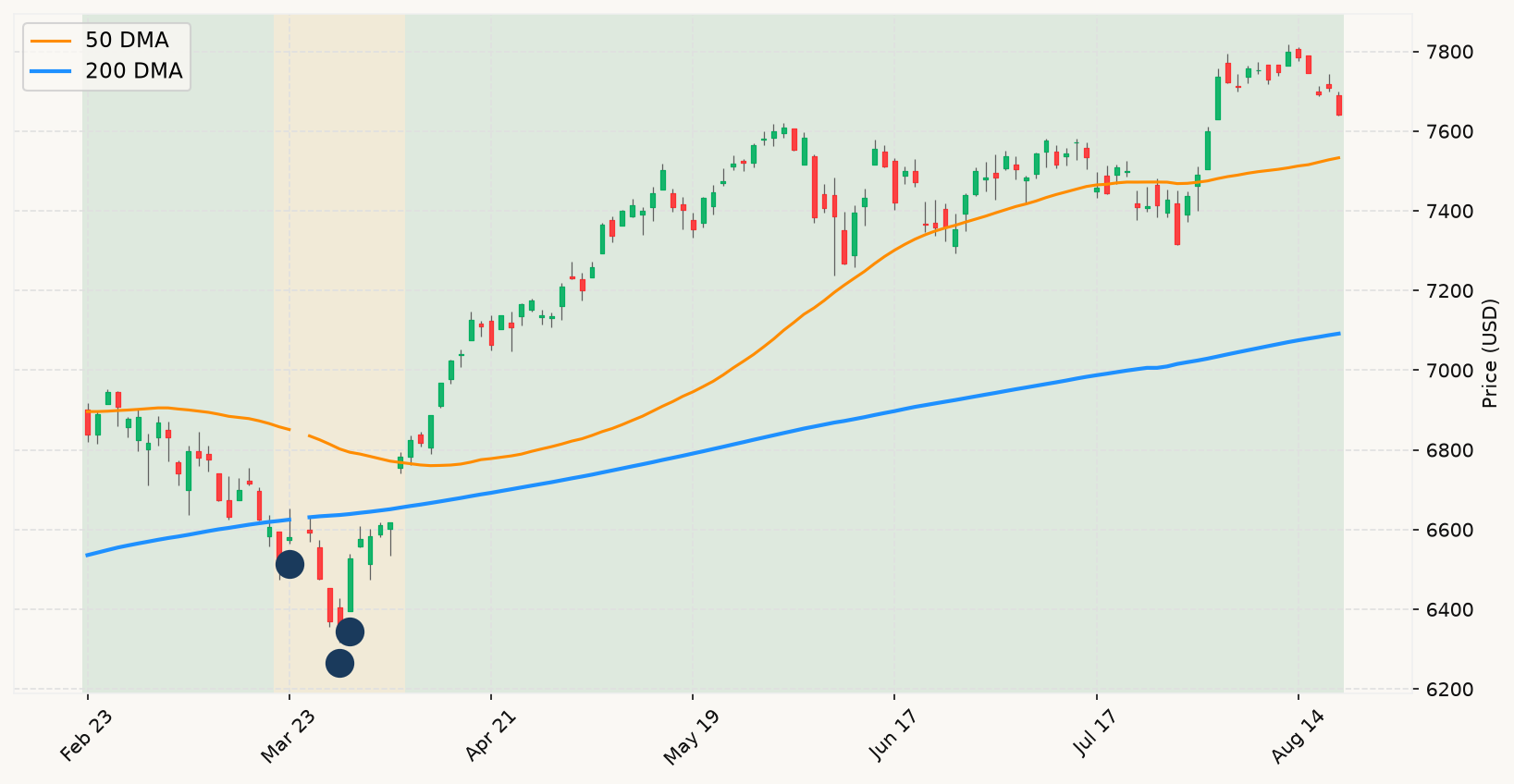
The bond market drama dominating headlines this week is exactly the kind of noisy, scary-sounding macro event that has historically had no reliable bearing on near-term equity market direction — and yet it is being treated by commentators as though it signals something definitive about where stocks are headed. Let's be clear about what the signals actually say. The S&P 500 is trading comfortably above its primary market trend. The market made a new all-time high just eight days ago. The current drawdown is a little over 2%. There is nothing in the price action that constitutes a warning. A bull market confirmed by price is a bull market until the price says otherwise — and price isn't saying otherwise.
The Treasury's bond buyback escalation and the hawkish FOMC minutes are both noise through this lens. By the time the minutes were public, the information was already priced into markets — the July meeting was weeks ago, and every sophisticated participant in the world had already handicapped the Fed's intentions. The fact that the 30-year yield snapped back after the Treasury's intervention — erasing most of Wednesday's rally overnight — tells you something important: the market itself is skeptical that the buybacks change the fundamental picture. That's the market talking, and what the market does with information is far more valuable than the information itself. Elevated long-end yields reflect a combination of AI-driven debt issuance, fiscal deficit concerns, and geopolitical oil pressure. These are real forces, but they are already embedded in asset prices. The question for equity investors isn't whether these forces are real — it's whether they are triggering a convergence of the specific signals that have historically preceded prolonged bear markets. They are not.
Walmart's disappointing comp-store guidance briefly rattled sentiment, but off-price retail — exemplified by Ross Stores blowing out estimates — is telling a more nuanced consumer story. The divergence between value-seeking discount shoppers and a softening mid-tier consumer is a classic late-cycle retail pattern, not a recession signal. More importantly, the employment picture and the broader economic nowcasts remain in positive territory. The leading indicators that actually matter — labor market signals, the interest rate environment with a positively-sloped short-to-long spread, and growth tracking — are not converging in the direction that has historically preceded the kind of prolonged equity decline worth defending against. Three out of four FOMC dissenters preferring a quarter-point hike actually tells you something mildly reassuring: this is not a committee watching an economy fall apart.
The positioning conclusion is straightforward: stay fully invested. The S&P 500 above its primary market trend, a recent all-time high, a 2% drawdown, a positively-sloped interest rate environment, and no recession confirmation is the textbook "enjoy the ride" scenario. The noise around bond buybacks, Fed hawks, and Walmart's cautious guidance is designed to feel consequential — but it moves none of the needles that matter. The base rate says 80% of declines of this scale resolve without becoming something worse. Nothing in this week's headlines changes that base rate. Investors who let bond market volatility drive them to defensive positioning are taking exit risk seriously and ignoring what the price of equities is actually saying. The market is still in bull mode. Trust it. MoreLess