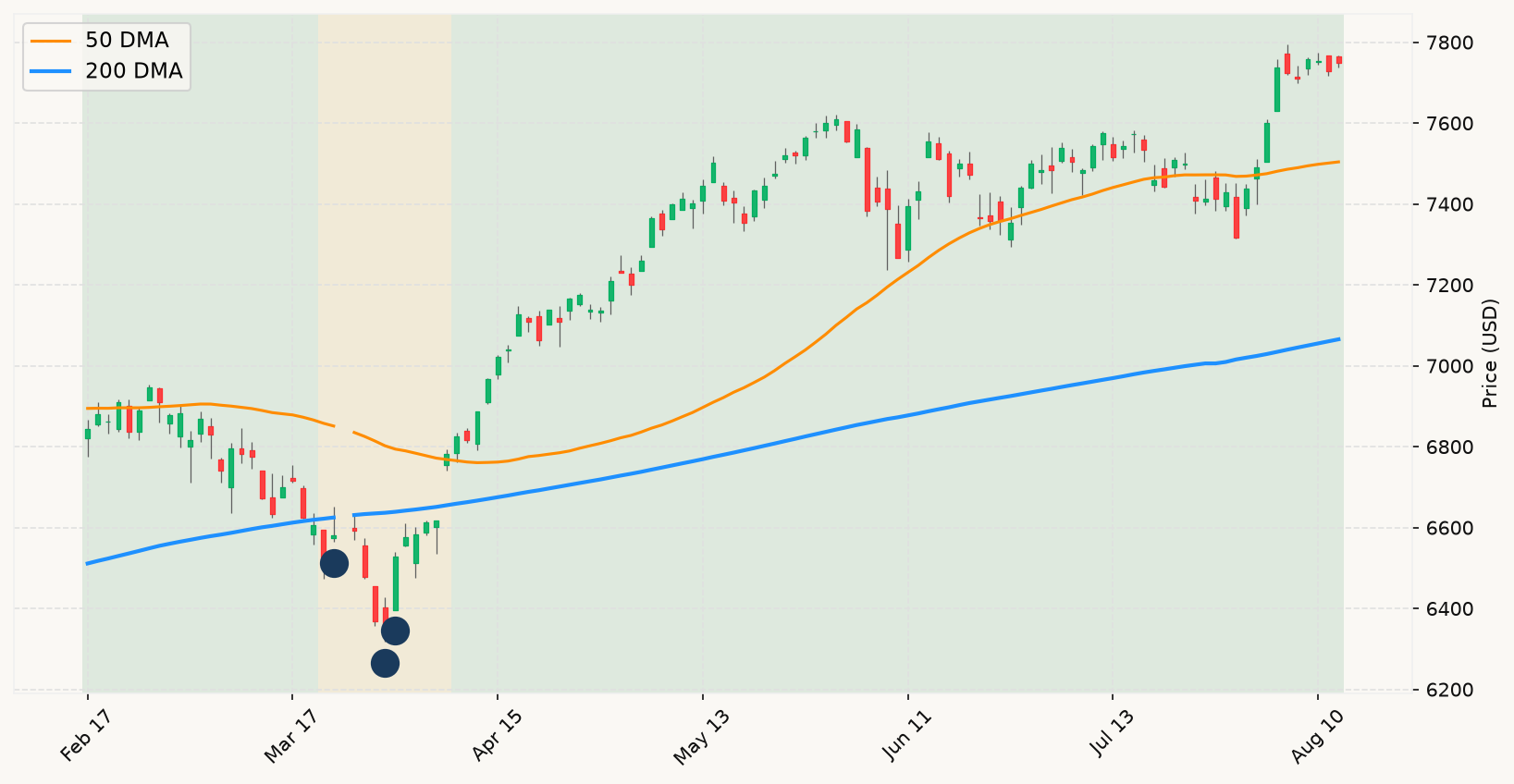
The Ticker Analysis
Bull Trend Intact — Stay the Course
The July CPI print is the headline, but from a market-signal standpoint, it's noise with a bullish tilt. An in-line inflation reading doesn't move any needle in the framework — the data was fully anticipated, the market's reaction was muted rather than panicked, and the Fed's posture was already well understood. What matters is the broader context that print dropped into: the primary market trend is unambiguously bullish, the index is within a whisker of its all-time high, and the interest rate environment has shifted from genuinely threatening to merely elevated. A Fed that is on hold and possibly pushing any hike to October is not a headwind that competes with a market running at full strength. The correct read here is that the inflation story, for now, is a non-event dressed up as a catalyst.
Cisco's post-earnings stumble is worth noting as a sentiment data point, but it's not a market signal. Beat-and-raise quarters that sell off after hours are a classic feature of fully-priced bull markets — the bar rises faster than the results can clear it. Cisco is up roughly 60% year-to-date and was priced for perfection; the market simply shrugged at "good enough." This kind of action doesn't indicate deterioration in the primary trend. If anything, it's consistent with the texture of a mature, high-momentum bull run where leadership stocks face elevated expectations. Broad market breadth remains extraordinary — 183 consecutive sessions without a significant downside-volume day is not the fingerprint of a market in distress. That is the fingerprint of persistent, underlying buying demand.
The IEA's oil demand downgrade deserves a slightly more careful look, not because it's a direct market signal, but because energy prices remain the primary mechanism keeping headline inflation above the Fed's comfort zone. The Strait of Hormuz disruption is a genuine geopolitical supply shock, and if it deepens, it could re-accelerate energy CPI and complicate the Fed's hold posture. That's a tail risk worth monitoring — but it is still a tail risk, not a signal. The market is already aware of this dynamic and has priced it. If the shock were to genuinely threaten growth in a meaningful way, the primary trend would begin to reflect it before any economic data confirmed it. Right now, it's not. The trend says stay invested.
The overall picture is about as clean as it gets. The market is sitting just below its all-time high, the primary trend is firmly bullish, employment conditions remain healthy, monetary policy signals — while not accommodative — are not tightening further in the near term, and the breadth data is historically strong. There are no converging signals pointing toward a recession or sustained decline. The correct posture is fully invested, and the elevated RSI is not a warning — it reflects momentum in a healthy uptrend, not exhaustion. Investors who have been tempted to trim into strength based on valuation anxiety or Fed fear have been paying for that caution all year. The data says the same thing it has been saying: stay put and let the bull run. MoreLess