The Ticker Analysis
Bull Trend Rules — Stay In, Tune Out the Noise
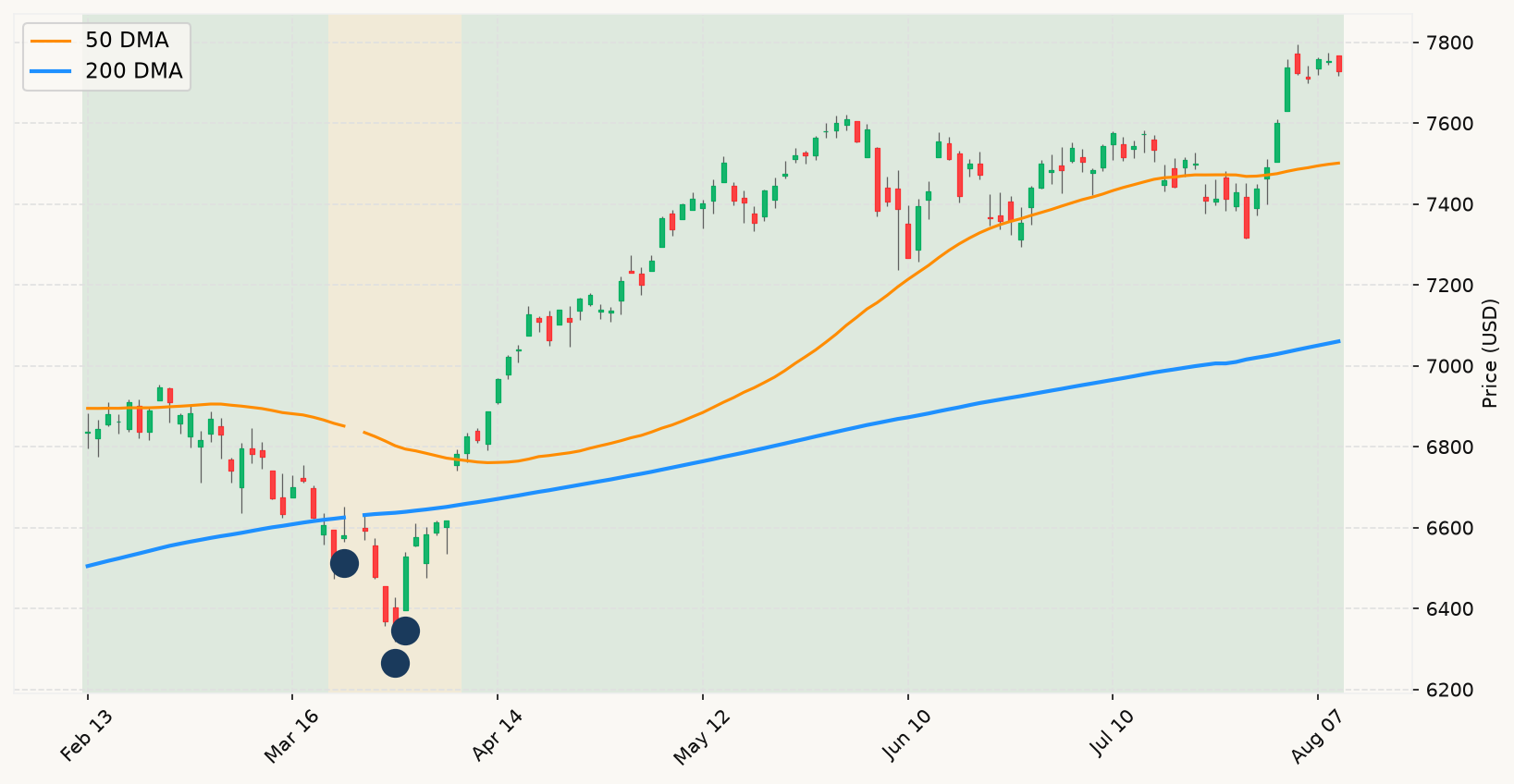
Today's July CPI print — arriving right at consensus — is, by any rigorous read, noise for the long-term investor. The stock market trend remains firmly bullish: prices are well above the primary trend line, the index sits just a fraction below its all-time high set five days ago, and every structural signal points to a healthy bull regime. A single monthly inflation reading that lands in line with expectations does not move any needle that matters for the framework. What the Fed does in September is similarly irrelevant to the question of whether you should be in or out of equities. Rate decisions are priced in continuously by the market, not revealed as surprises in a 2:00 p.m. announcement. The market is already telling you what it thinks about Fed policy — and what it's saying, loudly, is that the bull trend is intact.
The July jobs miss — 23,000 payrolls lost against expectations of 83,000 or more — deserves more serious attention, but the analytical verdict is still: noise, not signal. Yes, private payrolls are soft, prior months were revised down sharply, and the labor force participation rate hit a multi-year low. That is a legitimate deterioration worth watching. But the framework requires convergence — labor market softness meeting a grinding, gradual market decline. What we have instead is a market sitting within a half-percent of an all-time high. A single negative payroll print into a bull-trend market is precisely the kind of scary headline that triggers the wrong response. The labor market data warrants a raised eyebrow, not defensive repositioning. The moment to act is if a slow, grinding multi-month market decline begins to confirm what the employment data is hinting at — and we are nowhere near that today.
The Iran conflict and the Strait of Hormuz closure represent a genuine, multi-month macro disruption — elevated oil prices, sticky headline inflation, supply chain friction — and it is the most credible structural risk in today's environment. But here is the key insight the framework demands: if this risk were systematically threatening to tip the economy into contraction, the stock market would be pricing it. A gradual, grinding equity decline is how the market signals systemic danger. Instead, we are within shouting distance of all-time highs. The market, in aggregate, is telling you that the most sophisticated participants in the world — who have every resource and incentive to price geopolitical risk accurately — have looked at the Hormuz situation and concluded it does not warrant a recessionary repricing of equities. You do not have better information than the collective signal embedded in the price. Trust the tape.
The AI and semiconductor earnings wave is producing some of the most extraordinary revenue and profit numbers in the sector's history — Broadcom guiding AI revenue up over 200%, TSMC posting record quarters and raising its full-year outlook above 40% growth. For the framework, this is confirmation data, not a reason to act differently. Strong earnings during a bull trend are perfectly consistent with continued bull trend behavior. What they are not is a buy signal on their own — and chasing individual semiconductor names based on earnings momentum is exactly the kind of concentrated bet the historical record argues against. The superior play, as always in a confirmed bull regime, is to stay fully invested in broad market exposure and let the index — which already owns all of these AI winners and every future winner not yet identified — capture the upside. The current posture is unambiguous: stay the course, remain fully invested, and do not let geopolitical noise or a single soft jobs print talk you into a defensive move that the market's primary signal does not support. MoreLess