The Ticker Analysis
Bulls Still in Charge — Ignore the Noise
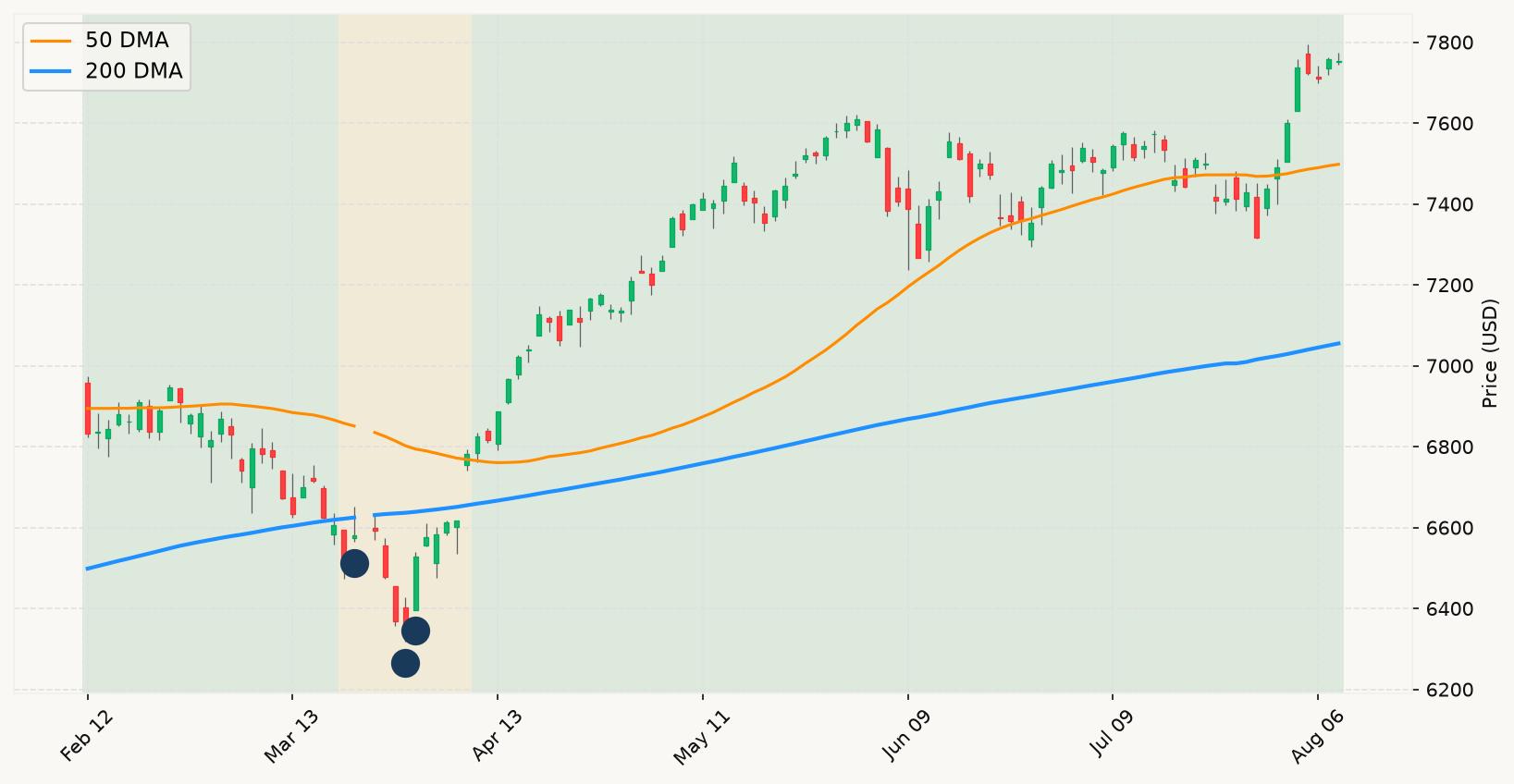
The primary market trend is unambiguously bullish — equities are sitting a hair's breadth from all-time highs, and the historical record is clear that new highs are a green light, not a warning sign. The noise machine is working overtime today: oil's 5% surge, Iran's intransigence on Hormuz, and a soft July jobs report are all being packaged as potential threats to the rally. Run each one through the diagnostic and the signal is the same: none of these move the needle on what actually matters. The market is above its long-run trend by a wide margin, there is no sustained gradual decline in progress, and none of the four leading recession indicators are in convergence. The correct posture is to stay fully invested, and no headline today changes that.
The jobs miss deserves a sober look rather than reflexive alarm. July payrolls declined 23,000 with significant negative revisions, which sounds concerning until you remember the base rates: isolated soft payroll prints, even negative ones, have appeared in dozens of non-recessionary months over the past 45 years. What matters is whether this is the beginning of a broadening deterioration confirmed by other leading indicators — and right now it is not. Wage growth slowing to 3.2% actually reduces inflationary pressure. Employment conditions remain fundamentally intact: the unemployment rate is near cycle lows, labor force dynamics are in flux from government job losses rather than private-sector retrenchment, and there is no Sahm-Rule-style trigger firing. One weak month does not a bear market make. The framework demands patience and a sustained pattern, not a single data point.
The Hormuz-driven oil spike and the looming CPI print are the kind of macro drama that feels urgent in the moment and proves irrelevant to long-term equity outcomes remarkably often. Oil at $87-$90 Brent with a partially constrained strait is already embedded in market prices — this is not new information. What matters for the bull case is whether oil's inflationary impulse is sufficient to push real economic activity into contraction, and nothing in the current data suggests that threshold is being crossed. The interest rate environment is worth monitoring: the Fed holding at 3.50–3.75% while three members dissent in favor of hikes creates some policy uncertainty, and a hot CPI print Wednesday could amplify that. But monetary policy uncertainty is not a sell signal — it is a reason to watch the primary trend and the leading indicators closely. Right now, both are constructive.
The Anthropic IPO story is the week's most seductive narrative distraction. A $965 billion valuation for a private AI company, a confidential S-1, secondary-market trading implying even higher prices — this is precisely the kind of headline that generates excitement and poor decision-making. The historical IPO record is unambiguous: across the most prominent listings of the past 15 years, the median first-year return has been deeply negative, with peak-to-trough drawdowns that would shock most retail investors. AI enthusiasm is real and the business may be exceptional, but the framework's message on individual stock picking — and especially on headline IPOs — is clear: the concentration risk is enormous, the unknowns (starting with gross margin, which has never been disclosed) are material, and the broad market index solves the selection problem automatically. The right move is to let Anthropic's gross margin become public information, let the stock season in public markets, and let the index own whatever share of it the market ultimately assigns. The AI infrastructure rally in CoreWeave, Applied Materials, and the broader semiconductor complex is the better read today — and those earnings, not the IPO hype, will tell you whether the AI capital expenditure cycle is sustaining. MoreLess