The Ticker
Bull Market
The bulls are still strutting down Main Street with a spring in their step — sure, the jobs crowd showed up a little thin this morning, but the band is still playing, the punch bowl is full, and the market's dancing like it just got the best table in the house.
Top Story
July Payrolls Shock: Economy Sheds 23,000 Jobs in Surprise Miss
The U.S. economy blindsided Wall Street on Friday morning, reporting a loss of 23,000 nonfarm payroll jobs in July — a stark reversal from expectations of a gain of more than 80,000. The headline miss instantly reset the conversation about where the labor market is heading and what that means for the Federal Reserve's next move.
The weak jobs number arrives at a moment when corporate earnings have been a genuine bright spot. Airbnb topped estimates with revenue up more than 16% and cited AI-driven momentum and a surge in first-time bookers. Cloudflare soared after raising its full-year guidance well above Wall Street forecasts, crediting the explosive demand for AI-agent infrastructure. With a substantial portion of S&P 500 companies having already reported, the earnings season has broadly been a constructive narrative — revenues running ahead of analyst estimates — even as the macro picture grows cloudier.
On the Fed front, the payroll shock is likely to renew debate about the timing and pace of rate cuts. Markets were already pricing in the possibility of easing later in 2026, and a second consecutive month of disappointing job creation — June came in at just 57,000 — adds pressure on policymakers to acknowledge slowing labor market momentum. The next FOMC meeting is scheduled for September 16, and today's data will almost certainly shape the tone of deliberations heading into that window.
Beyond the jobs number and earnings, the Strait of Hormuz remains the wild card on the macro board. Iran's renewed attacks in the critical waterway have pushed oil higher even as a proposed Iran-Oman deal to partially reopen the strait shows signs of stalling. The interplay between energy prices, inflation expectations, and a softening labor market creates a genuinely complex backdrop for the Fed — and for investors trying to read the road ahead. MoreLess
Six Month Chart (SPX)
⊞ Expand
The Ticker Analysis
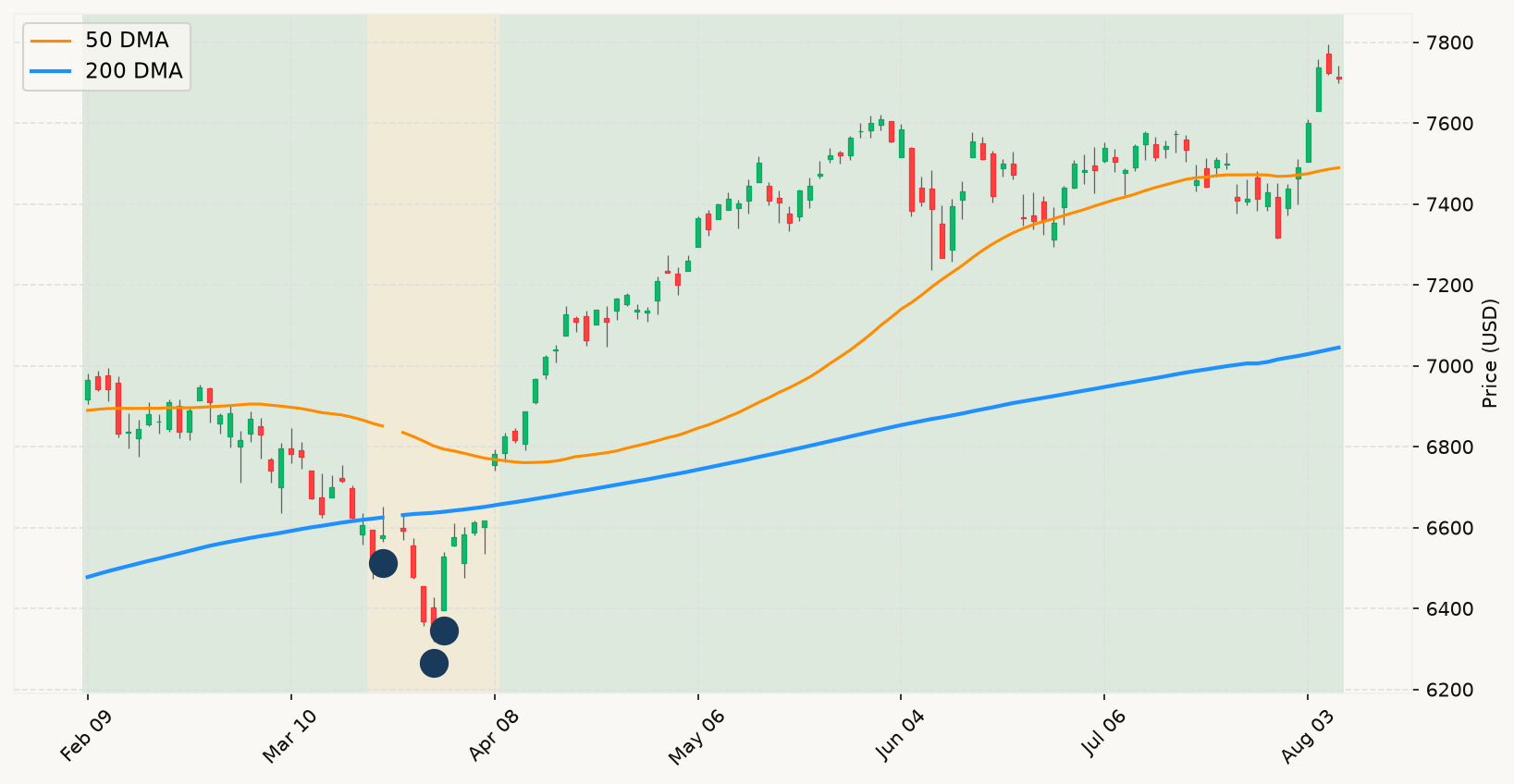
Bull Trend Intact — One Bad Jobs Print Is Just Noise
The July payrolls miss is dramatic in isolation, but context matters enormously before drawing any conclusions. Monthly jobs data is notoriously noisy — prone to large revisions, seasonal distortions, and survey-week quirks that bear no relationship to the underlying trend. Two consecutive soft months do not establish a recessionary pattern; what matters is whether this feeds a broader, sustained deterioration across multiple labor market indicators simultaneously. Right now, the unemployment rate actually ticked down, and there is no convergence yet across the constellation of leading indicators that would constitute a genuine recession signal. One alarming headline is not a diagnostic. It is a data point.
The stock market itself — which remains the single most important real-time signal — continues to trade near all-time highs. The primary market trend is decisively bullish, with price sitting well above long-run trend levels. When the market is doing what it is doing right now, the analytical posture is clear: the bull trend is intact, the burden of proof falls entirely on the bear case, and that case has not been made. A drawdown of less than half a percent from the all-time high is not a warning signal — historically, markets hitting new highs have gone on to deliver above-average forward returns. The data argues strongly for staying fully invested.
The Strait of Hormuz situation and the Iran-Oman deal uncertainty are generating real noise, and oil price volatility is complicating the inflation picture. But from a framework standpoint, this is precisely the kind of geopolitical headline that markets are already processing in real time. The equity market's continued resilience near all-time highs — despite months of elevated Hormuz tension — is itself a signal. If the geopolitical risk were genuinely threatening to crater corporate earnings or tip the economy into contraction, the primary market trend would be reflecting that. It is not. The market is the aggregator; trust the price action, not the narrative.
The earnings picture reinforces the constructive posture. Cloudflare's AI-driven guidance raise and Airbnb's broad beat underscore that corporate fundamentals are holding up. The interest rate environment, with the spread between short and long rates back in positive territory, is no longer sending the inversion warning that characterized the pre-recessionary playbook of the past. Employment conditions are softening at the margins but have not triggered the kind of sharp, broad-based deterioration that historically precedes a prolonged downturn. The overall read: no recession signal is flashing, the primary trend is bullish, and the correct positioning remains fully invested. Watch the jobs data closely over the next two months — if the deterioration deepens and broadens — but do not act on one month's print. MoreLess