The Ticker
Bull Market
The sun is shining, the birds are singing, and Wall Street is doing its best impression of a backyard barbecue where everyone showed up, the burgers are perfect, and somebody just announced the neighbors stopped feuding — it's full-on party mode out there.
Top Story
Iran Deal Hopes Sink Oil, Fuel Wall Street's Record-Breaking Rally
Wall Street is waking up to a world that looks a little less dangerous this morning. Diplomatic signals from Washington and Tehran are pointing toward a potential agreement to reopen the Strait of Hormuz — one of the world's most critical shipping chokepoints — and markets are celebrating with record highs, tumbling oil prices, and a renewed appetite for risk assets across the board.
The earnings season backdrop is providing powerful fuel beneath the rally. Shopify's stunning 34% revenue growth and a 26% premarket surge signal that digital commerce demand remains red-hot, while Disney's parks-and-streaming combination delivered better-than-expected profits. The scorecard this season has been broadly strong: companies from Caterpillar to Palantir to McDonald's have beaten estimates, reinforcing the view that corporate America is holding up well against a backdrop of elevated rates and geopolitical uncertainty. The one blemish — SpaceX and AMD selling off despite beats — reflects not fundamental weakness but investor nervousness about the relentless pace of AI capital spending and whether those investments will pay off at the scale the market has priced in.
On the Fed front, policy remains in a holding pattern. The Fed held rates steady at its most recent meeting, and with inflation continuing to moderate and the labor market showing signs of cooling without cracking, the consensus is drifting toward the possibility of rate cuts later in 2026. Markets appear content with that trajectory for now — the combination of steady policy, falling energy prices, and strong earnings is about as friendly an environment as bulls could ask for.
The macro read beneath all of this is notably constructive. Falling oil prices — driven by Hormuz deal optimism — act as a direct tax cut for consumers and businesses alike, giving an additional lift to growth expectations. The labor market remains healthy, consumer spending has been resilient, and AI-driven capital investment continues to pour into the economy at a historic pace. The biggest near-term wildcard is whether the Iran diplomacy holds: a breakdown in talks could reverse the oil-price tailwind quickly and inject fresh uncertainty into a market that has run hard and fast. MoreLess
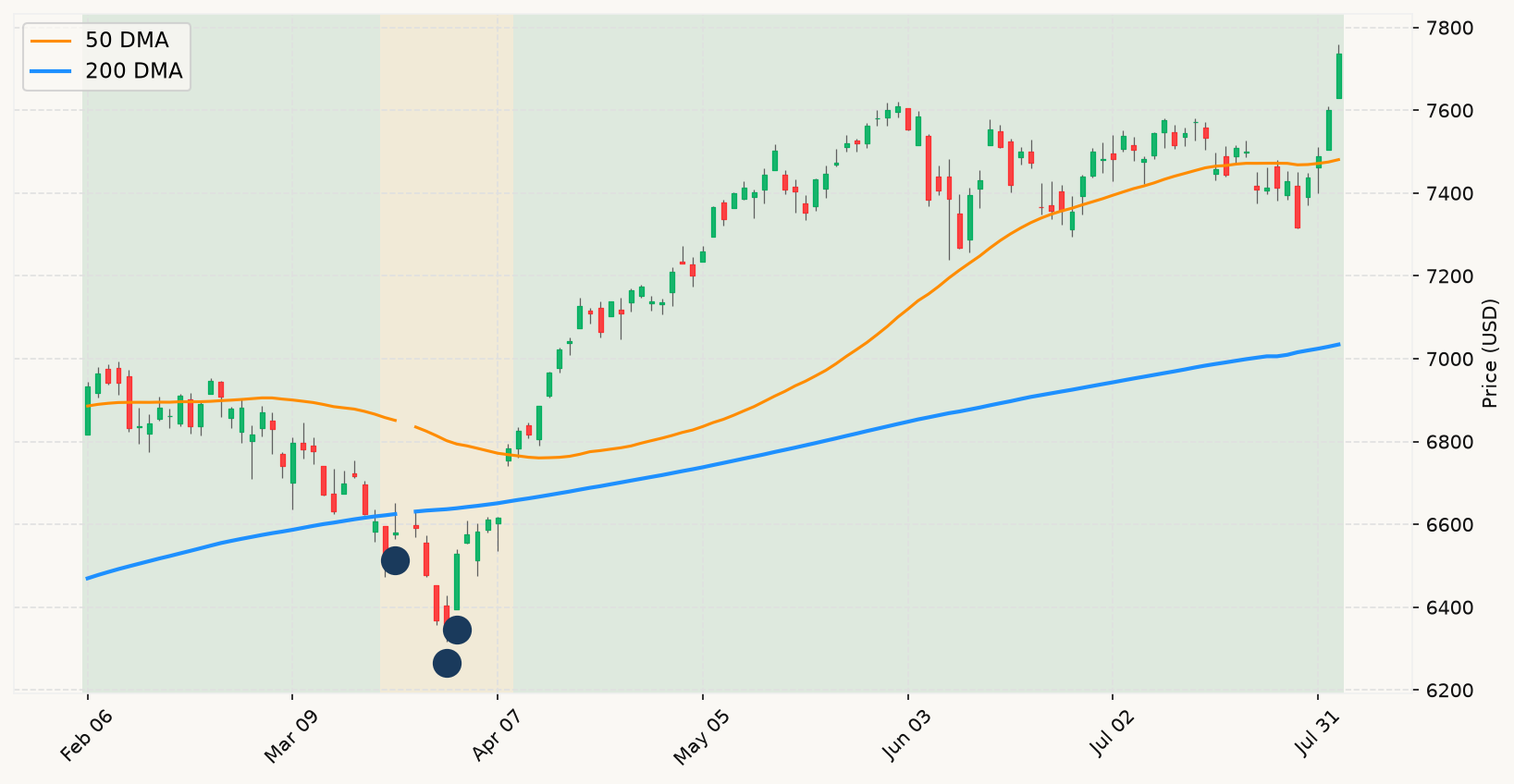
Six Month Chart (SPX)
⊞ Expand
The Ticker Analysis
All Signals Green — Stay the Course
The primary market trend is unambiguously bullish right now — the S&P 500 closed at a fresh all-time high on Tuesday, and history is clear that new highs are not a warning sign. They are a green light. The data across more than three decades of market history shows that the index starting from a new all-time high has outperformed all other starting points over one, three, and five-year horizons. Investors who treat record highs as a reason for caution are fighting the tape with one hand and the historical record with the other. The correct posture here is fully invested, and the burden of proof falls entirely on the bear case to produce evidence — none of which is present today.
The two news themes most likely to tempt investors into making a mistake are the SpaceX/AMD after-hours selloff and the ongoing Iran-Hormuz negotiations. Both are noise within this analytical lens. The selloffs in SpaceX and AMD — despite beats on revenue and earnings — are exactly the kind of headline-driven single-session volatility that the historical record categorizes as irrelevant to the primary trend. Both stocks remain well above their respective long-term trend lines, and the broader market shrugged off the individual-name pressure entirely, with index futures pointing higher. As for the Hormuz situation, the market has already been pricing in improving geopolitical conditions over the past week — the rally into record highs reflects that. A deal, if it comes, would likely provide an additional tailwind; a breakdown would be a headwind. But neither outcome changes the underlying economic or trend picture enough to alter positioning.
What deserves attention is the Shopify and Disney earnings, not as individual stock picks but as data points about the health of consumer spending and the digital economy. Shopify's 34% revenue growth with accelerating guidance is not the profile of a company operating in a weakening demand environment. Disney's parks beat tells a similar story about discretionary consumer spending holding up. Taken together with Caterpillar, Palantir, McDonald's, and the broader earnings beat rate this season, the economic picture being painted by corporate results is one of durable expansion — not the early-stage deterioration that precedes the kind of prolonged recessionary bear market that would actually warrant defensive action. Employment conditions remain solid, monetary policy signals are tilting toward eventual easing rather than tightening, and the stock market trend itself is pointing straight up.
The only analytical question worth asking in this environment is whether any of the leading recession indicators are beginning to converge toward a warning signal — and the answer right now is no. The interest rate environment has shifted from inverted to positively sloped, which historically has been associated with expansion rather than contraction. Employment conditions show no Sahm-Rule-level deterioration. Growth nowcasts are running hot. And the market itself — the most sophisticated real-time aggregator of all available information — is printing new all-time highs. When every signal in the diagnostic framework is pointing the same direction, the job is simple: stay fully invested, tune out the daily noise, and let compounding do its work. MoreLess