The Ticker Analysis
Stay the Course — The Noise Is Deafening, the Signal Is Not
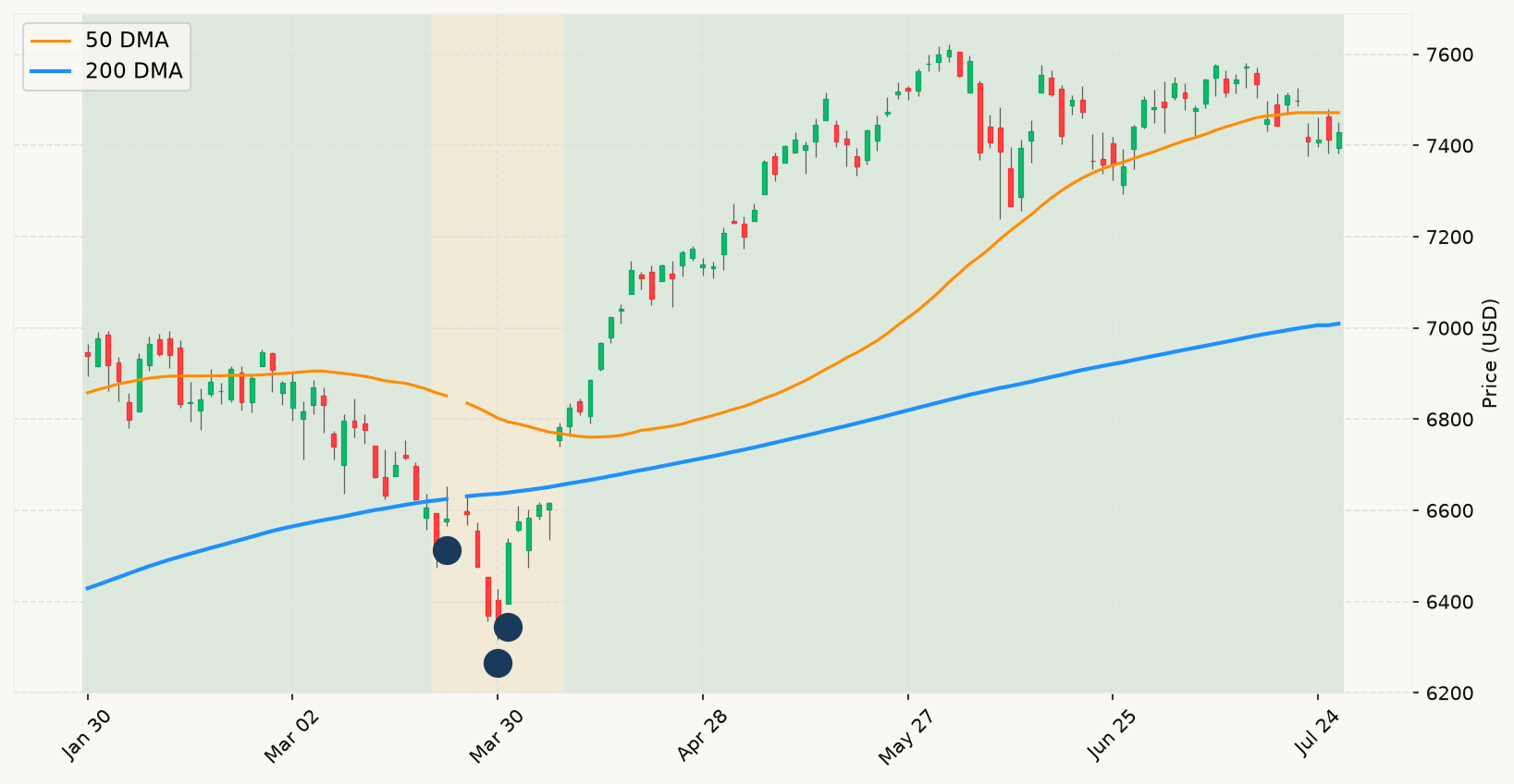
The chip selloff is the loudest noise in the room right now, but the primary market trend keeps it in its proper place: noise. The S&P 500 remains comfortably above its long-run stock market trend, which means the bull market is confirmed and the burden of proof falls entirely on the bear case — not the other way around. The semiconductor index bleeding 25%-plus from its June peak is ugly in isolation, but sector-specific corrections, even violent ones, are a completely normal feature of equity markets. The broader index shaking off the damage while chips get hammered is actually a sign of internal resilience, not hidden weakness. When the framework asks "does this move any needle?", the answer here is no: there is no sustained breach of the primary trend, no recession confirmation, and no convergence of deteriorating leading economic indicators. The ruling is noise, and it should be treated accordingly.
The oil spike driven by renewed U.S.-Iran hostilities is a more complex input, but it too resolves to noise under a rigorous read. Geopolitical events — however alarming in the moment — have an extremely poor track record as predictors of sustained equity market declines. The market processes geopolitical risk in real time; if this escalation were genuinely threatening to the broader economic expansion, the primary trend would begin reflecting it. So far it hasn't. What the oil move does accomplish is making the Fed's job harder at the margin, keeping inflation fears alive and tilting the interest rate environment slightly more hawkish. That's worth watching, but it is not a signal to act on. The monetary policy signals, per the locally computed data, remain bullish — and a positive 10-year/3-month spread confirms the yield curve is not sending a recession warning.
The FOMC decision and Big Tech earnings tonight are textbook examples of what the framework explicitly treats as irrelevant to positioning: news events. By the time Warsh speaks and Microsoft and Meta post their numbers, those results will be priced almost immediately. The AI capex debate — whether Microsoft's $255-260 billion fiscal 2027 spend and Meta's $125-145 billion 2026 program will generate returns — is a genuine long-term question, but it is not a market-timing signal. What would matter is if sustained disappointment in these names began dragging the broader index below its long-run stock market trend in a slow, grinding fashion while economic indicators simultaneously softened. We are nowhere near that scenario. Employment conditions remain healthy, growth nowcasts are positive on both models, and the primary trend is intact.
The positioning prescription is the same it has been: stay fully invested in diversified, broad-market exposure. The S&P 500 is roughly 2.4% off its all-time high, sitting well above both the primary market trend and the long-run 200-week average — a configuration that historically has been associated with above-average forward returns, not danger. The 80% base rate for recovery, applicable once a 10%+ decline is established, isn't even in play yet; the current drawdown is too shallow to enter the diagnostic. Investors who feel compelled to react to the chip rout, the oil spike, or the Fed meeting are doing exactly what the historical record says costs them: mistaking loud, temporary noise for a signal that simply isn't there. MoreLess