The Ticker Analysis
Noisy Week, Unbroken Trend — Stay the Course
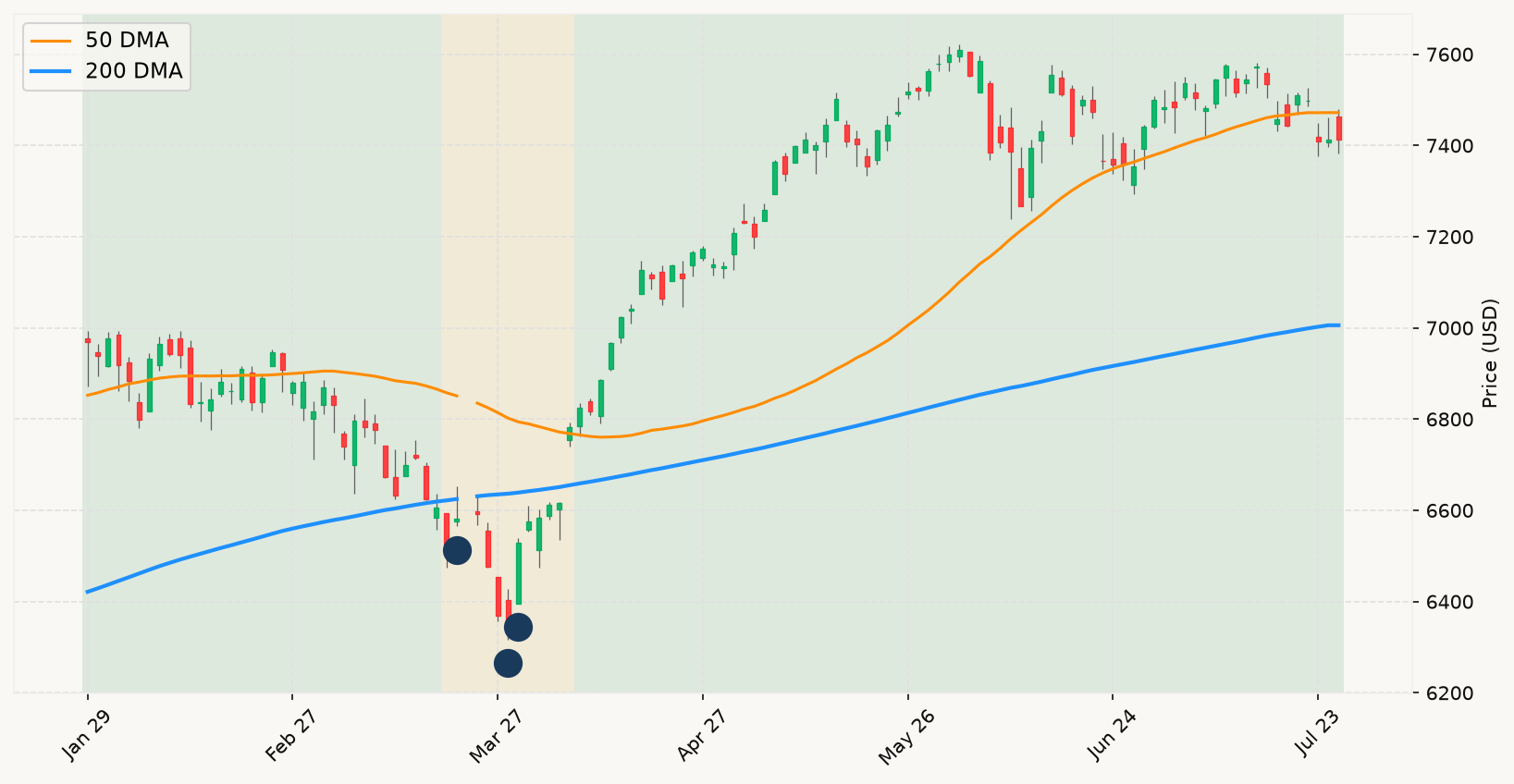
The primary market trend remains the dominant signal here, and it is unambiguously bullish. The S&P 500 is trading well above its long-term trend line, the interest rate environment has shifted from inverted to a healthy positive spread, and employment conditions show no deterioration. The semiconductor selloff and AI capex anxiety are real, loud, and genuinely unsettling for anyone holding a chip-heavy portfolio — but the framework's first question is always: does this change the primary trend? So far, the answer is no. A noisy week of earnings and a live Fed meeting is not the same thing as a grinding, broad-based market deterioration. The burden of proof falls on the bear case, and the bear case has not made its case at the index level.
The AI capex debate is the kind of narrative that feels structural and urgent — and it may well matter enormously over a multi-year horizon. But markets are efficient aggregators of exactly this kind of visible, widely-discussed risk. Every institutional desk in the world has been stress-testing hyperscaler free cash flow and AI return-on-investment models for months. The market's response to Alphabet's print was swift and severe for that stock, but the broad index barely registered. That divergence is itself informative: this is sector rotation and valuation repricing within the AI complex, not a systemic repricing of equity risk. The distinction matters enormously for positioning decisions.
The FOMC is the more consequential wild card this week. The current interest rate environment — positive spread, no inversion — is not sending a recession warning. But a surprise hike tomorrow, or hawkish Warsh commentary that meaningfully reprices the path of rates, could shift that calculus. The thing worth watching is not whether the Fed moves 25 basis points tomorrow — even a hike at this level, in a normal business cycle, is not a bear market catalyst on its own. What would matter is a sustained repricing toward substantially tighter policy that begins pushing the curve negative again, or that visibly crimps growth expectations. Neither of those conditions is present today. Until they are, the correct posture remains fully invested.
The earnings week itself deserves a disciplined reading. The historical base rate says four out of five 10%+ corrections resolve without becoming prolonged bears — and the current drawdown from the all-time high is a modest 2.6%, nowhere near the threshold where that diagnostic even activates. With employment conditions firm and growth nowcasts still positive, the convergence of signals required to justify a defensive shift simply does not exist. Big Tech earnings volatility is the cost of owning some of the most heavily analyzed, highest-valued securities in history. The framework's prescription: hold through the noise, monitor the primary trend, and don't let a single week of earnings drama and Fed speculation rewrite a bullish regime that the data has not yet challenged. MoreLess