The Ticker Analysis
Bull Market Intact — Don't Let the Headlines Win
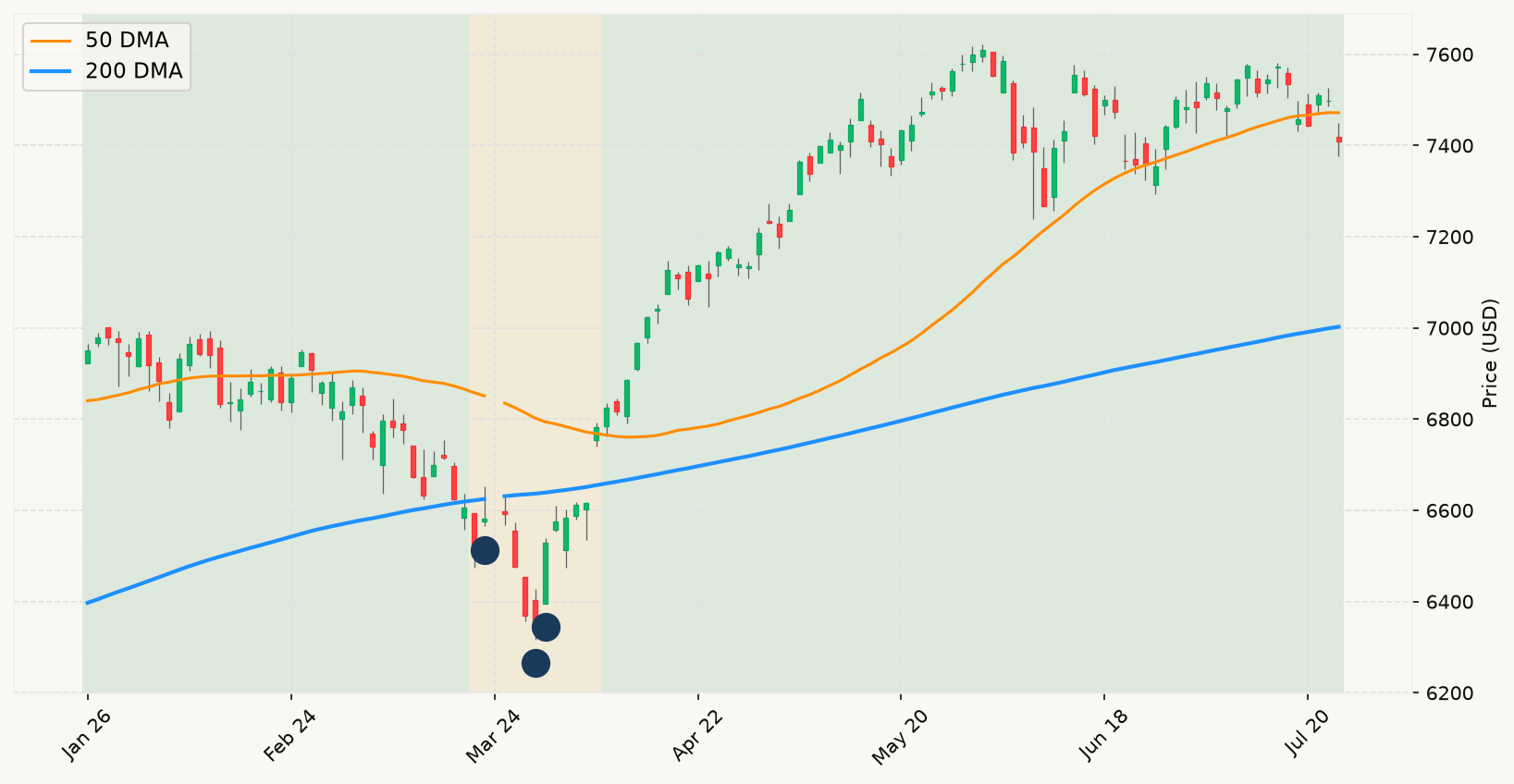
The headline today is oil above $100 and a tech-led selloff, but before treating either as a market signal, the primary question is: what is the stock market trend actually doing? The answer, per the metric cards, is unambiguous — the S&P 500 is trading solidly above its primary market trend line, and we are less than 3% off the all-time high. That is not a bear market configuration. That is a bull market with noise in it. A pullback of under 3% from a high, driven by geopolitical headlines and AI capex anxieties, sits well within the category of routine chop that the historical record says to ignore. The burden of proof remains on the bear case, and right now, that case hasn't built anything close to a compelling structure.
The Middle East conflict and the oil spike are legitimately dramatic stories. But dramatic stories and actionable market signals are not the same thing. The correct diagnostic question isn't "is this scary?" — it's "does this move any needle in the recession confirmation checklist?" Right now, the interest rate environment is not flashing a recession warning — the spread between long and short rates is positive and widening, not inverted. Employment conditions remain firmly in the green. Both real-time growth trackers are running positive. The oil shock is a real inflationary risk, and a potential Fed hike later this year is a real possibility — but a rate hike into solid growth and full employment is not the same thing as a rate hike into recession. History shows these two scenarios produce very different market outcomes.
The Alphabet and Tesla earnings selloffs are worth contextualizing against the broader earnings season. When nearly 25% year-over-year S&P 500 earnings growth is the backdrop, two mega-cap misses on margins — even large ones — are stock-specific events, not systemic signals. The market is a forward-looking machine; if the AI capex story were genuinely broken, you'd expect to see it bleeding into credit spreads and economic indicators, not just in two post-earnings press conferences. Intel and Oracle moving the opposite direction on the same day reinforces the point: the market is sorting through winners and losers in the AI buildout, not issuing a verdict on equities broadly. That is exactly what healthy price discovery looks like in a functioning bull market.
The positioning read for someone fully invested is: stay put. The velocity diagnostic isn't even close to triggering — a 2.65% drawdown from the high in 52 days is barely a rounding error. The fast-crash buying signal is inactive because there's no crash to buy. The relevant scenario from the decision matrix is the simplest one: market above its primary trend, all-time high recently made, no recession signals converging. That maps directly to the "stay fully invested" posture. The one genuine watch item is what happens to inflation and Fed signaling after next week's FOMC meeting, particularly if oil stays above $100. If that drives sustained deterioration in growth estimates — not a dip, but a multi-week grinding trend — that's when the checklist earns another look. Until then, the noise is loud, the signal is quiet, and the correct response is discipline. MoreLess