The Ticker
Bull Market
The sun's shining, the crops are growing, and the bulls are out grazing in wide-open pastures — sure, there's a little smoke on the horizon from the Middle East and a tariff cloud or two drifting by, but this market is still a sunny day at the county fair.
Top Story
Oil Spikes & Futures Slip as Alphabet & Tesla Earnings Loom
Wall Street is holding its breath Wednesday as two of the market's most closely watched companies — Alphabet and Tesla — prepare to report after the closing bell, while oil's sharp surge on fresh U.S.-Iran military escalation is adding a layer of macro unease to an otherwise strong earnings season.
The earnings backdrop coming into this week's big reports is notably robust. With about 88% of the S&P 500 names that have already reported topping profit estimates, the season is running well ahead of historical beat rates. Full-year expectations for Q2 earnings growth have risen to 23% year-over-year — nearly double what analysts projected at the start of 2026 — with technology and energy leading the revisions higher. The critical question for Alphabet and Tesla is whether AI capital expenditure commitments and EV demand trends hold up under scrutiny, and whether managements can credibly outline a return on their massive infrastructure investments.
On the Fed front, the backdrop remains complicated. Oil's surge toward $90+ per barrel for WTI injects fresh inflationary pressure into an environment where markets are already pricing in the possibility of another rate increase before year-end. The Iran conflict, now in its eleventh consecutive night of U.S. airstrikes, risks keeping energy costs elevated for longer than the Fed would like, which could push back the timeline for any pivot toward easier policy and keep longer-dated yields elevated.
Beyond oil and earnings, the tariff story is evolving rapidly. The Trump administration is moving to make expiring 10% global tariffs more permanent while layering on sector-specific measures — including a potential 100% duty on imported generic drugs and a fresh 25% tariff on Brazilian goods. These measures arrive just as the global semiconductor rally, fueled by AI optimism, is pulling equities higher, creating an unusual tension between strong corporate momentum and an increasingly complex macro backdrop. MoreLess
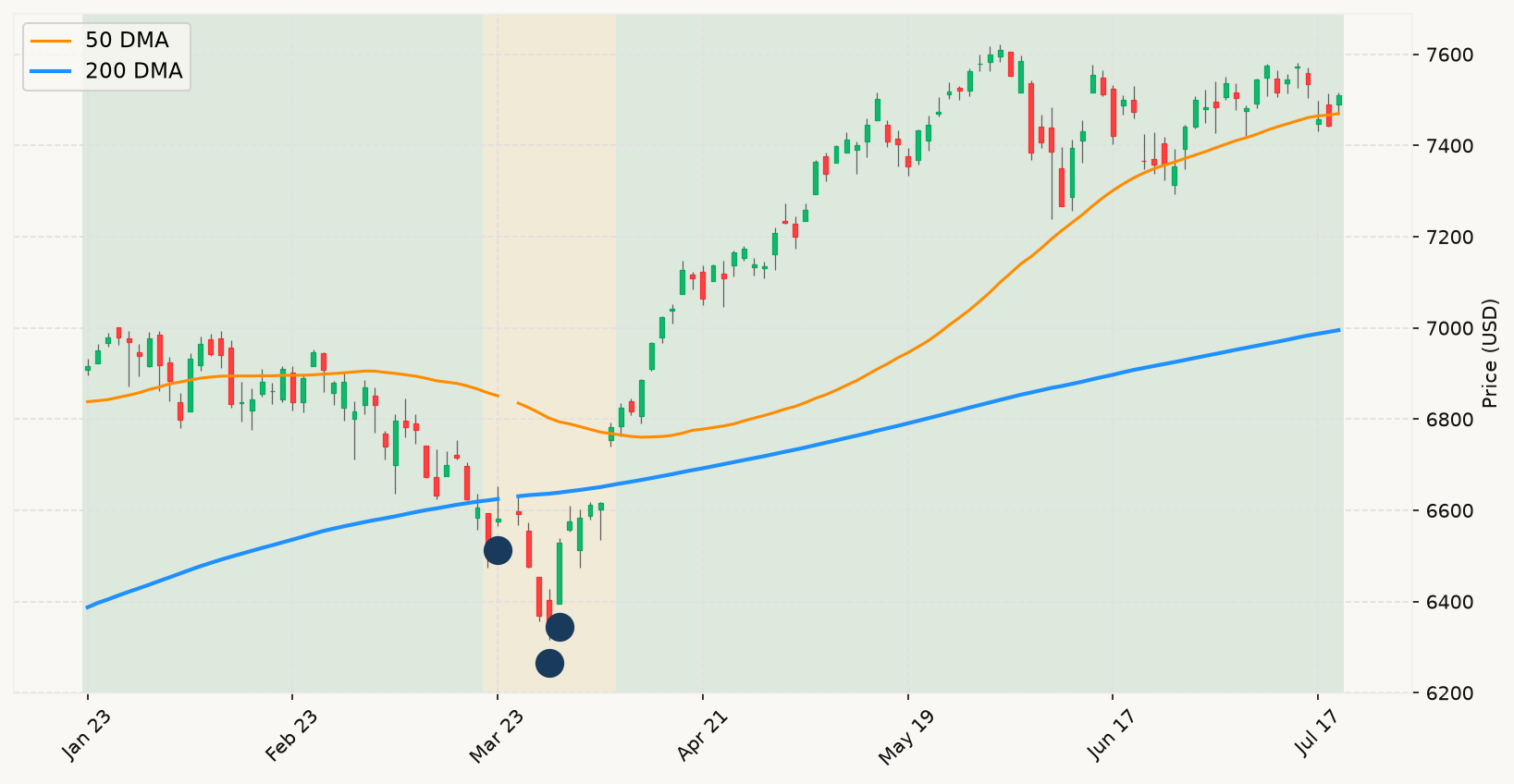
Six Month Chart (SPX)
⊞ Expand
The Ticker Analysis
Bull Market Intact — Stay Invested, Tune Out the Noise
The primary market trend is unambiguously bullish right now — the index is sitting comfortably above its long-run trend line, and the drawdown from the all-time high is barely a rounding error. That context matters enormously when reading today's news. Oil spiking on Iran escalation, futures dipping pre-earnings, new tariffs on Brazil and generic drugs — this is the kind of daily noise that consistently traps investors into reactive decisions they later regret. The historical record is explicit: bad news that's public is already priced in before you can act on it. What actually matters is whether any of these developments are shifting the underlying market regime or moving the recession probability needle. Right now, they aren't.
The earnings picture is the real signal worth watching, and it's flashing green. An 88% beat rate with 23% year-over-year growth expected for Q2 is not the earnings profile of an economy rolling over. Strong results from 3M and GM — both cyclically sensitive industrials — are exactly the kind of broad-based confirmation that keeps the bull thesis intact. The week's main event, Alphabet and Tesla reporting tonight, will be dissected for AI capex commitments and demand signals. But even if one or both disappoint, a single quarter's guidance miss doesn't move the trend. The market is a forward-looking aggregator of millions of participants' views; if a structural AI spending problem were genuinely developing, it would already be showing up in the price action — and it isn't.
The interest rate environment deserves a calm assessment rather than alarm. Yes, oil above $90 adds inflationary pressure, and yes, markets are pricing in a possible additional rate hike. But the monetary policy signals are currently bullish — the 10-year/3-month spread is positive and widening, meaning the curve has un-inverted. That is the opposite of the configuration that has historically preceded recessions. A higher-for-longer environment with a positively sloped curve is not a recession signal — it's a mid-cycle signal. The Fed isn't cutting aggressively, but it also isn't engineering a credit crunch. Employment conditions remain solid with no Sahm-style deterioration in the data. Every leading indicator that has historically mattered is pointing away from contraction.
The bottom line is straightforward: the market is above its primary trend, well within 3% of its all-time high, the velocity diagnostic shows no evidence of a grinding recessionary decline, and economic leading indicators are not converging on contraction. The correct posture is fully invested. Tariff headlines, oil spikes, and pre-earnings jitters are the perennial cost of equity ownership — they are noise by definition in this framework, not signals. The investors who most consistently underperform are those who mistake volatility for danger and exit in exactly these moments, only to watch the market recover before they re-enter. Stay the course, ignore the Iran headlines and tariff chatter, and let the earnings results speak for themselves. MoreLess